WARSAW: The migrants pouring into Europe have changed routes: the crossing between Turkey and Greece is practically closed, but ever greater numbers are risking their lives to cross the Mediterranean between Libya and Italy.
A criminal industry has flourished, while the EU has beefed up its border agency Frontex to try to check the mass migration.
Frontex is at once both good cop and bad cop, rescuing migrants from sinking boats but also dropping them off at welcome centers where they risk being sent back home.
Frontex head Fabrice Leggeri summed up the situation in an interview.
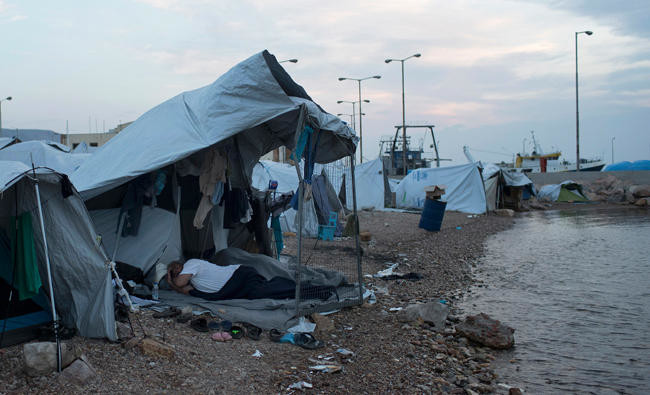
On the shores of Greece there are now “80 or 100 people who arrive every day, whereas we had 2,500 a day” before the agreement with Turkey, said Leggeri.
Among those who arrive from Africa via the central Mediterranean and Libya, whose number is up by more than 40 percent, most come from west Africa. They are Senegalese, Guineans, Nigerians. In 2016 they totalled 180,000.
They are mainly economic migrants and include many young men but also families and young women. Nigerian women are often exploited as prostitutes in Europe.
“It’s not the poorest who leave, because they have to be able to pay the smugglers,” said Leggeri.
According to the International Organization for Migration (IOM), of the more than one million people who made it to Europe in 2015, 850,000 crossed into Greece via the Aegean Sea. More than half came from Syria and most of the rest from Afghanistan and Iraq.
Following a landmark EU-Turkey accord in March 2016, the total number arriving in Europe by sea fell that year to around 363,000, IOM figures show.
But as the number of arrivals in Greece dropped, the figures arriving from north Africa started to grow.
By mid-April 2017, “some 36,000 migrants had arrived in Italy since the beginning of the year, or an increase of 43 percent over the same period last year,” according to Frontex.
At the beginning of the most dangerous leg of the trip across the Sahara, the migrants are transported by Tuareg or Tebu nomads, for whom it is a traditional commercial activity, Leggeri said.
The Mediterranean crossing however is run by criminal networks, both big and small, as well as lone smugglers.
At the bottom of the ladder there are petty crooks, sometimes migrants themselves, who become the skippers of the small overloaded boats to pay for their own crossing, according to Leggeri.
Then there are the middlemen who collect the money and organize the trip but who do not board. Their bosses are the network chiefs who “likely include people who previously worked in the police force” in Libya, Leggeri said.
Coming up with an estimate is not easy but according to a recent report by the EU’s law enforcement agency Europol, gangs smuggling migrants to or within Europe raked in 4.7 billion-5.7 billion euros ($5.1 billion-$6.1 billion) in 2015.
But those profits dropped by nearly two billion euros last year.
The major traffickers use money earned smuggling migrants to undertake other criminal activities that require an initial investment, “be it drug trafficking, arms trafficking, or even terrorism financing — we can’t exclude it,” Leggeri said.
The funds are sometimes moved openly through money transfer service Western Union, especially in west Africa. In east Africa, traffickers more often use “hawala,” an informal system of payment based on trust that is far more difficult to trace than bank transfers.
Migrants from west Africa begin by taking the bus, Leggeri said. The territory of the Economic Community of West African States (ECOWAS) is somewhat similar to the visa-free Schengen zone, as individuals can travel freely within it for a modest fee of around 20 euros.
Once the migrants arrive in Niamey, capital of Niger, the illegal activity begins and they must fork out up to 150 euros each to reach the north of the country and the Libyan border.
Then comes the crossing which can cost up to 1,000 euros, depending on the boat. Individuals can, for example, pay 300 euros for a place on an inflatable boat, but those journeys are particularly risky.
The east Africa route — which originates from the Horn of Africa and is taken by Eritreans, Somalians and Ethiopians — is more expensive.
The journey is organized by national criminal gangs that work together, so a Sudanese network, for example, will hand over its clients to a Libyan network at the border.
“There, the fee can run to 3,000 euros, from the Horn of Africa all the way to Italy,” Leggeri said.
The turning point came in 2015, when the migrant crisis hit Greece, leading Europe to reinforce Frontex.
“In early 2015, we were able to deploy around 300 to 350 border guards at any given moment. Today, we’re able to have 1,300 to 1,400 border guards deployed at once across several fields of operation,” Leggeri said.
In 2016, Europe established a rapid reaction pool of 1,500 border guards who can be deployed within five working days if necessary.
At the same time, Frontex is looking to work upstream to stop the migration influx before it reaches the Mediterranean. The agency recently opened an office in Niamey to reinforce its collaboration with authorities in Niger.
Paradoxically, the sea rescues encourage migration and benefit the smugglers who load up their rickety boats with more and more people while assuring the migrants that once they leave Libyan waters they will be taken care of.
“There have never been as many boats patrolling the Mediterranean as in 2016... and unfortunately there have never been as many deaths, 4,000 deaths most probably according to the IOM,” Leggeri said.
He has a message for any country with potential migrants to Europe: the paradise expected “is a lie.”
“Either you die in the Mediterranean, or you arrive in Europe under extremely deplorable conditions. It’s not the El Dorado that the smugglers describe,” Leggeri said.
“And on top of that the EU is reinforcing a return policy, a repatriation policy, so what risks happening is that the migrants lose their savings to pay the smugglers and at the end of their journey there’s a plane that takes them back to their country of origin.”
Even if the great crisis that hit the Greek islands appears to be over, migratory pressure at Europe’s borders shows no signs of evaporating.
Geopolitical instability, like the conflict in Syria or the chaos in Libya and Iraq, will continue to lead asylum seekers to Europe. Others will come because of poverty or for demographic reasons.
As long as the countries of origin are unable to offer their residents a suitable quality of life and suitable prospects, “men and women will move, as they always have in human history,” Leggeri said.


![]()
Migrant influx shifting but no let-up: Frontex
Migrant influx shifting but no let-up: Frontex
Latest updates


Recommended


© 2026 SAUDI RESEARCH & PUBLISHING COMPANY, All Rights Reserved And subject to Terms of Use Agreement.