BRUSSELS: The EU watchdog on Wednesday announced a probe into the bloc’s border patrol agency Frontex over its actions after a boat packed with migrants off Greece sank last month, killing hundreds.
The investigation is “aimed at clarifying Frontex’s role in search and rescue operations in the Mediterranean sea following the drowning of hundreds of people off the coast of Greece on 14 June,” ombudsman Emily O’Reilly said in a statement.
The independent probe by the European Union watchdog — which looks into suspected cases of poor administration by EU bodies — was launched on O’Reilly’s own initiative.
It adds to two investigations Greece says it has started: a criminal one into alleged smugglers it blames for the tragedy, and another into the actions of its coast guard.
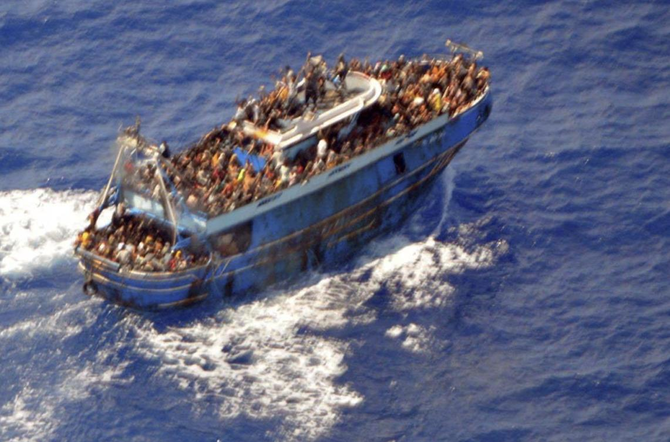
The boat that sank, an overcrowded fishing trawler, was carrying up to 750 people picked up in Libya who sought to cross the Mediterranean to irregularly enter Europe.
Around 100 of them were saved, but it is thought that some 600 drowned, according to Greek figures relayed by EU commissioner Ylva Johansson to the European Parliament in early July.
O’Reilly spoke of “the deaths of at least 500 people.”
EU lawmakers in that hearing expressed skepticism that the Greek probes into the sinking would be adequately carried out. They called for an independent and transparent investigation.
Athens has already rejected survivors’ accounts that the Greek coast guard tied a rope to the drifting vessel and then powered off, causing it to capsize.
O’Reilly said her office’s investigation would be carried out in coordination with the Greek ombudsman’s office.
It will request a “wide range” of Frontex documents on the sinking, including an internal Serious Incident Report, as well as those related to other incidents in the Mediterranean.
One aspect will focus on rules about the use of cameras on boats during joint operations.
That could yield information as to why state-of-the-art cameras on a Greek coast guard vessel near the migrant boat were switched off at the time of its sinking.
The probe would also examine how Frontex and national authorities in EU member states share search and rescue information, and what role they give to ships run by charities that carry out rescue operations.
Frontex chief Hans Leijtens, in the same July 6 European Parliament hearing as Johansson, said that, on the night of the sinking, “we offered to help, but there was no response from Greek authorities.”
On Wednesday, Leijtens posted a social media message welcoming the EU investigation and saying he “will cooperate in full transparency.”
O’Reilly said: “A tragedy of this magnitude requires all those involved to reflect on their responsibilities and to be clear to the public who is accountable for these deaths.”
She said her office’s probe will “try to piece together the events that led to the capsizing of the boat.”
The investigation will also weigh how the EU lives up to its commitments on maintaining fundamental rights when it comes to migration “and does not lose sight of the human suffering that compels people to seek a better life beyond their home countries,” she said.
O’Reilly said she planned future investigations into the EU’s migration and border policies, including one into a deal struck with Tunisia to curb migrant departures from its shores.

EU watchdog probes Frontex’s action in Greece boat tragedy
https://arab.news/msf8m
EU watchdog probes Frontex’s action in Greece boat tragedy
- It adds to two investigations Greece says it has started: a criminal one into alleged smugglers it blames for the tragedy, and another into the actions of its coast guard
India’s wealthy embrace a new luxury symbol: water
- Tap water in India is not fit for human consumption
- Wealthy opt for premium water as wellness craze boosts industry
NEW DELHI: At an Indian gourmet food store, Avanti Mehta is organizing a blind tasting of drinks sourced from France, Italy and India. No, this isn’t wine, it’s water.
Participants use tiny shot glasses to check the minerality, carbonation and salinity in samples of Evian from the French Alps, Perrier from southern France, San Pellegrino from Italy and India’s Aava from the foothills of the Aravalli mountains.
“They will all taste different ... you should be choosing a water that can give you some sort of nutritional value,” said Mehta, who is 32 and calls herself India’s youngest water sommelier, a term usually associated with premium wine. Her family owns the Aava mineral water brand. Premium water is a $400 million business in the world’s most populous nation and is growing bigger as its wealthy see it as a new status symbol that fits in with a spreading wellness craze.
Premium Indian mineral water costs around $1 for a one-liter bottle, while imported brands are upwards of $3, or 15 times the price of the country’s lowest-priced basic bottled water.
Clean water is a privilege in the country of 1.4 billion people where researchers say 70 percent of the groundwater is contaminated. Tap water remains unfit to drink, and 16 people died in Indore city after consuming contaminated tap water in December.
Many in India see bottled water as a necessity and standard 20 US-cent bottles are available widely at convenience stores, restaurants and hotels. The market is worth nearly $5 billion annually and is set to grow 24 percent a year — among the fastest in the world.
Bottled water demand in United States or China is driven by convenience, making it a $30 billion-plus market in each country which will grow just 4-5 percent each year, Euromonitor says.
In India, the premium water segment is leading the surge in demand, accounting for 8 percent of the bottled water market last year compared to just 1 percent in 2021, Euromonitor said.
“Distrust of municipal water in some areas has escalated the demand for bottled water. Now, people understand how mineral water has more health benefits. It’s expensive, but the category will boom,” said Amulya Pandit, a senior consultant at Euromonitor specializing in the drinks market.
Among its consumers are New Delhi-based real estate developer B.S. Batra, who says his family uses only premium water at home to get more minerals and safeguard health.
“You feel different, more energetic during the day,” said Batra, 49, an avid badminton player.
“I consume mineral water even with whisky at home, and kids use it for their smoothies.”
Water lures Bollywood star, wealthy
The popular 20-cent plastic bottled water is mainly made by Pepsi, Coca-Cola and Indian market leader Bisleri. In addition, Indians who can afford it, install purifiers in their homes which clean the water but also remove most minerals.
Imported and local premium waters are luring wealthy consumers and businesses alike.
Bollywood star Bhumi Pednekar and her sister have launched Backbay — selling 750 ml cartons of mineral water for $2.2; Indian conglomerate Tata is expanding its premium water portfolio, and retailers and businesses are reporting higher sales.
Tata Consumer Products, also Starbucks’ partner in India, sells 20-cent bottled water, but premium water is its priority as it sees affluent, health-focused consumers willing to spend on the drink without worrying about the price, CEO Sunil D’Souza said in an interview.
“I don’t have to push water uphill...I see a long, long, long runway for the business,” he said.
Tata’s premium “Himalayan” mineral water factory — which a Reuters photographer visited — is located in the foothills of the Himalayan range in Himachal Pradesh state. Workers there largely keep a hands-free watch on machines filling plastic and glass bottles with water sourced from a natural underground aquifer.
Looking for springs
Most Indians prefer still water, and the sparkling variant remains niche. Tata said it plans to launch a sparkling Himalayan water, and is also scouting for natural springs for expanding its other offerings. At three Foodstories Indian gourmet stores, sales of premium waters tripled in 2025. Customer demand prompted the chain to import “light and creamy” Saratoga Spring Water from New York, which costs 799 rupees ($9) for a 355-milliliter (12-fluid-ounce) bottle, and stocks sold out within days, said co-founder Avni Biyani.
Indian mineral water brand Aava’s sales touched a record 805 million rupees ($9 million) last year, growing 40 percent a year since 2021. Tata said its basic and premium water portfolio will grow 30 percent a year, after growing tenfold to $65 million in six years.
Imported waters, which attract an over 30 percent tax, are pricier than Indian brands. Nestle’s Perrier and San Pellegrino, and Danone’s Evian retail for over 300 rupees, or $3.20, for a 750 ml bottle.
Nestle declined to comment, while Danone said the Indian bottled water market was growing at a “robust” pace but imported waters “tend to be niche and boutique.”
“When you open your tap, you’re not getting an Aava, Evian ... And that is what you’re essentially paying for,” said water sommelier Mehta.
At the water tasting session, some participants said they enjoyed the experience but many found the price hard to swallow.
“To be honest, it is kind of expensive,” said executive Hoshini Vallabhaneni, one of 14 people at the event. “For everyday use — it will burn a hole in the pocket.”


