

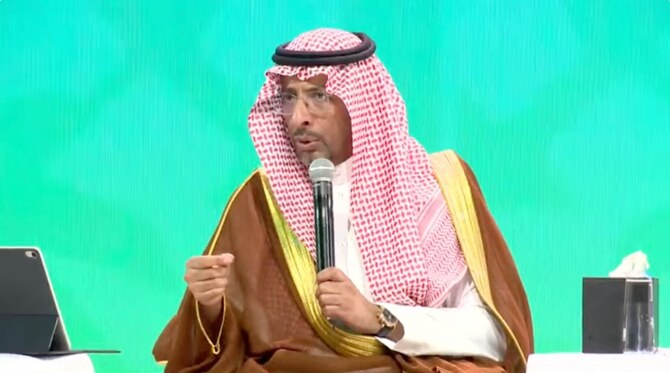
Saudi Arabia aims for central role in global supply chains, says Alkhorayef

Minister of Industry and Mineral Resources Bandar Alkhorayef emphasized the Kingdom’s vast resources, competitive energy landscape, strategic location, financial and political stability, and advanced infrastructure.
Short Url
Updated 24 October 2024
Follow

Saudi Arabia aims for central role in global supply chains, says Alkhorayef

RIYADH: Saudi Arabia is a “great believer” in becoming a central player in the global supply chain across multiple sectors, according to a top official.

In an interview with Arab News during the Multilateral Industrial Policy Forum in Riyadh, Minister of Industry and Mineral Resources Bandar Alkhorayef emphasized the Kingdom’s vast resources, competitive energy landscape, strategic location, financial and political stability, and advanced infrastructure.

“We are a great believer that Saudi Arabia is a great place to solve for so many challenges, especially with the supply chain. The combination of the resources that we have allows us to be a great place and hub for different capabilities,” Alkhorayef stated.

He added: “International players are engaged with us to understand how we can complement their offering and where we see their contribution in our industrial strategy journey.”

The minister also highlighted that the Kingdom has identified 800 key projects across sectors such as automotive, pharmaceuticals, and renewable energy, as part of its broader industrial strategy aimed at attracting significant foreign investment. This vision underscores Saudi Arabia’s commitment to becoming a global industrial hub, leveraging its energy resources, strategic location, and financial strength to foster both national and international partnerships.

“There’s so much opportunities we have, but in a nutshell, we have identified 800 projects in Saudi that are essential for our industrial strategy. Those range from automotive to pharmaceuticals to renewable to downstream chemicals and so on,” Alkhorayef noted.

He further explained that 12 specific subsectors have been defined, with the projects and investment technologies being developed indicating that Saudi Arabia will play an active role in the supply chain of each division.

Alkhorayef also elaborated on the Kingdom’s efforts to implement various policies and programs designed to support small and medium-sized enterprises and entrepreneurs as part of the country’s industrial transformation and green energy initiatives.

“We have a program called 1000 Mile. It takes an entrepreneur from an idea to an actual project. We also have the industrial hackathon, which incentivizes entrepreneurs to collaborate with large corporations to develop proofs of concept and solve problems,” the minister stated.

He added: “We also have a program to support small and medium enterprises and entrepreneurs entering the sector through the Industrial Support Program, which offers loans and grants to newcomers, especially those targeting specific areas of interest.”

Similarly, Omar Al-Suwaidi, undersecretary at the UAE’s Ministry of Industry and Advanced Technology, highlighted a comprehensive initiative that has assessed over 500 firms.

“We’ve had a comprehensive program, the program, in the last couple of years, assessed over 500 companies. These 500 companies, what they get out of it is a roadmap on how to do their transformation,” Al-Suwaidi told Arab News.

He continued: “They get incentives with a number of other partner banks for a reduced financing for their projects. These plans have resulted in these companies allocating almost 600 million dirhams in investment plans, which are going to be coupled now with the financing banks.”

Al-Suwaidi further elaborated on the growing significance of international partnerships, particularly in balancing national security and enhancing global supply chain resilience amidst geopolitical challenges.

“We have the initiative that we’ve started more than two years ago. It’s called the Industrial Alliance for Sustainable Economic Development, which we worked on with UAE, Egypt, Jordan, Bahrain and Morocco,” he said.

He concluded: “In the last two years, we’ve had 15 joint projects, joint agreements that are worth more than $3 billion.”

Saudi investment hits 32% of GDP, non-oil fixed capital reaches 40%, minister says

Updated 05 January 2026
Follow

Saudi investment hits 32% of GDP, non-oil fixed capital reaches 40%, minister says

RIYADH: Saudi Arabia’s investment now accounts for 32 percent of gross domestic product, with non-oil fixed capital at 40 percent, according to the minister responsible for portfolio.

Speaking during his visit to the Shoura Council, Khalid Al-Falih said that foreign direct investment is expected to grow fivefold, signaling strong Vision 2030 progress.

“Regarding cumulative performance, the Kingdom has exceeded all expectations, achieving high levels of investment,” Al-Falih said, according to a video posted on Al-Ekhbariya’s X account focused on economic matters.

The minister added: “Today, investment accounts for 32 percent of the total GDP. In terms of non-oil GDP, fixed capital represents 40 percent, compared with 41 percent in China, the highest globally.”

If we take the non-oil GDP, he said, fixed capital will make 40 percent. “China is the largest globally with 41 percent. So, we will rank second if we compare it to the non-oil economy and fourth when measured against total GDP,” Al-Falih said.

He emphasized that the Kingdom offers an investment-attractive environment, noting that when focusing on foreign direct investment rather than overall investment, Saudi Arabia ranks among the world’s highest.

The minister of investment added that FDI is expected to grow fivefold by the end of 2025, though these data require confirmation, stressing that this is “a big indicator for the success of Saudi Vision 2030.”

During his address to the session, Al-Falih emphasized that Saudi Vision 2030 prioritizes economic diversification and reducing dependence on oil, through boosting the private sector’s contribution to inclusive economic development, supporting national sectoral priorities, and driving growth in the Kingdom’s GDP.

He highlighted key initiatives enabling the private sector, including the establishment of the Ministry of Investment and the Saudi Investment Promotion Authority, the launch of the “Shareek” program, the development of the National Investment Strategy, and linking all stakeholders in the investment ecosystem.

“The Cabinet’s adoption of the National Investment Strategy, launched by Crown Prince in 2021 and implemented in 2022 as a comprehensive national framework, has played a major role in positioning investment as a driver of economic growth,” he said.

Al-Falih revealed that the ministry has identified more than 2,000 investment opportunities worth over SR1 trillion ($267 billion), noting that 346 of these opportunities have been converted into closed deals valued at over SR231 billion through the “Invest Saudi” platform.

He also highlighted the success of the regional headquarters attraction program, with licenses issued to more than 700 global companies by the end of 2025, surpassing the 2030 target of 500 companies, across diverse sectors that reinforce Saudi Arabia’s role as a regional business hub.

The minister revealed that active investment licenses have grown tenfold, rising from 6,000 in 2019 to 62,000 by the end of 2025, highlighting the role of companies in creating over one million jobs, including numerous positions for Saudi nationals.

Al-Falih noted the Kingdom’s success in attracting 20 of the world’s top 30 banks, as part of efforts to strengthen the presence of leading asset managers and international banks in support of the Saudi banking sector.

He also discussed reforms to enhance the business environment, such as the Civil Transactions Law, Companies Law, and the updated Investment Law issued in mid-2024, which contributed to Saudi Arabia moving up 15 places in the global competitiveness ranking.

The minister also announced the update of the National Investment Strategy in 2025, focusing on quality, productivity, and directing investments toward sectors with the highest economic impact, while developing financing solutions for SMEs.