

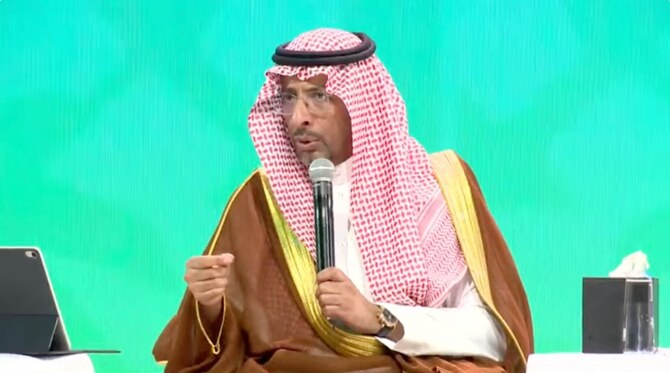
Saudi Arabia aims for central role in global supply chains, says Alkhorayef

Minister of Industry and Mineral Resources Bandar Alkhorayef emphasized the Kingdom’s vast resources, competitive energy landscape, strategic location, financial and political stability, and advanced infrastructure.
Short Url
Updated 24 October 2024
Follow

Saudi Arabia aims for central role in global supply chains, says Alkhorayef

RIYADH: Saudi Arabia is a “great believer” in becoming a central player in the global supply chain across multiple sectors, according to a top official.

In an interview with Arab News during the Multilateral Industrial Policy Forum in Riyadh, Minister of Industry and Mineral Resources Bandar Alkhorayef emphasized the Kingdom’s vast resources, competitive energy landscape, strategic location, financial and political stability, and advanced infrastructure.

“We are a great believer that Saudi Arabia is a great place to solve for so many challenges, especially with the supply chain. The combination of the resources that we have allows us to be a great place and hub for different capabilities,” Alkhorayef stated.

He added: “International players are engaged with us to understand how we can complement their offering and where we see their contribution in our industrial strategy journey.”

The minister also highlighted that the Kingdom has identified 800 key projects across sectors such as automotive, pharmaceuticals, and renewable energy, as part of its broader industrial strategy aimed at attracting significant foreign investment. This vision underscores Saudi Arabia’s commitment to becoming a global industrial hub, leveraging its energy resources, strategic location, and financial strength to foster both national and international partnerships.

“There’s so much opportunities we have, but in a nutshell, we have identified 800 projects in Saudi that are essential for our industrial strategy. Those range from automotive to pharmaceuticals to renewable to downstream chemicals and so on,” Alkhorayef noted.

He further explained that 12 specific subsectors have been defined, with the projects and investment technologies being developed indicating that Saudi Arabia will play an active role in the supply chain of each division.

Alkhorayef also elaborated on the Kingdom’s efforts to implement various policies and programs designed to support small and medium-sized enterprises and entrepreneurs as part of the country’s industrial transformation and green energy initiatives.

“We have a program called 1000 Mile. It takes an entrepreneur from an idea to an actual project. We also have the industrial hackathon, which incentivizes entrepreneurs to collaborate with large corporations to develop proofs of concept and solve problems,” the minister stated.

He added: “We also have a program to support small and medium enterprises and entrepreneurs entering the sector through the Industrial Support Program, which offers loans and grants to newcomers, especially those targeting specific areas of interest.”

Similarly, Omar Al-Suwaidi, undersecretary at the UAE’s Ministry of Industry and Advanced Technology, highlighted a comprehensive initiative that has assessed over 500 firms.

“We’ve had a comprehensive program, the program, in the last couple of years, assessed over 500 companies. These 500 companies, what they get out of it is a roadmap on how to do their transformation,” Al-Suwaidi told Arab News.

He continued: “They get incentives with a number of other partner banks for a reduced financing for their projects. These plans have resulted in these companies allocating almost 600 million dirhams in investment plans, which are going to be coupled now with the financing banks.”

Al-Suwaidi further elaborated on the growing significance of international partnerships, particularly in balancing national security and enhancing global supply chain resilience amidst geopolitical challenges.

“We have the initiative that we’ve started more than two years ago. It’s called the Industrial Alliance for Sustainable Economic Development, which we worked on with UAE, Egypt, Jordan, Bahrain and Morocco,” he said.

He concluded: “In the last two years, we’ve had 15 joint projects, joint agreements that are worth more than $3 billion.”


From barrels to bytes: How AI is powering Saudi Arabia’s industrial transformation

Updated 08 January 2026
Follow

From barrels to bytes: How AI is powering Saudi Arabia’s industrial transformation

  • Inside the Kingdom’s drive to merge energy expertise with digital intelligence

RIYADH: Artificial intelligence is moving beyond concept to become a cornerstone of Saudi Arabia’s energy sector, reshaping how oil, gas, and power systems are managed and optimized.

Industry giants like Saudi Aramco are embedding smart systems into their operations to boost efficiency, reliability, and sustainability—key pillars in the Kingdom’s efforts to modernize its industrial base and diversify its economy.

According to the International Energy Agency, oil and gas companies were among the first to adopt digital technologies. The agency estimates that applying AI to power plant operations and maintenance could save up to $110 billion annually by 2035 through reduced fuel consumption and maintenance costs.

For Saudi Arabia, this technological momentum offers both a blueprint and an opportunity. Under Vision 2030, integrating data and intelligent automation is transforming how energy is explored, refined, and delivered.

At the heart of Saudi Aramco’s operations is a digital transformation strategy centered on artificial intelligence, big data, and the industrial Internet of Things. These technologies are applied at every stage of production—from mapping reservoirs and optimizing drilling to improving efficiency and safety.

AI also underpins Aramco’s Digital Transformation Program, which develops in-house smart tools and data-driven platforms designed to cut emissions, reduce costs, and enhance performance while ensuring a reliable energy supply.

A prime example is the Upstream Innovation Center, where engineers have implemented AI solutions that reduce fuel gas use in boilers, improve efficiency, and detect potential leaks through fiber-optic monitoring. At the Khurais oil field, more than 40,000 sensors monitor approximately 500 wells via an Advanced Process Control system—the first of its kind for a conventional oil field at Aramco. Digitization at Khurais has increased production by around 15 percent, doubled troubleshooting speed, and lowered both costs and environmental impact.

These advances illustrate how Aramco’s network is evolving into a connected, adaptive model, blending traditional engineering expertise with digital intelligence.

DID YOU KNOW?

• AI could save up to $110 billion a year in global power plant fuel and maintenance costs by 2035.

• Advanced Process Control enables real-time monitoring of hundreds of oil wells in the Kingdom.

• AI-powered simulations now replace weeks of manual analysis, enabling faster operational decisions.

As Saudi Arabia develops an AI-driven energy economy, the King Abdullah University of Science and Technology is bridging the gap between digital innovation and industrial application. 

Bernard Ghanem, chair of the Center of Excellence for Generative AI, said the university is working with Saudi Aramco to develop AI systems that predict the chemical properties of materials and accelerate research into direct air capture technologies for carbon dioxide removal.

He told Arab News that KAUST is partnering with SABIC and ACWA Power to apply AI in process optimization and materials discovery, turning lab-scale research into practical solutions for the energy sector.

Ghanem said KAUST’s generative AI materials program combines a robotic chemistry lab with its AI Chemist foundation model, a system that accelerates the development of catalysts, battery materials, and membranes for clean energy applications.

“This is our lab of the future, automating experimentation and speeding up energy innovation,” he said.

Opinion

This section contains relevant reference points, placed in (Opinion field)

Mani Sarathy, professor of chemical engineering at KAUST, noted that AI-based reinforcement learning tools are already improving efficiency in hydrocarbon refineries by enhancing simulations and shortening analysis cycles.

“AI is helping energy companies run complex simulations that once took weeks, enabling faster and more precise operational decisions,” he told Arab News.

Sarathy added that the next phase will combine automation with expert oversight. Hybrid human-AI control systems, he explained, are likely to become standard in critical operations, balancing digital autonomy with safety and reliability as Saudi industries expand AI deployment.

These efforts highlight KAUST’s growing role in transforming AI from an academic discipline into a driver of industrial innovation in Saudi Arabia’s energy sector under Vision 2030.

Meanwhile, Skeleton Technologies is bringing AI-driven energy storage solutions to Saudi partners, solutions that are already reshaping industrial systems across Europe and beyond. In Europe, the company combines artificial intelligence and advanced materials to reduce energy use and improve efficiency in data centers, electricity grids, and defense systems.

“Our solutions allow AI infrastructure to consume less electricity and reduce grid connection needs, making AI operations more energy efficient,” Arnaud Castaignet, vice president of government affairs and strategic partnerships at Skeleton, told Arab News.

Inside its factories, Skeleton uses AI-driven digital twin models, created with Siemens Digital Industries, to simulate production, optimize operations, and enable predictive maintenance, Castaignet said. At the core of its technology is curved graphene, a proprietary carbon material that gives Skeleton’s supercapacitors exceptional conductivity.

“It allows our supercapacitors to charge and discharge within microseconds, around 12 microseconds, something batteries cannot do,” Castaignet said.

The company’s flagship Graphene GPU system, built on these supercapacitors, cuts energy use in AI data centers by up to 40 percent and reduces grid requirements by 45 percent while boosting computing performance. The devices are free of lithium, nickel, and cobalt, relying instead on graphene derived from silicon carbide—essentially sand—processed entirely in Germany.

“To build sustainable AI infrastructure, you need energy-saving hardware as well as renewable power,” Castaignet added. “Our Graphene GPU shows both can work together.”

As Saudi Arabia continues linking engineering expertise with digital intelligence, its industrial progress is measured not only in barrels of oil but also in bytes, data, and the smart systems shaping its energy future.