

Saudi Arabia pushes forward with industrial and mining strategies at UNIDO MIPF 2024

1 / 3
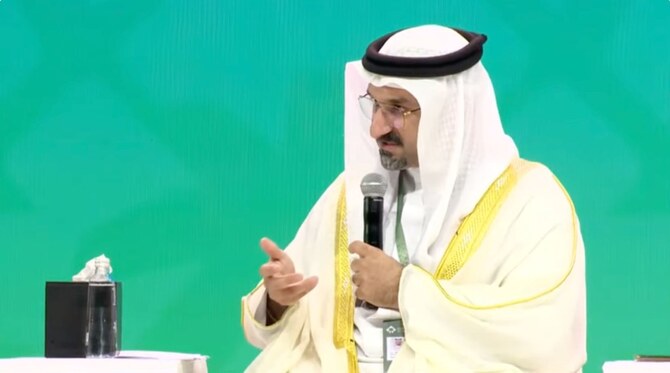
Bahrain’s Minister of Industry and Commerce Abdulla Adel Fakhro. Screenshot
2 / 3
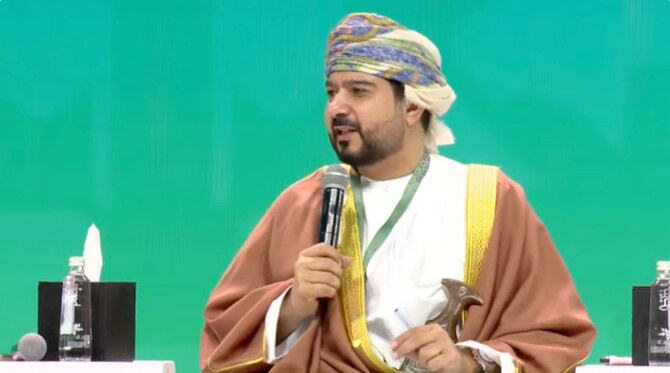
Oman’s Minister of Commerce, Industry, and Investment Promotion Qais bin Mohammed Al-Yousef. Screenshot
3 / 3
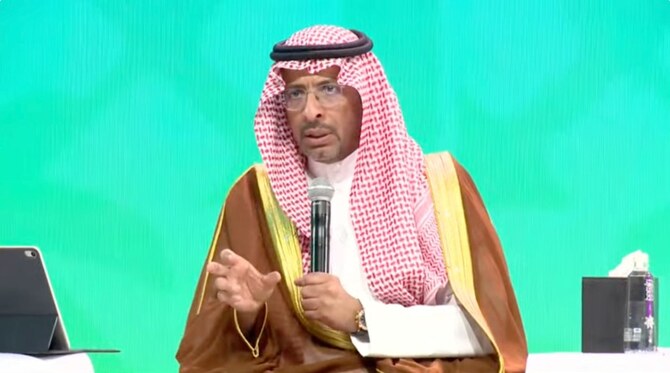
Saudi Arabia’s Minister of Industry and Mineral Resources Bandar Alkhorayef. Screenshot
Short Url
Updated 23 October 2024
Follow

Saudi Arabia pushes forward with industrial and mining strategies at UNIDO MIPF 2024

  • Saudi minister of industry and mineral resources outlined the Kingdom’s strategy of focusing on 12 key sectors
  • Saudi Arabia’s strategic position enables it to become both an industrial powerhouse and a global logistics hub

RIYADH: Saudi Arabia’s Minister of Industry and Mineral Resources has emphasized the importance of industrial and mining sectors in achieving the country’s Vision 2030 goals of economic diversification. 

At the UN Industrial Development Organization Multilateral Industrial Policy Forum panel discussion in Riyadh, Bandar Alkhorayef said that the Kingdom’s vision encompasses economic diversification, underlining that from the initiative’s beginning, it was evident that sectors like industry and mining held the greatest potential for achieving this diversification.

He underscored Saudi Arabia’s demographic advantage, with the majority of the population under 30, as a significant asset for the nation’s future. “We have a country that’s full of young people. This is a great asset to be used and considered,” he said.

Alkhorayef outlined the Kingdom’s strategy of focusing on 12 key sectors, grouping them into three pillars. The first group includes national security and resilience divisions, such as food security, pharmaceuticals, water security, and defense. 

The second pillar focuses on leveraging Saudi Arabia’s competitive advantages, particularly its natural resources like oil, gas, petrochemicals, and minerals. “We have two very important competitive advantages: our natural resources and our geographical location,” he said. 

He added that Saudi Arabia’s strategic position enables it to become both an industrial powerhouse and a global logistics hub, with downstream chemicals and metal refining playing key roles.

The third group of products emphasizes research, innovation, and human capital development. “How can we ensure that Saudi Arabia is well positioned to take advantage of the next trend?” Alkhorayef questioned, highlighting the need for readiness in the face of rapid global change.

The panel also focused on regional collaboration, with Alkhorayef highlighting that Saudi Arabia and the UAE are well-positioned to attract investments in key sectors. “We are working with investors in both ways to ensure that investments do come to the sector, to ensure also the right investment coming in terms of the right product, but be very mindful of choosing the right technology,” he said. 

He further emphasized Saudi Arabia’s global ambitions, saying: “We are building manufacturing for the future, and it’s not only for Saudi Arabia, it’s for the region, for the global community.”

Bahrain’s Minister of Industry and Commerce Abdulla Adel Fakhro praised the Kingdom’s leadership in industrial transformation. 

“Saudi Arabia today is leading the region in transforming their industrial sector, and this is something we are very proud of,” Fakhro said. 

He also shared Bahrain’s progress, citing the country’s industrial strategy launch in 2022, which focuses on the Fourth Industrial Revolution, digital technology, environmental, social, and governance awareness, and supply chain efficiency.

Oman’s Minister of Commerce, Industry, and Investment Promotion Qais bin Mohammed Al-Yousef discussed his country’s diversification efforts to make manufacturing one of the top five sectors driving the country’s economy away from reliance on oil and gas.


Saudi civil aviation sector posts 9% growth as passengers exceed 140m 

Updated 6 sec ago
Follow

Saudi civil aviation sector posts 9% growth as passengers exceed 140m 

RIYADH: Saudi Arabia’s civil aviation sector recorded a sharp expansion in 2025, with passenger traffic exceeding 140 million, up about 9 percent from a year earlier, according to the General Authority of Civil Aviation. 

The figures were presented at the 19th meeting of the National Aviation Sector Strategy Activation Steering Committee in Riyadh, chaired by Abdulaziz Al-Duailej, president of GACA, according to a press release. 

This comes as Saudi Arabia welcomed an estimated 122 million visitors in 2025, moving closer to its Vision 2030 target of attracting 150 million tourists annually and reinforcing aviation’s role in economic diversification. 

The year saw an expansion in global connectivity, with international destinations increasing to 176, while Saudi Arabia remained home to three of the world’s busiest air routes. 

Al-Duailej credited this performance to the “unlimited support” from the nation’s leadership, identifying aviation as a key enabler of Saudi Vision 2030. 

“He added that 2025 saw further strengthening of the competitive environment and the attraction of global investment, through the approval of new national carriers such as Riyadh Air and the Air Arabia alliance, as well as the licensing of major international companies including FedEx and Swissport,” the release added. 

The private aviation sector also saw further empowerment, while national airlines played a leading role in localizing the aviation industry and improving the efficiency of operational and engineering services. 

Al-Duailej outlined key features of the 2026 plan, which focuses on empowering the private sector to develop airports and increase capacity, alongside the launch of more than 30 new routes. 

“He stressed the importance of full preparedness by all operational teams and harnessing national talent to serve pilgrims, with the aim of delivering a seamless, spiritually enriching travel experience that reflects qualitative progress in logistics services and the Kingdom’s global leadership,” the release added. 

Al-Duailej also announced the official launch of the fourth edition of the Future Aviation Forum, to be held in Riyadh in April. 

The forum has been formally endorsed by the International Civil Aviation Organization as a leading global platform to shape the future of aviation and tackle its greatest challenges through an ambitious Saudi vision, gathering industry leaders from around the world. 

The meeting, attended by several top officials, also reviewed progress on the Aviation Sector Activation Program. This program, a cornerstone of the National Transport and Logistics Strategy, aims to transform the Kingdom into a global logistics hub connecting three continents and a leading aviation center in the Middle East.