UK warns Russian strikes on Black Sea delay grain supplies to Palestinians, global south

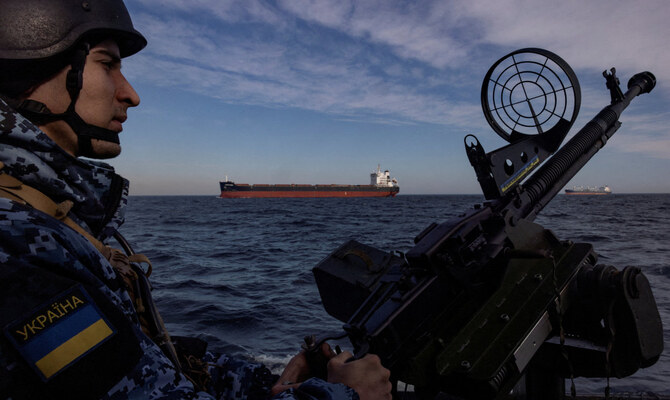
A serviceman of Ukraine's coast guard mans a gun on a patrol boat as a cargo ship passes by in the Black Sea, amid Russia’s attack on Ukraine. (Reuters/File)
Short Url
Updated 23 October 2024
Follow

UK warns Russian strikes on Black Sea delay grain supplies to Palestinians, global south

  • According to British Defense Intelligence, Starmer said, at least four merchant vessels have been struck by Russian munitions in the Black Sea between Oct. 5-14

Russia’s increased attacks on the Black Sea ports in Ukraine are delaying vital aid reaching Palestinians and stopping crucial grain supplies from being delivered to the global south, British Prime Minister Keir Starmer said late on Tuesday.
“Russia’s indiscriminate strikes on ports in the Black Sea underscore that (Russian President Vladimir) Putin is willing to gamble on global food security in his attempts to force Ukraine into submission,” Starmer said in a statement issued by his press office.
The United Nations said on Monday that Russian attacks on Ukrainian Black Sea ports have damaged six civilian vessels as well as grain infrastructure since Sept. 1, calling the ramp-up in strikes “distressing.”
According to British Defense Intelligence, Starmer said, at least four merchant vessels have been struck by Russian munitions in the Black Sea between Oct. 5-14.
“(Putin) is harming millions of vulnerable people across Africa, Asia and the Middle East, to try and gain the upper hand in his barbaric war,” Starmer said.
The Russian strikes are believed to have delayed a ship from departing Ukraine while carrying vegetable oil destined for the World Food Programme in Palestine, according to Starmer’s statement, as well as vessels with grain destined for Egypt and World Food Programme shipments bound for southern Africa.
Ukraine is a major global wheat and corn grower and before Russia’s invasion in 2022 the country exported about six million tons of grain alone per month via the Black Sea. Despite the ongoing war, grains sales remain a crucial revenue source for the country.
After the collapse last year of a UN-backed Black Sea grain export initiative that involved Russia and had ensured safe passage of grain ships, Ukraine has managed to create a shipping corridor in the Black Sea.


Police in Finland arrest 2 in connection with damage to undersea telecom cable

Updated 1 sec ago
Follow

Police in Finland arrest 2 in connection with damage to undersea telecom cable

HELSINKI: Finnish authorities have arrested two people in connection with damage to an undersea telecommunications cable in the Gulf of Finland that occurred earlier this week between the capitals of Finland and Estonia, police said Thursday.
The damage was discovered early Wednesday in Estonia’s exclusive economic zone. The cable belongs to Finnish telecommunications service provider Elisa and is considered to be critical underwater infrastructure.
Helsinki police have opened an investigation into aggravated criminal damage, attempted aggravated criminal damage and aggravated interference with telecommunications.
Officials placed two other people under travel bans as a result of the ongoing investigation, Helsinki police said in a statement Thursday.
The individuals’ connections to the ship was not immediately clear and police would not release their nationalities or other details.
The ship, named the Fitburg, was flagged in St. Vincent and the Grenadines. It had been traveling from Russia to Israel. The 14 crew members hail from Russia, Georgia, Azerbaijan and Kazakhstan and were detained by Finnish authorities.
Finnish National Police Commissioner Ilkka Koskimäki said earlier this week that the ship was dragging its anchor for hours when it was discovered in Finland’s exclusive economic zone. He noted investigators are not speculating on whether a state-level actor was behind the damage.
Finnish Customs discovered structural steel in the cargo that originated in Russia and falls under sanctions imposed by the European Union, the agency said in a statement.
“Import of such sanctioned goods into the EU is prohibited under EU sanctions regulations,” the statement said. “Finnish Customs continues to investigate the sequence of events and the applicability of EU sanctions legislation to this case.”
The undersea cables and pipelines that crisscross one of the busiest shipping lanes in Europe link Nordic, Baltic and central European countries. They promote trade and energy security and, in some cases, reduce dependence on Russian energy resources.
Finnish authorities last year charged the captain and two senior officers of a Russia-linked vessel, the Eagle S, that damaged undersea cables between Finland and Estonia on Christmas Day in 2024.
The Finnish deputy prosecutor general said in an August statement that charges of aggravated criminal mischief and aggravated interference with communications were filed against the captain and first and second officers of the oil tanker. The officers, whose names were not made public, denied the allegations, the statement said.
The Kremlin previously denied involvement in damaging the infrastructure, which provides power and communication for thousands of Europeans.
The Eagle S was flagged in the Cook Islands but had been described by Finnish customs officials and the European Union’s executive commission as part of Russia’s shadow fleet of fuel tankers. Those are aging vessels with obscure ownership, acquired to evade Western sanctions during the war in Ukraine and operating without Western-regulated insurance.
For the West, such incidents are believed to be part of widespread sabotage attacks in Europe allegedly linked to Moscow following its full-scale invasion of Ukraine in 2022.