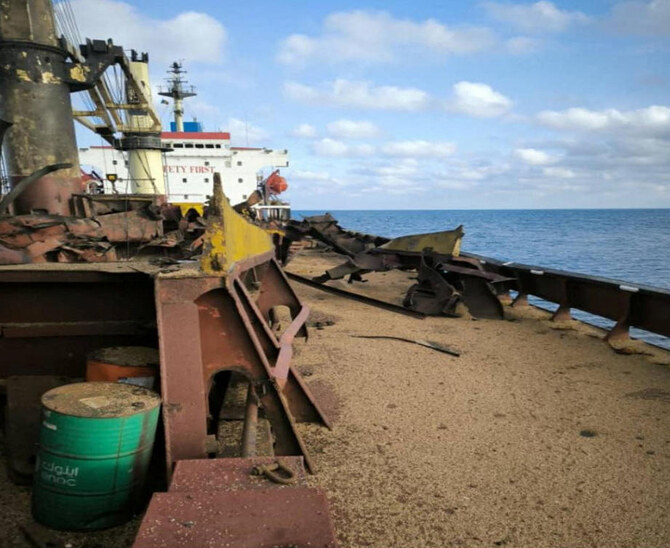
KYIV: A Russian missile on Thursday morning hit an Egypt-bound cargo ship in the Black Sea carrying wheat, Ukrainian President Volodymyr Zelensky said.
The Black Sea is a crucial trading route for Ukraine, one of the world’s largest agricultural producers and exporters, but was turned into a naval battleground when Russia invaded Ukraine.
“Russian missile against a wheat cargo bound for Egypt ... Russia launched a strike on an ordinary civilian vessel in the Black Sea right after it left Ukrainian territorial waters,” Zelensky said in a post on social media.
There were no casualties from the attack, Zelensky added, urging global condemnation after the strike.
“Domestic stability and normal life in dozens of countries around the world are dependent on the normal and unhindered operation of our food expert corridor,” he said.
Moscow last year pulled out of a UN-brokered deal guaranteeing safe passage for Ukraine’s agricultural exports on the Black Sea, but Kyiv has carved out a maritime corridor allowing trade to continue.
Over 5,000 ships have sailed through the grain corridor since it was created, Defense Minister Rustem Umerov said Wednesday.
Global food prices shot up when Russia invaded Ukraine amid fears conflict in the Black Sea would hobble global food supplies.


![]()


Russian missile hit an Egypt-bound wheat cargo ship in Black Sea: Zelensky
Short Url
https://arab.news/2pnbm
Russian missile hit an Egypt-bound wheat cargo ship in Black Sea: Zelensky
- “Russia launched a strike on an ordinary civilian vessel in the Black Sea right after it left Ukrainian territorial waters,” Zelensky said
- There were no casualties from the attack, Zelensky added, urging global condemnation after the strike


Former Bolivian President Arce arrested in corruption investigation a month after leaving office
LA PAZ: Bolivian law enforcement officials on Wednesday arrested former President Luis Arce as part of a corruption investigation, opening an uncertain chapter in the country’s politics a month after the inauguration of conservative President Rodrigo Paz ended 20 years of socialist rule.
A senior official in Paz’s government, Marco Antonio Oviedo, told reporters that Arce had been arrested on charges of breach of duty and financial misconduct related to the alleged embezzlement of public funds during his stint as economy minister in the government of charismatic former leader Evo Morales (2006-2019).
A special police force dedicated to fighting corruption confirmed to The Associated Press that Arce was in custody at the unit’s headquarters in Bolivia’s capital of La Paz.
Officials described Arce’s arrest as proof of the new government’s commitment to fighting graft at the highest levels in fulfillment of its flagship campaign promise.
“It is the decision of this government to fight corruption, and we will arrest all those responsible for this massive embezzlement,” Oviedo said.
But underlining the country’s polarization, Arce’s allies said his arrest was unjustified and smacked of political persecution.
Accusations of theft from a fund for rural peasants
Authorities accused Arce and other officials of diverting an estimated $700 million from a state-run fund dedicated to supporting the Indigenous people and peasant farmers who formed the backbone of Morales’ Movement Toward Socialism party. As Bolivia’s first Indigenous president, Morales transformed the country’s power structure and gave Indigenous peoplemore sway than ever.
Serving on the board of directors of the Indigenous Peasant Development Fund from 2006 to 2017, Arce was in charge of allocating funds to social development projects in rural areas. During that time, officials allege, Arce siphoned off some of that money for personal expenses.
“Arce was identified as the main person responsible for this vast economic damage,” said Oviedo.
Bolivia’s attorney general, Roger Mariaca, told local media that Arce had invoked his right to remain silent during police questioning.
He said Arce would remain in police custody overnight before being brought before a judge to determine whether he will remain detained pending trial. The charges against Arce carry a maximum sentence of 4-6 years in prison.
An ex-president allegedly grabbed from the street
Arce’s key ally and former government minister, Maria Nela Prada, insisted on the ex-president’s innocence and denounced the corruption scandal as a case of political persecution.
Although the prosecution said it issued an arrest warrant, she said Arce was not notified of the case before he was bundled into a minivan with tinted windows in an upscale La Paz neighborhood on Wednesday and brought in for interrogation.
Arce had been walking along the cafe-lined streets of Sopocachi after teaching an economics class at a major public university, Prada said, and managed to tell her of his arrest before losing communication. A police spokesperson did not immediately respond to a request for comment on that account of events.
“This is a total abuse of power,” Prada said, banging furiously on the doors of the police headquarters where Arce was being held.
Mariaca, the prosecutor, promised the case was about nothing more than tackling graft in Bolivia.
“This is not persecution, nor is it a political act,” he said.
Paz swept to victory in October elections on a wave of public outrage over the unmitigated shambles that Arce’s administration bequeathed its successors, including sky-high inflation, a shortage of fuel and empty state coffers.
Critical to his popularity was his running mate, the straight-talking, TikTok-savvy former police Capt. Edman Lara, who achieved celebrity status when he denounced high-ranking police officers for corruption.
Courts not neutral arbiters
Experts long have noted that Bolivia’s brittle institutional framework fosters corruption, and that its politicized judiciary often lets those in power off the hook — whether on the left or right of the political spectrum.
Morales, who guided the country through an era of economic growth and shrinking inequality before his fraught 2019 ouster, was accused of stacking the constitutional court and bending the laws to stay in power.
When he resigned in the wake of mass protests over his disputed reelection to a fourth term, the right-wing interim government that took over issued arrest warrants for Morales and his officials on charges ranging from terrorism to corruption.
Then Arce won the 2020 elections and went on to target his own political rivals.
Former interim president Jeanine Añez was sentenced to 10 years in prison on charges tied to her 2019 takeover and other right-wing opposition leaders landed in jail. Judges even went after Morales, Arce’s mentor-turned-rival, who remains hunkered down in Bolivia’s remote tropics evading an arrest warrant related to statutory rape.
Shifting political winds
With the pendulum now swinging back to the right, Añez and many of her allies have walked free from prison. President Paz has set to work undoing the leftist policies of Arce and Morales.
Celebrating Arce’s arrest on social media, Vice President Lara warned that the ex-president was just the first felled by what would become a wave of anti-corruption cases against former officials.
“Those who have stolen from this country will return every last cent,” Lara said, ending his message by wishing “death to the corrupt.”
A senior official in Paz’s government, Marco Antonio Oviedo, told reporters that Arce had been arrested on charges of breach of duty and financial misconduct related to the alleged embezzlement of public funds during his stint as economy minister in the government of charismatic former leader Evo Morales (2006-2019).
A special police force dedicated to fighting corruption confirmed to The Associated Press that Arce was in custody at the unit’s headquarters in Bolivia’s capital of La Paz.
Officials described Arce’s arrest as proof of the new government’s commitment to fighting graft at the highest levels in fulfillment of its flagship campaign promise.
“It is the decision of this government to fight corruption, and we will arrest all those responsible for this massive embezzlement,” Oviedo said.
But underlining the country’s polarization, Arce’s allies said his arrest was unjustified and smacked of political persecution.
Accusations of theft from a fund for rural peasants
Authorities accused Arce and other officials of diverting an estimated $700 million from a state-run fund dedicated to supporting the Indigenous people and peasant farmers who formed the backbone of Morales’ Movement Toward Socialism party. As Bolivia’s first Indigenous president, Morales transformed the country’s power structure and gave Indigenous peoplemore sway than ever.
Serving on the board of directors of the Indigenous Peasant Development Fund from 2006 to 2017, Arce was in charge of allocating funds to social development projects in rural areas. During that time, officials allege, Arce siphoned off some of that money for personal expenses.
“Arce was identified as the main person responsible for this vast economic damage,” said Oviedo.
Bolivia’s attorney general, Roger Mariaca, told local media that Arce had invoked his right to remain silent during police questioning.
He said Arce would remain in police custody overnight before being brought before a judge to determine whether he will remain detained pending trial. The charges against Arce carry a maximum sentence of 4-6 years in prison.
An ex-president allegedly grabbed from the street
Arce’s key ally and former government minister, Maria Nela Prada, insisted on the ex-president’s innocence and denounced the corruption scandal as a case of political persecution.
Although the prosecution said it issued an arrest warrant, she said Arce was not notified of the case before he was bundled into a minivan with tinted windows in an upscale La Paz neighborhood on Wednesday and brought in for interrogation.
Arce had been walking along the cafe-lined streets of Sopocachi after teaching an economics class at a major public university, Prada said, and managed to tell her of his arrest before losing communication. A police spokesperson did not immediately respond to a request for comment on that account of events.
“This is a total abuse of power,” Prada said, banging furiously on the doors of the police headquarters where Arce was being held.
Mariaca, the prosecutor, promised the case was about nothing more than tackling graft in Bolivia.
“This is not persecution, nor is it a political act,” he said.
Paz swept to victory in October elections on a wave of public outrage over the unmitigated shambles that Arce’s administration bequeathed its successors, including sky-high inflation, a shortage of fuel and empty state coffers.
Critical to his popularity was his running mate, the straight-talking, TikTok-savvy former police Capt. Edman Lara, who achieved celebrity status when he denounced high-ranking police officers for corruption.
Courts not neutral arbiters
Experts long have noted that Bolivia’s brittle institutional framework fosters corruption, and that its politicized judiciary often lets those in power off the hook — whether on the left or right of the political spectrum.
Morales, who guided the country through an era of economic growth and shrinking inequality before his fraught 2019 ouster, was accused of stacking the constitutional court and bending the laws to stay in power.
When he resigned in the wake of mass protests over his disputed reelection to a fourth term, the right-wing interim government that took over issued arrest warrants for Morales and his officials on charges ranging from terrorism to corruption.
Then Arce won the 2020 elections and went on to target his own political rivals.
Former interim president Jeanine Añez was sentenced to 10 years in prison on charges tied to her 2019 takeover and other right-wing opposition leaders landed in jail. Judges even went after Morales, Arce’s mentor-turned-rival, who remains hunkered down in Bolivia’s remote tropics evading an arrest warrant related to statutory rape.
Shifting political winds
With the pendulum now swinging back to the right, Añez and many of her allies have walked free from prison. President Paz has set to work undoing the leftist policies of Arce and Morales.
Celebrating Arce’s arrest on social media, Vice President Lara warned that the ex-president was just the first felled by what would become a wave of anti-corruption cases against former officials.
“Those who have stolen from this country will return every last cent,” Lara said, ending his message by wishing “death to the corrupt.”
Latest updates




© 2025 SAUDI RESEARCH & PUBLISHING COMPANY, All Rights Reserved And subject to Terms of Use Agreement.