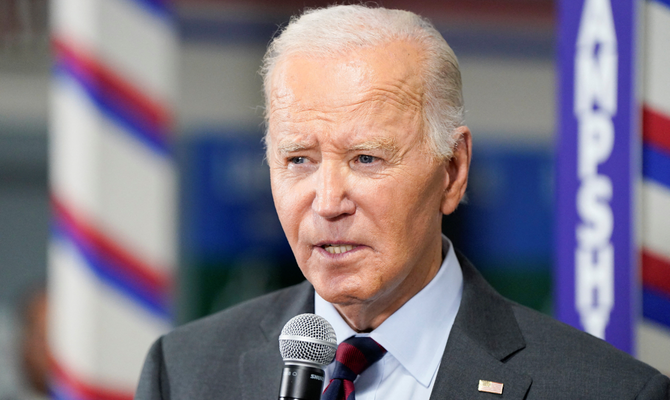
CONCORD, N.H.: President Joe Biden tore into his predecessor on Tuesday, suggesting that global leaders are terrified of what Donald Trump’s return to the White House could do to democratic rule around the world.
“Every international meeting I attend,” Biden said, specifically referencing his whirlwind trip to Germany last week, “They pull me aside — one leader after the other, quietly — and say, ‘Joe, he can’t win.’ My democracy is at stake.”
His voice rising, Biden then asked if, “America walks away, who leads the world? Who? Name me a country.”
The comments came during what was supposed to be a rather staid speech on health care in New Hampshire. They were a dose of unfiltered politics at an event otherwise focused on Biden’s policy legacy with the race to replace him just two weeks from concluding. And they made clear that the president also sees not having Trump succeed him as an important piece of how he might go down in history.
After the speech, Biden went to a campaign office to support New Hampshire Democratic candidates and continued his broadsides against Trump, even saying at one point, “We’ve got to lock him up.” Some supporters of Vice President Kamala Harris — who replaced Biden at the top of the Democratic ticket in July — have yelled that during her rallies.
That line drew applause from those assembled at the campaign office, but Biden quickly corrected himself: “Lock him out, that’s what we have to do.”
Biden didn’t mention Harris much during his comments, though he noted that she’d been endorsed by some high-profile Republicans. That includes former Rep. Liz Cheney, the GOP’s onetime No. 3 in the House and daughter of ex-Vice President Dick Cheney. Instead, Biden continued to focus on Trump, slamming him for being proud about being friends with Russian President Vladimir Putin, and joking that Trump “believes in the free press like I believe I can climb Mt. Everest.”
He said Trump and supporters of his “Make America Great Again” movement have “anti-democratic” attitudes toward the way the Constitution functions and “virtually no regard” for it.
“Think about what happens if Donald Trump were to win this election,” Biden said, adding, “He’s not joking about it, he’s deadly earnest” and “It’s a serious, serious problem.”
“We must win,” Biden said.
Biden was in New Hampshire’s capital of Concord with Vermont Sen. Bernie Sanders, the last candidate he beat to win the 2020 Democratic presidential primary. They both appeared at Concord Community College to trumpet the Department of Health and Human Services finding that almost 1.5 million Medicare enrollees saved nearly $1 billion on prescription drugs during the first half of the year.
Much of those savings came as a result of a cap on out-of-pocket drug costs created by the sweeping climate and health care law that the Biden administration helped carry through Congress in 2022. It put an annual maximum of $3,500 that recipients of Medicare, the government’s health insurance coverage plans for seniors, pay for their prescriptions while making recommended vaccines for older Americans, like immunization for shingles, free.
Biden said that seniors aren’t the only ones benefitting from the savings: “It’s also saving taxpayers billions of dollars.”
Next year, the drug cost cap for Medicare recipients falls to $2,000 per year, which will save some of the sickest Americans more. But the change has come at a price for others – it’s contributed to rising drug plan premiums that the government has tried to keep down by paying insurers billions of dollars from the Medicare trust fund. Still, some insurers have raised plan prices significantly – or pulled plans from markets.
The legislation is expected to deliver major savings in other ways, though, for taxpayers and Medicare enrollees in the long term.
For the first time ever, the federal government will negotiate the price of 10 of Medicare’s costliest drugs. The negotiated list prices, announced in August, will take effect in 2026. Taxpayers spend more than $50 billion yearly on the 10 drugs, which include popular blood thinners Xarelto and Eliquis and diabetes drugs Jardiance and Januvia.
The nonpartisan Congressional Budget Office estimates that Medicare drug pricing negotiations will save taxpayers $3.7 billion in the first year.
But his championing of lower drug prices was overshadowed by the warnings Biden offered about Trump.
“No president has ever been like this guy. He’s a genuine threat to our democracy.”


Biden says global leaders are terrified of Trump quietly tell him, ‘He can’t win’
https://arab.news/vfag3
Biden says global leaders are terrified of Trump quietly tell him, ‘He can’t win’

- Biden says that Trump and supporters of his “Make America Great Again” movement have “anti-democratic” attitudes toward the way the Constitution functions and “virtually no regard” for it


Youth voters take center stage in Bangladesh election after student-led regime change
- About 45% of Bangladeshis eligible to vote in Thursday’s election are aged 18-33
- Election follows 18 months of reforms after the end of Sheikh Hasina’s 15-year rule
DHAKA: When he goes to the polls on Thursday, Atikur Rahman Toha will vote for the first time, believing that this election can bring democratic change to Bangladesh.
A philosophy student at Dhaka University, Toha was already eligible to vote in the 2024 poll but, like many others, he opted out.
“I didn’t feel motivated to even go to vote,” he said. “That was a truly one-sided election. The election system was fully corrupted. That’s why I felt demotivated. But this time I am truly excited to exercise my voting rights for the first time.”
The January 2024 vote was widely criticized by both domestic and international observers and marred by a crackdown on the opposition and allegations of voter fraud.
But the victory of the Awami League of ex-Prime Minister Sheikh Hasina was short-lived, as a few months later the government was ousted by a student-led uprising, which ended the 15-year rule of Bangladesh’s longest-serving leader.
The interim administration, led by Nobel laureate Muhammad Yunus, took control in August 2024 and prepared a series of reforms to restructure the country’s political and institutional framework and organize the upcoming vote.
About 127.7 million Bangladeshis are eligible to cast their ballots, according to Election Commission data, with nearly a third of them, or 40.4 million, aged 18-29. Another 16.9 million are 30-33, making it a youth–dominated poll, with the voters hopeful the outcome will help continue the momentum of the 2024 student-led uprising.
“We haven’t yet fully transitioned into a democratic process. And there is no fully stable situation in the country,” Toha said. “After the election we truly hope that the situation will change.”
For Rawnak Jahan Rakamoni, also a Dhaka University student, who is graduating in information science, voting this time meant that her voice would count.
“We are feeling that we are heard, we will be heard, our opinion will matter,” she said.
“I think it is a very important moment for our country, because after many years of controversial elections, people are finally getting a chance to exercise their voting rights and people are hoping that this election will be more meaningful and credible. This should be a fair election.”
But despite the much wider representation than before, the upcoming vote will not be entirely inclusive in the absence of the Awami League, which still retains a significant foothold.
The Election Commission last year barred Hasina’s party from contesting the next national elections, after the government banned Awami League’s activities citing national security threats and a war crimes investigation against the party’s top leadership.
The UN Human Rights Office has estimated that between July 15 and Aug. 5, 2024 the former government and its security and intelligence apparatus, together with “violent elements” linked to the Awami League, “engaged systematically in serious human rights violations and abuses in a coordinated effort to suppress the protest movement.”
It estimated that at least 1,400 people were killed during the protests, with the majority shot dead from military rifles.
Rezwan Ahmed Rifat, a law student, wanted the new government to “ensure justice for the victims of the July (uprising), enforced disappearances, and other forms of torture” carried out by the previous regime.
The two main parties out of the 51 contesting Thursday’s vote are the Bangladesh Nationalist Party and Jamaat-e-Islami. Jamaat, which in 2013 was banned from political participation by Hasina’s government, heads an 11-party alliance, including the National Citizen Party formed by student leaders from the 2024 movement.
“I see this election as a turning point of our country’s democratic journey … It’s not just a normal election,” said Falguni Ahmed, a psychology student who will head to the polls convinced that no matter who wins, it will result in the “democratic accountability” of the next government.
Ahmed added: “People are not voting only for their leaders; they are also voting for the restoration of democratic credibility. That’s why this election is very different.”


