

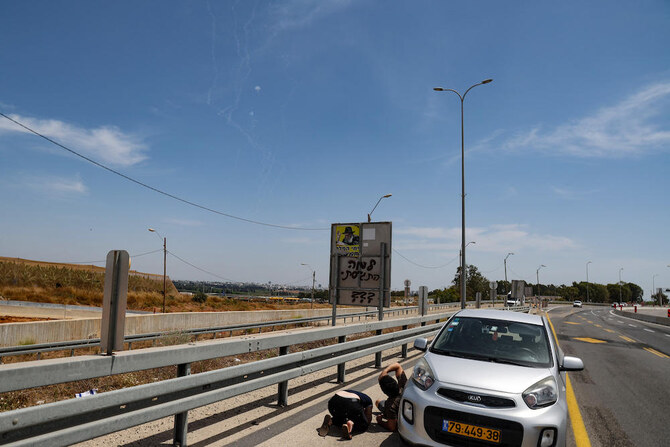

BEIRUT: The ongoing conflict between Lebanon’s Hezbollah and Israel intensified on Tuesday, with Hezbollah launching a series of rocket and missile strikes on Israeli positions, prompting retaliatory Israeli airstrikes.
The exchange marks a significant escalation in hostilities, resulting in thousands of casualties.
Hezbollah Targets Israeli Sites
Hezbollah claimed responsibility for multiple attacks on Israeli military positions, including areas near Tel Aviv. The group announced that it had launched rockets targeting the “Glilot base of the 8200 military intelligence unit” in Tel Aviv's suburbs. This followed a similar attack on the base the previous night. Additionally, Hezbollah reported firing rockets at a naval base in Haifa, a key coastal city in northern Israel.
In a statement, Hezbollah said it aimed at the “Stella Maris naval base northwest of Haifa,” marking one of the group's most significant assaults on Israel's military infrastructure.
Clashes in Southern Lebanon
Hezbollah also reported ground operations near the Lebanon-Israel border. Fighters claimed to have targeted an Israeli Merkava tank near the village of Taybeh, setting it ablaze. The group said clashes occurred on Monday in the outskirts of the village as Hezbollah forces engaged Israeli troops attempting to infiltrate Lebanese territory.
Israeli Military Response
In response to Hezbollah’s attacks, the Israeli military reported intercepting several projectiles. According to a statement, five projectiles were launched toward central Israel, most of which were intercepted by the country’s defense systems. In the northern regions of Upper Galilee and the Golan Heights, the Israeli army detected approximately 15 projectiles from Lebanon, with some intercepted and others falling in open areas.
No immediate casualties were reported from the Israeli side.
The Israeli military retaliated with overnight strikes on Hezbollah's weapons storage facilities and command centers. One of the key targets was Hezbollah’s naval base in Beirut, where Israel claimed the group stored military speedboats and conducted training and experiments.
The Israeli army said it struck around 300 targets in the past 24 hours, including a financial firm linked to Hezbollah. The strikes extended to southern Beirut, near Lebanon’s largest public hospital, resulting in the deaths of four civilians, including a child, according to Lebanese authorities.
However, the Israeli military said on Tuesday that its jets hit a Hezbollah target close to the Rafik Hariri University Hospital in Beirut late on Monday but did not target the hospital.
Lebanon's Infrastructure and Civilian Lives
The conflict has increasingly impacted Lebanon's civilian infrastructure. On Monday, a Lebanese security official reported that Beirut's international airport had to reroute landings due to Israeli strikes hitting close to the main runway.
The recent escalation began on September 23, when Israel intensified its air campaign against Hezbollah targets in Lebanon. Hezbollah has justified its actions as support for Hamas in Gaza, which has been engaged in its own conflict with Israel.
According to Lebanese authorities, at least 2,467 people have been killed in the violence over the past year, with more than half of these casualties occurring since the conflict escalated in September. Both Hezbollah and Israel have signaled their intent to continue the hostilities, leaving little hope for a resolution in the near term.
As the conflict shows no signs of abating, regional tensions remain high, with concerns growing over the potential for a broader war in the Middle East.


