

Moldova holds key polls on EU future amid fears of Russian meddling

1 / 2
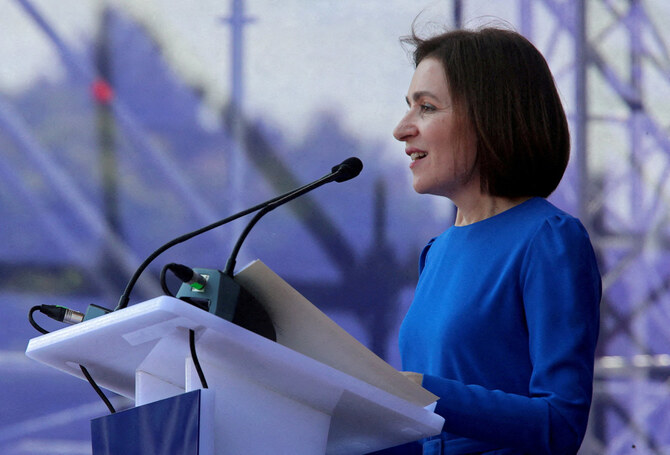
Moldovan President Maia Sandu delivers a speech during a rally to support a European path for the country, in Chisinau, Moldova. (REUTERS/File Photo)
2 / 2
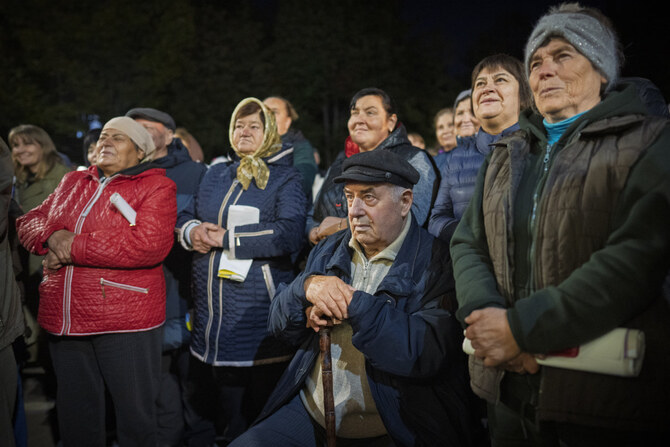
People listen to Moldova's President Maia Sandu speaking in Magdacesti, Moldova, onOct. 17, 2024, as she seeks a second term in office ahead of a presidential election and a referendum of whether to enshrine in Moldova's Constitution its path to European Union membership. (AP)
Short Url
Updated 20 October 2024
Follow

Moldova holds key polls on EU future amid fears of Russian meddling

  • The elections are a litmus test of the former Soviet republic’s pro-European turn under incumbent President Maia Sandu
  • ncumbent President Maia Sandu cut ties with Moscow and applied for Moldova to join the EU following Russia’s invasion of Ukraine in 2022

CHISINAU: Moldovans vote on Sunday in a presidential election and a referendum on joining the European Union, with fears of Russian meddling in the two key electoral tests amid the war in neighboring Ukraine.
The elections are a litmus test of the former Soviet republic’s pro-European turn under incumbent President Maia Sandu, who is seeking a second term in the country of 2.6 million.
Police have made hundreds of arrests after discovering a massive vote-buying scheme, warning this week that up to a quarter of the ballots cast could be tainted by Russian cash.
“Our country is at a crossroads... A group of thieves are trying to deceive people, promise them money, give them false information,” Prime Minister Dorin Recean said, urging Moldovans “to be vigilant.”
Sandu, who beat a Moscow-backed incumbent in 2020, cut ties with Moscow and applied for Moldova to join the EU following Russia’s invasion of Ukraine in 2022.
She has repeatedly sounded the alarm on Russian efforts to interfere in the vote — a claim Moscow has rejected.
Washington also issued a fresh warning this week, while the EU passed new sanctions on several Moldovans.

Sandu, 52, a former World Bank economist, is the clear favorite in the race.
But with only 35.8 percent of voter support, she is predicted to fall short of the majority needed to avoid a second round on November 3, according to the latest polls by the WatchDog think tank.
Her 10 competitors include Alexandr Stoianoglo, a 57-year-old former prosecutor supported by the pro-Russian Socialists, who is polling at nine percent.
Renato Usatii, a 45-year-old former mayor of Moldova’s second largest city of Balti, is predicted to win 6.4 percent.
Polls open at 7:00 am (0400 GMT) and close at 9:00 pm, with partial results expected from around 10:00 pm.
For the referendum, 55.1 percent of those surveyed have said they would vote “yes,” while 34.5 percent said they were set on “no.”
The referendum asks if the constitution should be modified to include joining the EU as an objective. The 27-member bloc began membership talks with Chisinau this June.
For any result to be valid, participation must reach at least 33 percent. Some pro-Russian parties have campaigned for a boycott.
“The future of Moldova will depend on what the people will choose... I hope we will take firm steps toward the European Union,” accountant Lidia Ceban said.
Sandu has been touring the country to say that joining the EU will help improve life in one of Europe’s poorest nations.
“The fate of our country, for many decades to come, rests on this (Sunday’s) decision,” Sandu said at a campaign event.
Sandu’s critics say she has not done enough to fight inflation and reform the judiciary.
In his campaign, Stoianoglo — who was fired as prosecutor by Sandu — has called for the “restoration of justice,” while Usatii has said he is the best choice as he is “the only one who is not controlled either by the East or the West.”

Fears of Russian interference are looming large.
Millions of dollars from Russia to corrupt voters were funnelled into the country by people affiliated to Ilan Shor, a fugitive businessman and former politician, police said earlier this month.
The “unprecedented” scheme could taint up to 300,000 ballots, according to police.
Convicted in absentia last year for fraud, Shor regularly accuses Moldova of being a “police state” and the West’s “obedient puppet.”
“Russia is hard at work. They have never (before) put in so much money,” Romanian historian Armand Gosu, who specializes in Russia and the former Soviet space, told AFP.
In addition to the vote buying, hundreds of young people were found to have been trained in Russia and the Balkans to create “mass disorder” in Moldova, including in tactics to provoke law enforcement, according to police.


Thousands in Kosovo march against war crimes trials on 18th anniversary of independence declaration

Updated 2 sec ago
Follow

Thousands in Kosovo march against war crimes trials on 18th anniversary of independence declaration

  • Protesters, many wrapped in red and black Albanian flags, braved cold and snowy weather in the capital, Pristina, to voice their opposition to the proceedings in The Hague
  • PM Albin Kurti added that ‘the KLA-led war was pure, liberation (struggle) and an anti-colonial war ... a just struggle of an occupied and oppressed people under apartheid’
PRISTINA, Kosovo: An air of defiance marked Kosovo’s independence celebrations on Tuesday as thousands of people joined a march in support of former fighters who are facing trial at a Netherlands-based court for alleged war crimes during a 1998-1999 separatist war from Serbia.
Protesters, many wrapped in red and black Albanian flags, braved cold and snowy weather in the capital, Pristina, to voice their opposition to the proceedings in The Hague against former president and rebel leader Hashim Thaci and three others accused of atrocities during and after the conflict that killed some 13,000 people.
Earlier on Tuesday, Kosovo’s security forces paraded in Pristina as part of the independence ceremonies, and Parliament held a special session.
The war started in 1998 when the rebel Kosovo Liberation Army launched its struggle for independence and Serbia responded with a brutal crackdown. The war ended after NATO bombed Serbia for 78 days in 1999, eventually forcing it to pull out its troops from the territory.
Serbia still does not recognize the 2008 declaration of independence of Kosovo and this has been a source of persistent tension in the volatile Balkan region. As both Kosovo and Serbia seek European Union membership, they have been told they must normalize ties before joining.
Prosecutors at the Kosovo Specialist Chambers in The Hague — which formally is part of Kosovo’s judicial system although seated abroad — have asked for a maximum 45-year prison sentence for Thaci and the other defendants. Thaci also faces a separate trial on charges of intimidating witnesses that will begin later this month.
Officials and protesters in Kosovo have criticized the proceedings as political and designed to strike a false balance with Serbia whose political and military leaders previously had been tried and convicted of war crimes in Kosovo by a separate UN court.
Protesters at Tuesday’s march held banners reading “History cannot be rewritten” and “Freedom for the liberators.” They arranged metal fences around a landmark independence monument and placed a sign reading ”Kosovo in Prison” on top of it.
President Vjosa Osmani said in a statement that “truth cannot be changed by attempts to rewrite history or to tarnish and devalue the struggle of Kosovo’s people for freedom.”
Prime Minister Albin Kurti added that “the KLA-led war was pure, liberation (struggle) and an anti-colonial war ... a just struggle of an occupied and oppressed people under apartheid.”
In Belgrade, a Serbian government liaison office for Kosovo described the independence declaration 18 years ago as a “flagrant violation of international law.” The statement alleged “systematic terror” and persecution against minority Serbs in Kosovo.
The United States and most EU countries are among more than 100 nations that have recognized Kosovo’s independence while Russia and China have backed Serbia’s claim on the territory.
Thaci resigned from office in 2020 to defend himself against the 10 charges of crimes against humanity and war crimes.
The court and an associated prosecutor’s office were created after a 2011 report by the Council of Europe, a human rights body, following allegations that KLA fighters trafficked human organs taken from prisoners and killed Serbs and fellow ethnic Albanians. The organ harvesting allegations haven’t been included in indictments issued by the court.