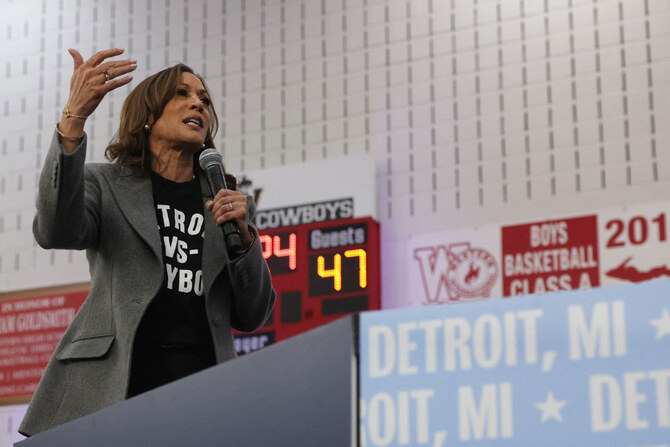
DETROIT, Michigan: US Vice President Kamala Harris on Saturday repeated her call for a ceasefire in Israel’s war in Gaza and said it was important to seize the opportunity provided by the killing of Hamas leader Yahya Sinwar, a mastermind of the Oct. 7 attack.
Harris acknowledged challenges ahead but told reporters she would continue to push for an end to the conflict.
“This creates an opening that I believe we must take full advantage of — to dedicate ourselves to ending this war and bringing the hostages home,” she said.
“As it relates to the issues in the Middle East and in particular in that region, it has never been easy. But that doesn’t mean we give up. It’s always going to be difficult. We can’t give up.”
Harris dodged a question on whether Arab American and Muslim anger over US support for Israel’s continued bombardment of Gaza and more recently in Lebanon could cost her the election in the battleground state of Michigan, but said she would continue speaking out about the tragic loss of innocent lives.
“I speak publicly all the time about the fact that there are so many tragic stories coming from Gaza,” Harris said, also referencing the initial Hamas Oct. 7 attack on Israel.
“What’s critically important as we look at this moment, is ... acknowledging the tragedy of what has happened in Gaza, in terms of the extraordinary number of innocent Palestinians that have been killed, and taking that seriously and speaking truth about that,” she said.
Harris and Trump are essentially tied in the most competitive states like Michigan, with just 17 days until the Nov. 5 election.
Harris will need strong results in the majority non-white cities of Detroit and Atlanta and their surrounding suburbs — both of which have large Arab American and Muslim populations — to repeat US President Joe Biden’s 2020 wins in Michigan and Georgia. Trump won Michigan by 11,000 votes in 2016. In 2020, Biden beat Trump by 155,000 votes.
Harris on Friday won the endorsements of 50 prominent Lebanese-Americans, who said the US had been “unrelenting” in its support for Lebanon under the Biden administration and that they expect additional backing if Harris wins in November.
The endorsement came amid ongoing Israeli attacks on Lebanon that have killed at least 2,350 people over the last year, according to the Lebanese health ministry, with more than 1.2 million people displaced. Hezbollah attacks have killed 50 Israeli soldiers and civilians, according to Israel.
The death toll has mounted in Gaza after the Oct. 7 attack that killed around 1,200 people, with another 253 taken hostage, according to Israeli tallies. Israel’s military response in Gaza has killed more than 42,500 people, Palestinian officials say.


![]()

Kamala Harris says she won’t give up pushing for end to Israel-Gaza war
Short Url
https://arab.news/94n2b
Kamala Harris says she won’t give up pushing for end to Israel-Gaza war
- Harris acknowledged challenges ahead but told reporters she would continue to push for an end to the conflict
- Harris on Friday won the endorsements of 50 prominent Lebanese-Americans, who said the US had been “unrelenting” in its support for Lebanon under the Biden administration


Latest updates


© 2026 SAUDI RESEARCH & PUBLISHING COMPANY, All Rights Reserved And subject to Terms of Use Agreement.