


CHICAGO/LONDON: The Arab American voter base, often viewed primarily through the lens of Middle East concerns like the Palestinian-Israeli conflict, presents a far more nuanced picture in the upcoming US elections, experts have told Arab News.
Discussing the preview of a new survey conducted by Arab News and YouGov, Joseph Haboush, Washington correspondent for Al Arabiya English, and Tarek Ali Ahmad, head of Arab News’ Research & Studies Unit, said that while the Palestinian issue remains significant, Arab Americans are equally focused on domestic issues like the economy, border security and hate speech.
“The issue of Palestine is not as prevalent among the Arab American voters as one might think,” Haboush said.

The poll results suggest that Arab American voters are focused on both domestic issues and the Middle East conflict, but believe that Trump, rather than Harris, is more likely to end the ongoing wars. (Getty Images/File)
A Lebanese American, Haboush said that many Arab Americans, particularly those of Lebanese origin, have conflicting views on Palestine due to Lebanon’s own complex history with the Palestinian community during its civil war.
Some blame the Palestinians for their role in the conflict, while others view the matter differently, Haboush said during the taping of “The Ray Hanania Radio Show” on Thursday.
“It’s interesting that it might not be as high of a priority among the Arab American voters as an outsider might think.”

The poll results suggest that Arab American voters are focused on both domestic issues and the Middle East conflict, but believe that Trump, rather than Harris, is more likely to end the ongoing wars. (Getty Images/File)
Lebanon’s demographic shift, fueled by the influx of Palestinians in 1948 and 1967, contributed to tensions that culminated in the Lebanese Civil War from 1975 to 1990.
The conflict, pitting Palestinian and Lebanese Muslim forces against Christian militias, drew in regional powers like Syria, Israel and Iran, leading to devastating consequences.
The war left Lebanon in a fragile sectarian balance that persists today.

A cloud of smoke erupts following an Israeli airstrike on Beirut's southern suburbs on October 19, 2024. (AFP)
Many Lebanese fled the violence, seeking refuge in the US and Europe, where they established communities that, while preserving Lebanese heritage, have become increasingly integrated into local society and politics.
With the 2024 election shaping up to be a head-to-head race between Republican nominee Donald Trump and Democrat Kamala Harris, Arab American voters are weighing multiple priorities. The survey shows that these voters, who have often been portrayed as a monolithic bloc driven by foreign policy, are just as concerned about bread-and-butter issues facing their daily lives.
This signals a shift in priorities, where domestic economic challenges are competing with longstanding foreign policy issues for Arab Americans’ attention.
“The poll that was conducted by YouGov and Arab News essentially revealed that Arab Americans are nearly evenly split in their support for two major presidential candidates, Donald Trump and Kamala Harris,” Arab News’s Ali Ahmad said.

Democratic presidential nominee Vice President Kamala Harris (left) and Republican presidential candidate Donald Trump campaign in the US state of Michigan, a key battleground state for the two candidates, on October 19, 2024. (Getty Images/AFP)
He added that while only 4 percent favored third-party candidate Jill Stein — known for criticizing US support for Israel — a small segment of undecided voters could play a crucial role, particularly in battleground states such as Michigan, where the Arab American community could sway the election outcome.
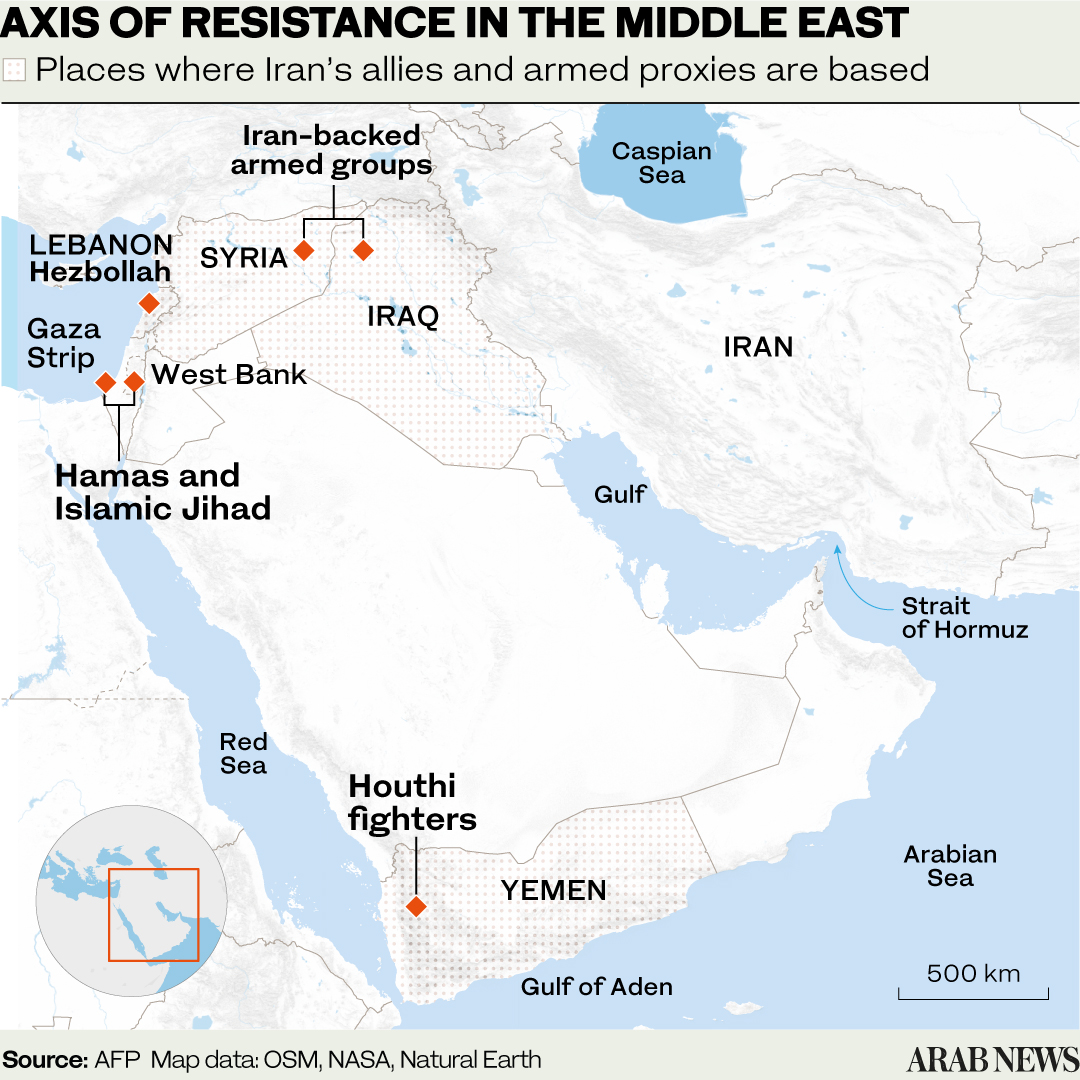
The Biden administration has faced heavy criticism for its unwavering support of Israel’s military actions against Hamas and Hezbollah, pushing the region to the brink of a wider conflict involving Iran’s “Axis of Resistance.”
The alliance, comprising Tehran-backed militias in Lebanon, Iraq, Syria and Yemen, has fueled a tit-for-tat escalation of violence, with diplomats worldwide scrambling to prevent further chaos.
Haboush argued that Washington, despite co-leading negotiations for ceasefires in Gaza and Lebanon, has failed to effectively leverage its diplomatic power, “putting a bit of a dent on the US image abroad”
Despite that, 52 percent of Arab Americans surveyed want the US to either maintain or increase its military presence in the region, Haboush highlighted.
“They want the US to kind of work its diplomatic channels, (and) at the same time they don’t want the US to leave, according to this poll, at least from a military point of view. Because, I think, the belief is that once the military presence is gone, just the overall interest is gone,” Haboush said, adding that the survey results reflect a belief in the value of US involvement, despite recent diplomatic shortcomings.
This sentiment emerged as Israel on Thursday confirmed the death of Yahya Sinwar, the head of Hamas and mastermind of the Oct. 7 attacks where 1,200 people were killed, mostly civilians, and 250 abducted, killed during a patrol in Rafah in southern Gaza.
Sinwar’s death, widely seen as pivotal, could mark a new phase in the conflict that has claimed more than 42,000 lives in Gaza and more than 2,400 in Lebanon, following clashes between Israel and Hezbollah.

In this Oct. 21, 2011 photo, Yahya Sinwar, a founder of Hamas' military wing, talks during a rally in Khan Younis, southern Gaza Strip. (AP Photo/File)
While Israeli Prime Minister Benjamin Netanyahu vowed to press on, some officials view Sinwar’s death as a potential opening for peace, providing a chance for the more than year-long conflict in Gaza to finally end, and for Israeli hostages to be brought home.
With less than 20 days until the election, analysts expect that US President Joe Biden may seize this window to push for a ceasefire, a move that could influence the election and boost the campaign of Kamala Harris, who is viewed by respondents of the survey as less likely to resolve the Israeli-Palestinian conflict compared to Republican nominee Donald Trump.
“There’s a notable division in who Arab Americans believe is better to handle the situation (in Gaza and Lebanon). Many of them feel that both candidates are simply incapable regarding Middle East issues,” Ali Ahmad said, adding that “a significant enough amount (of voters) to alter this election” have veered toward Stein in protest of US foreign policy.
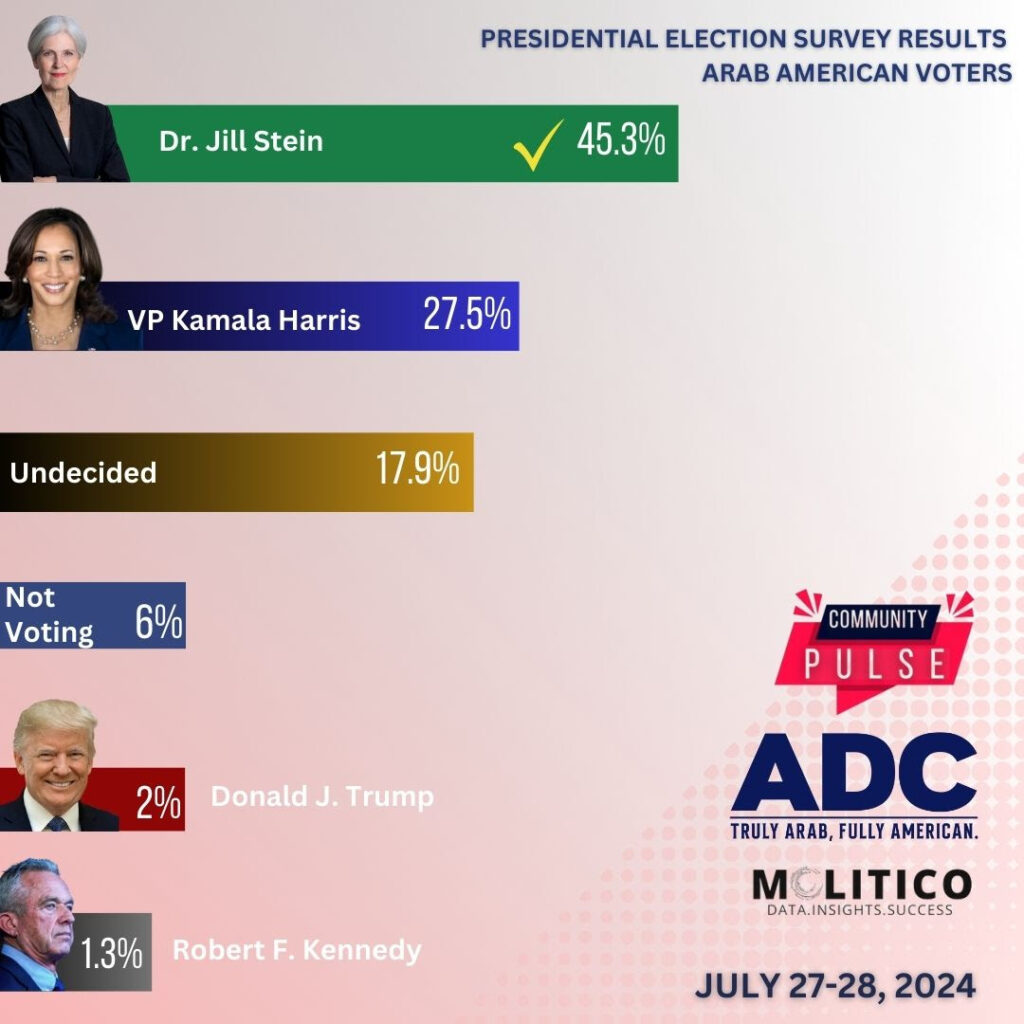
Poll by the US civil rights group ADC in July showing independent presidential aspirant Jill Stein being a better option by American Muslims to the Republican and Democratic nominees. (ADC image
“The results showed that a majority of those polled, 40 percent, considered themselves as Democrat, while 28 percent considered themselves Republican,” he said.
“Yet, they found that Donald Trump was more likely to be the person who would be able to end the Palestine-Israel conflict.”
The fact that “the person that’s closer to the aggressor” is seen as more likely to resolve the conflict, is “kind of paradoxical in a sense,” Ali Ahmad added.
Further complicating the picture, more than one-third of respondents expressed equal support for both a two-state solution and a one-state model, where Israelis and Palestinians share equal rights.
As Haboush said on “The Ray Hanania Radio Show,” the Palestinian issue, while important, does not entirely overshadow other regional concerns.
He argued that people are still deeply invested in what happens in the Middle East, particularly the situation with Iran, highlighting his belief that Arab Americans supposedly wanting a more “hawkish approach” over a diplomatic one “wasn’t 100-percent accurate.”
Haboush said that although foreign policy is relevant, the 2024 election will likely be driven by domestic issues that deeply resonate with Arab American voters, such as the economy, border control and discrimination. The survey, designed to provide clearer insights into Arab American priorities, reveals a much more nuanced picture than anticipated.
“If you look domestically, the voter base would traditionally align with the conservative party,” Haboush said. “Even when you look at foreign policy, I thought a lot (of people) preferred this more hawkish approach, yet the poll says a little bit otherwise.”
He also pointed out that the younger generation of Arab Americans, many of whom have been vocal on social media about the conflicts in Gaza and Lebanon and may be first-time voters, adds another layer of complexity. “So, it’s just difficult to gauge,” he said.
With the election approaching and the race in a tight balance, Haboush said that both candidates are increasingly aware of the Arab American vote’s importance. This has been reflected in growing media attention to the demographic, as campaigns focus on undecided voters in key battleground states.
“The mainstream media in the US don’t understand the diversity of the Arab American community,” he said. “For decades, the Arab American has just been portrayed as a victim of war and conflict immigration.
Haboush criticized the media for selective coverage, saying that outlets “cover the Arab American polling in great detail (because) it fits into some sort of narrative … (but) don’t see the productive role that they’ve played generation after generation in this country, and a number of factors playing to that.”
The full survey, set to be released in the coming days, promises more detailed insights into Arab American voting patterns and the issues shaping their decisions, on one of the most anticipated elections in recent history.
As the US prepares for a head-to-head race between Donald Trump and Kamala Harris, the Arab American vote may prove more pivotal — and complex — than ever before.
“The Ray Hanania Radio Show” airs every Thursday on the U.S. Arab Radio Network on WNZK AM 690 Radio in Michigan at 5 p.m. EST, with a rebroadcast the following Monday. The show, sponsored by Arab News, is also available via podcast at ArabNews.com.rayradioshow and Facebook.com/ArabNews.


