

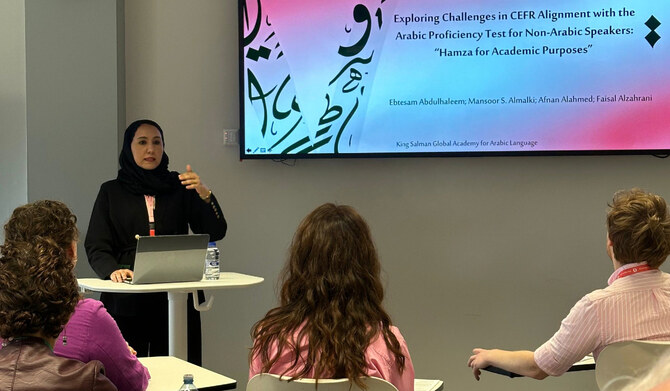


RIYADH: The King Salman Global Academy for Arabic Language participated in a conference on the Common European Framework of Reference for Languages, organized by Blanquerna-Ramon Llull University in Spain.
Held from Oct. 18-19 in Barcelona, the conference aimed to exchange experiences, explore language compatibility, and share lessons among framework users.
Abdullah Al-Washmi, the academy’s secretary-general, highlighted the academy’s role in strengthening linguistic identity, preserving the purity of Arabic, and fulfilling its core mission.
The academy’s participation aligns with its strategic goals to collaborate with language institutions, showcase initiatives, and promote Arabic teaching and learning.
The event featured several key research papers, including one by Dr. Ibtisam Abdel Haleem, director of the test development department.
She explored using the Common European Framework of Reference for Languages standards to design the Hamza Arabic Proficiency Test for non-native speakers in academic contexts.
Haleem discussed the challenges and solutions related to aligning the test with the unique characteristics of the Arabic language.
“The importance of this test stems from the growing global demand for learning Arabic among non-native speakers for educational, cultural, professional, and political reasons,” she noted, highlighting the need for a standardized global test to assess Arabic proficiency.
Presenting her research at this conference offers a key opportunity to elevate the global profile of the Hamza Arabic Language Test, aligning with the academy’s objectives, Haleem said.
"Several experts in language teaching and testing, including those in Arabic, have expressed interest in implementing the Hamza test in Spain soon," she added.
In an interview with Arab News, Haleem stressed that documenting the academy’s efforts in developing and applying the Hamza test through academic publications is vital for advancing Arabic, especially given the limited research on its assessment.
She anticipates the Hamza test will continue to evolve and gain international recognition, fostering collaboration with academic institutions worldwide.
The Hamza test is a computerized, standardized assessment measuring non-native speakers' proficiency in Arabic across four key skills: listening, reading, writing, and speaking.
The 155-minute test consists of 75 questions developed according to the Common European Framework of Reference for Languages, covering levels A2 to C1.
It targets Arabic language learners and educators at universities, language institutes, and centers, as well as potential employers.


