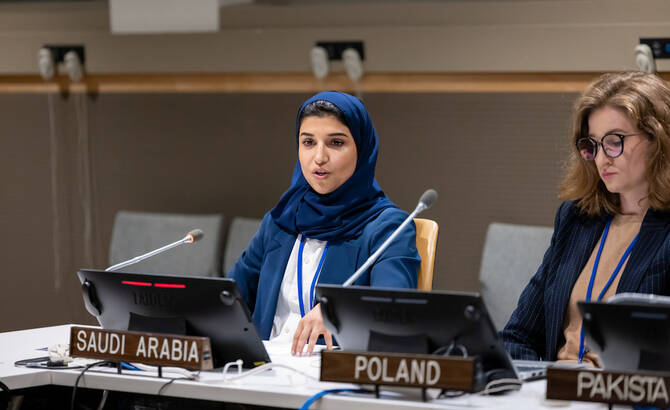

NEW YORK CITY: With four years left before the 2030 deadline for the UN Sustainable Development Goals, Saudi Arabia used a high-level side event at UN headquarters on Friday to argue that the central challenge facing governments is no longer setting ambitious targets but organizing institutions and resources to deliver them.
The session, “Rethinking SDG Delivery Through Prioritization and Implementation Approaches,” was organized by Saudi Arabia’s Ministry of Economy and Planning on the margins of the UN High-Level Political Forum on Sustainable Development, and brought together officials from Saudi Arabia, Singapore, Pakistan, Poland and Ireland, along with a recorded address from the UN’s South-South cooperation chief.
Opening the discussion, Fares Al-Otaibi, deputy permanent representative of Saudi Arabia to the UN, said the question before governments today “is no longer whether we are committed to the Sustainable Development Goals,” but how to organize national systems to deliver them.
He said today’s development landscape has grown more complex, forcing governments to respond to economic, social and environmental pressures with finite institutional and financial resources, meaning success should be measured not by the number of priorities pursued but by governments’ ability to identify and deliver the ones with the greatest transformative potential.
He said Saudi Arabia’s Vision 2030 has demonstrated that sustainable development accelerates when long-term ambition is paired with clear priorities, effective governance and coordinated implementation, underpinned by national ownership and international cooperation.
Hajar Algosair, General Supervisor for the Assistant Deputyship for Sustainable Development at the Ministry of Economy and Planning, said the global development conversation is shifting from setting goals and expanding partnerships toward how to deliver with greater impact and focus. She said governments today are navigating economic uncertainty, climate change, demographic shifts and ecological transformation simultaneously, making implementation “just as important as ambition” and execution “just as important as commitment.”
She stressed that Saudi Arabia was not presenting a single model for others to replicate but rather using the forum to create space for member states to exchange practical experience, noting that national contexts differ but implementation challenges are often remarkably similar across countries.
The most detailed presentation of Saudi Arabia’s methodology came from Yara Sindi, general manager for sustainability analytics and policy integration at the Ministry of Economy and Planning.

Yara Sindi (R), general manager for sustainability analytics and policy integration at the Ministry of Economy and Planning. (Supplied)
She said that because the SDGs assign equal weight to all 169 targets, the Kingdom needed a mechanism to translate the global agenda into nationally relevant priorities.
Sustainability, she added, sits at the heart of Vision 2030, and the Kingdom built a national sustainable development blueprint to channel institutional resources toward priority areas known as “missions.”
Officials mapped more than 90 sustainability themes drawn from the SDGs, the World Economic Forum’s sustainability agenda and national strategies, then evaluated each against four criteria: national relevance, institutional capacity to deliver, the size of the performance gap and the potential for multiplier impact across other goals.
That process produced nine national missions spanning economic, social and environmental dimensions, including water sustainability, resilient food systems, longer and healthier lives, empowered citizens, thriving cities and inclusive growth, each with defined outcomes, measurable indicators and ambitious targets.
Sindi said the missions were designed to complement rather than replace the SDGs and Vision 2030, with each mission simultaneously drawing targets from multiple goals. She said underperforming indicators are tracked through a “delivery engine” coordinated by the Sustainable Development Steering Committee, the Kingdom’s central governance body for sustainability, which convenes lead ministries for regular progress reviews and course-correction.
She pointed to Saudi Arabia’s standing as one of the fastest-improving G20 countries on sustainable development over the past decade, and cited efforts to engage the private sector, including a ministerial committee working on national sustainability reporting guidelines and a corporate taxonomy, alongside a public platform showcasing the Kingdom’s sustainability data.
Singapore’s ambassador, Burhan Gafoor, said prioritization has been “a condition for survival” for a small, resource-poor city-state, with national priorities concentrated on water, energy, food resilience, urban livability and human capital, chosen for their ability to compound benefits across multiple goals rather than any hierarchy of importance.

Singapore’s ambassador, Burhan Gafoor. (Supplied)
He noted that Singapore mainstreams the SDGs into existing ministries rather than creating parallel structures, and plans on a 50-year horizon well beyond 2030. “No country is on track to achieve all 169 targets,” he said, calling on the UN to begin a serious conversation on a post-2030 framework.
Pakistan’s deputy permanent representative, Usman Iqbal Jadoon, described how the 2030 Agenda was legislated into national planning as far back as 2016 and now sits under “Uraan Pakistan,” a five-pillar economic transformation framework running through 2029.

Pakistan’s deputy permanent representative, Usman Iqbal Jadoon. (Supplied)
He said falling fiscal space — federal development spending has dropped from almost 20 percent of the budget in 2017-18 to under 5 percent today — has made sequencing and completion of existing projects more critical than launching new ones. “A well-designed framework on paper does not automatically translate into consistent delivery,” he said.
Poland’s Agnieszka Jablonska outlined a system of 174 national indicators, revised most recently in 2023 to reflect the impact of COVID-19 and the war in Ukraine, alongside a geospatial statistics platform and regional monitoring covering more than 300 local entities. She noted Poland ranks 11th out of 169 countries in this year’s SDG index. “Real success depends on how we translate global goals into the national context,” she said.

Poland’s Agnieszka Jablonska. (Supplied)
Ireland’s Marc Kierans described a whole-of-government model in which every SDG has a ministerial “champion,” backed by a senior officials’ group under the prime minister’s office and a national implementation plan now in its third iteration, tested through OECD peer reviews.

Ireland’s Marc Kierans. (Supplied)
“One size does not fit all,” he said, adding that Ireland works to close the gap between top-down planning and bottom-up community input, with particular attention to engaging young people.
In a recorded closing message, Deema Al-Khatib, director of the UN Office for South-South Cooperation, delivered a sobering data point: the 2026 Sustainable Development Report shows only 36 percent of SDG targets are on track or progressing moderately, while 15 percent have regressed. She cited Saudi Arabia’s Vision 2030, alongside national models from Jordan, Egypt and Senegal, as examples of strategically integrated delivery architecture.

Deema Al-Khatib, director of the UN Office for South-South Cooperation. (Supplied)
She pointed to a new UN system-wide strategy on South-South and triangular cooperation for 2026-2029, and a Multi-Stakeholder Global Alliance for South-South and Triangular Cooperation launching in September as tools to help countries exchange practical solutions. “No country should have to solve today’s development challenges alone,” she said.