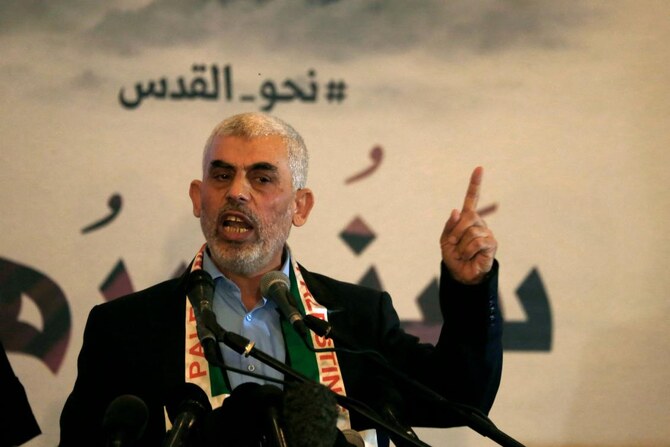
A senior Hamas official said the Palestinian militant group cannot be eliminated with the killing of its leaders, but stopped short of confirming the death of its chief, Yahya Sinwar.
“Hamas is a liberation movement led by people looking for freedom and dignity, and this cannot be eliminated,” Basem Naim, senior member of Hamas’s political bureau, told AFP.
In a statement, he listed several Hamas leaders killed in the past, and said their deaths had boosted the group’s popularity.
“It seems that Israel believes that killing our leaders means the end of our movement and the struggle of the Palestinian people,” Naim said.
“Hamas each time became stronger and more popular, and these leaders became an icon for future generations to continue the journey toward a free Palestine.”

Hamas official says group cannot be eliminated, does not confirm Sinwar’s death
https://arab.news/vkfnr
Hamas official says group cannot be eliminated, does not confirm Sinwar’s death
Jordan, Germany committed to two-state solution
- Chancellor Merz calls for more humanitarian aid to flow into the war-torn Gaza Strip
AMMAN: Jordan’s King Abdullah has warned of “the danger of continued Israeli escalations in the West Bank,” which Israel has occupied since 1967.
King Abdullah received German Chancellor Friedrich Merz during his brief stopover in Jordan on Saturday.
Their discussions in Aqaba focused mainly on the peace process in Israel and the Palestinian territories, AFP reported.
Merz called for more humanitarian aid to flow into the Gaza Strip and for Hamas fighters to lay down their weapons, adding that both Jordan and Germany are committed to a negotiated two-state solution.
FASTFACT
Jordan’s royal palace said in a statement that King Abdullah underlined ‘the need to commit to implementing all stages of the agreement to end the war and deliver humanitarian aid to all areas of the Gaza Strip.’
“There can be no place for terrorism and antisemitism in this shared future,” Merz said.
Jordan’s royal palace said in a statement that King Abdullah had underlined “the need to commit to implementing all stages of the agreement to end the war and deliver humanitarian aid to all areas of the strip.”
The meeting discussed ways to strengthen the partnership between Jordan and Germany, focusing on the deep-rooted ties between the two countries, Jordanian news agency Petra reported.
King Abdullah emphasized the importance of expanding cooperation in various domains, including the economic and defense sectors, and continuing to coordinate in support of efforts to achieve stability in the region, according to Petra.
The leaders highlighted the need to pursue a “political horizon to achieve a just and comprehensive peace in the region.”
Chancellor Merz expressed Germany’s readiness to strengthen cooperation with Jordan in various sectors.
The Syrian Arab Republic’s Sana news agency reported that the two leaders discussed ways to support Syria and Lebanon in maintaining their security, stability, and sovereignty.
They stressed the importance of respecting the sovereignty of regional countries and reviewed key developments in the Middle East.
Deputy Prime Minister and Foreign Minister Ayman Safadi had previously affirmed that Jordan continues to support Syria after years of war and destruction, expressing hope for a stable and secure future that ensures Syria’s territorial unity, Sana added.
King Abdullah separately met with Kaja Kallas, EU high representative for foreign affairs and security policy and European Commission vice president on Sunday to discuss ways to strengthen cooperation within the framework of the strategic and comprehensive partnership between Jordan and the EU.
The meeting at Basman Palace covered the importance of building on available economic opportunities, particularly through the Jordan-EU Summit, scheduled to be held in Amman in January 2026, as well as the joint economic forum scheduled for next year, with participation from investors on both sides.
The meeting also touched on regional developments and the need to achieve comprehensive calm and preserve the sovereignty of states.
The two sides emphasized that the two-state solution is the only way to achieve just and comprehensive peace.
The king reiterated the need to adhere to the terms of the agreement to end the war in Gaza and ensure the flow of relief aid, as well as to stop unilateral measures against Palestinians in the West Bank.
For her part, Kallas emphasized the importance of the EU’s partnership with Jordan and the shared commitment to deepen cooperation in various fields, noting Jordan’s pivotal role in the region.


