

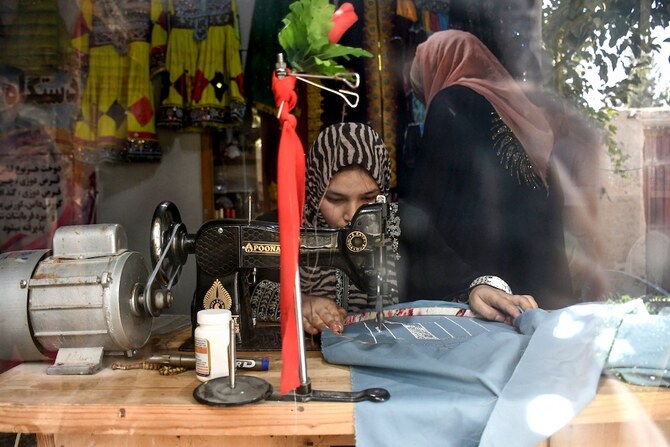

KABUL: Barred from schools, restricted in public places and not allowed to work in most jobs, women in Afghanistan’s western Herat province are turning to private entrepreneurship to empower themselves and others.
The employment rate has dropped significantly across Afghanistan since the Taliban took control in 2021 and their administration was hit with a host of international sanctions.
The situation is further aggravated by restrictions the Taliban have steadily imposed on women’s participation in the public sector, their secondary and higher education, and movement.
“The unemployed class is increasing, the education system is currently blocked, most women and girls are unemployed and stay at home, underage marriages have increased, and the economy is down,” said Shafiqa Barak, director of Afghan Barak, a clothing company based in Herat.
She is among an increasing number of businesswomen for whom entrepreneurship is a way to obtain some empowerment and independence.
As women have been absent from so many aspects of public life, Barak told Arab News that being professionally active was essential.
“Afghan Bark company has created work opportunities for 18 women ... creating jobs and creating work opportunities is today one of the basic needs of women in Afghanistan,” she said.
“Working as a businesswoman in the current situation, where there is no other way to improve my morale and earn income, gives me the best feeling because I make several families happy and help several women and girls get out of despair.”

Afghan women work at Watan Collection fashion company in Herat, September 2024. (Watan Collection)
She is not alone. Behnaz Saljoqi, head of the Women’s Chamber of Commerce and Industries in Herat told Arab News that the number of women obtaining business licenses was increasing, with 800 permits received over the past three years.
These female-led businesses are in sectors such as apparel, carpet weaving, miniature painting, food production, processing and packaging.
“Most of them have licenses from the municipality, and some have licenses from the Department of Commerce,” she said.
“Overall, the Islamic Emirate is ready to support women in the private sector, including women’s participation in international exhibitions outside Afghanistan.”
With women only allowed to work as long as they work for women and among women, navigating the restrictions is not easy. It is further complicated by the sanctions that are in place and the fragile Afghan economy.
“Working as a businesswoman in the current situation not only gives me a sense of power and empowerment, but also an opportunity to prove that women are capable to overcome challenges and excel in different professional fields,” said Parisa Elhami, who runs Watan Collection, a fashion brand in Herat which currently employs 15 women.
“One of the main obstacles facing women entrepreneurs is legal and financial complications. Among these obstacles, we can point out the difficulties of obtaining a business license, high business tax costs, restrictions on access to suitable places to operate, and economic fluctuations that affect the sales market,” she told Arab News.
“For me, creating job opportunities for other women means fulfilling social responsibility and realizing the latent potential in society. This also leads to reduction of gender inequality, increasing women's social participation, and strengthening family foundations.”


