

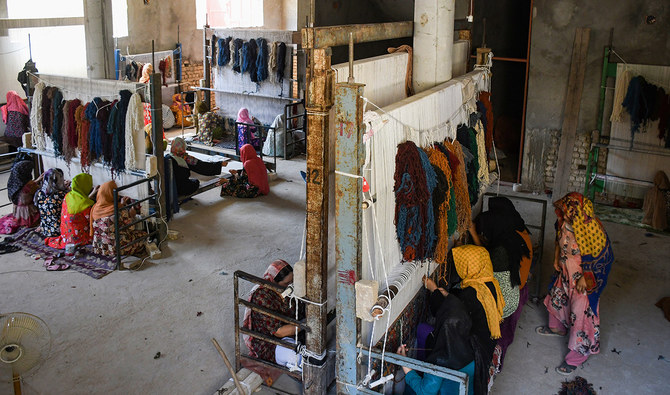

LONDON: Five months after Taliban supporters smashed up her restaurant, Afghan entrepreneur Laila Haidari opened a secret craft center where women earn a small income stitching elaborate dresses and fashioning jewelry from melted down bullet casings.
Her workshop is among an array of underground businesses that women have launched since losing their jobs after the Taliban grabbed power in 2021, ranging from gyms to beauty salons and girls’ schools.
“I opened this center to provide jobs for women who desperately need them,” Haidari said.
“This is not a permanent solution, but at least it will help them put food on their table.”
The Taliban administration, which marks two years in power on Aug. 15, has banned women from most jobs, barred girls from secondary and higher education, and imposed harsh restrictions on their freedom of movement.
But thousands of women continue to run micro-enterprises from their homes — which officials broadly allow, while others like Haidari oversee more clandestine businesses.
Haidari, 44, used to own a lively Kabul restaurant that was known for its music and poetry evenings and was popular with intellectuals, writers, journalists and foreigners.
The profits were plowed into a drugs rehabilitation center she set up nearby.
But a few days after the Taliban seized the country, gunmen and locals threw out the rehabilitation center’s patients, destroyed her restaurant and looted the furniture, Haidari said.
Her handicrafts enterprise now subsidises an underground school providing 200 girls with lessons in maths, science, and English. Some attend in person, others online.
“I don’t want Afghan girls to forget their knowledge and then, in a few years, we will have another illiterate generation,” she said, referring to the women and girls deprived of education during the Taliban’s last rule from 1996 to 2001.
The center, which also makes men’s clothing, rugs and home decor items, employs about 50 women who earn $58 a month.
“If the Taliban try to stop me I’ll tell them they must pay me and pay these women,” she said.
“Otherwise, how will we eat?“
MALE CHAPERONES
The Taliban’s return to power has rapidly reversed two decades of internationally backed efforts to boost economic opportunities for women that saw donors pour several billion dollars into empowerment programs.
Most businesses set up by women prior to 2021 were informal cottage industries like bakeries, but they had increasingly made inroads into traditionally male sectors such as IT, media services, exports, travel agencies and even construction.
Others, like Haidari, were running cafes and restaurants – also considered a male domain in Afghanistan, given the taboos around women interacting with men outside the home.
A few Afghan women continue to run large enterprises from abroad in sectors including mining, logistics and import-export.
But many others have closed their businesses amid Afghanistan’s severe economic crisis. The Taliban takeover triggered the meltdown after foreign governments cut funding and froze the country’s bank assets.
The crisis has hit all businesses hard, but the difficulties for women are compounded by Taliban curbs on their movement including a ban on travel without a “mahram” — a male relative to act as a chaperone.
Dressmaker Wajiha Sekhawat, 25, used to go to Pakistan and Iran to buy fabrics for her tailoring studio in the western city of Herat, from where she creates outfits for clients inspired by celebrities’ social media posts.
With her income already squeezed by the economic crisis, she cannot afford to take a chaperone with her. But when she sent a male family member to Pakistan in her place he returned with the wrong fabrics.
Sekhawat’s monthly income has fallen from about $600 to $200 or less. Demand for party dresses and outfits for professional women plummeted after most lost their jobs.
The Taliban’s rules on chaperones make it difficult for women to buy raw materials, meet people to do business with or sell their merchandise. The restrictions also make it harder for female customers to reach them.
“I used to make regular business trips abroad by myself, but now I can’t even go out for a coffee,” Sekhawat said.
“It’s suffocating. Some days I just go to my room and scream.”
BEAUTY SALONS SHUT DOWN
The Taliban’s restrictions are particularly hard for the country’s estimated 2 million widows, as well as single women and divorcees. Some are their family’s sole breadwinner, but may not have anyone to act as a mahram.
After her husband’s death in 2015, Sadaf relied on the income from her busy Kabul beauty salon to support her five children.
She offered hairstyling, make-up, manicures and wedding makeovers to a clientele ranging from government workers to TV presenters.
Sadaf, 43, who asked to use a pseudonym, began running her business from home after the Taliban told her to shut her salon.
But with clients having lost their own jobs, most stopped coming, or cut back. Her monthly income dropped from about $600 to $200.
In the aftermath of the Taliban takeover, social media was awash with images of beauty salons where posters of women’s faces had been painted over. But rules varied between districts and many businesses — unlike Sadaf’s — were allowed to reopen.
However, last month the authorities ordered all salons to shut, saying they offered treatments that went against their Islamic values.
More than 60,000 women are likely to lose their jobs, according to industry estimates.
Sadaf fears the Taliban will also start targeting women like her providing treatments from their homes.
WOMEN’S MICRO ENTERPRISES
Despite erasing women from most areas of public life, the Taliban have not banned them from running businesses, and some aid organizations continue to oversee employment projects.
Global charity CARE runs a large program which started before the Taliban took power.
“There is so much demand because no one wants to have to be reliant on humanitarian aid,” said Melissa Cornet, an adviser to CARE Afghanistan.
“Women are just desperate to get any type of livelihood they can.”
But aid agencies have had to adapt their programs.
“We’ve had to refocus more on training women in crafts they can do from home — tailoring, embroidery or making foodstuffs like cookies, jams, pickles etc,” Cornet said.
“Some had wanted to set up small shops but today it would be super challenging to do that.”
Although incomes are typically less than $100 a month, Cornet said this could be life-changing for a family at a time when unemployment is through the roof and 85 percent of the population is living under the poverty line.
Aid agencies said they promoted the economic benefits of allowing women to work when negotiating with Taliban authorities.
“We tell them if we create jobs it means that these women can feed their family, it means they are paying taxes,” Cornet said.
“We try to have a pragmatic approach and usually it’s quite successful. The Taliban are very keen on the economic argument.”


