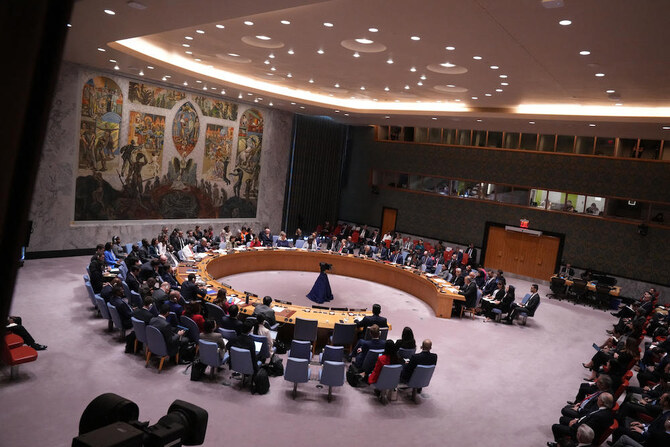
Britain calls UN meeting on Gaza, may sanction Israeli ministers

Britain and France have called an urgent meeting at the United Nations Security Council to discuss the humanitarian situation in Gaza. (AFP file photo)
Short Url
Updated 16 October 2024
Follow

Britain calls UN meeting on Gaza, may sanction Israeli ministers

  • British Foreign Secretary David Lammy says Israel must ensure civilians were protected and routes were open to allow life-saving aid through
  • Britain looking at sanctioning Israeli finance minister Bezalel Smotrich and national security minister Itamar Ben-Gvir over comments they had made about the conflict

LONDON: Britain and France have called an urgent meeting at the United Nations Security Council to discuss the humanitarian situation in Gaza and Britain is considering sanctioning two Israeli ministers, Prime Minister Keir Starmer said on Wednesday.
Reuters reported earlier this month that food supplies to Gaza had fallen sharply in recent weeks after Israeli authorities introduced a new customs rule, and the United States said the humanitarian situation must improve or Israel could face potential restrictions on US military aid.
“We are constantly making representations on this with our partners,” Starmer told parliament, when asked about the situation. “There is an urgent need, and has been now for a very long time, for more aid to get into Gaza.”
British Foreign Secretary David Lammy said in a statement Israel must ensure civilians were protected and routes were open to allow life-saving aid through, and that the United Nations meeting would address these issues. He said Algeria had also joined the call for the urgent meeting.
Starmer also said that Britain was looking at sanctioning Israeli finance minister Bezalel Smotrich and national security minister Itamar Ben-Gvir over comments they had made about the conflict.
Previous foreign secretary David Cameron was also reportedly looking at sanctioning the pair before the then-governing Conservative Party lost an election in June.
Asked if his government would sanction Smotrich over comments that starving civilians in Gaza might be justified and Ben-Gvir for saying perpetrators of settler violence in the West Bank were heroes, Starmer said: “We are looking at that because they’re obviously abhorrent comments.”
“Israel must take all possible steps to avoid civilian casualties, to allow aid into Gaza in much greater volumes and provide the UN humanitarian partners the ability to operate effectively,” Starmer said.
“Along with France, the UK will convene an urgent meeting of the UN Security Council to address this.”


Ireland’s defense gaps exposed as EU presidency nears

Cathal Berry, former Irish army special forces member, on The Curragh plain. (AFP)
Updated 7 sec ago
Follow

Ireland’s defense gaps exposed as EU presidency nears

  • Militarily neutral Ireland is not a NATO member, yet its waters — seven times its landmass — account for around 16 percent of the EU’s total

THE CURRAGH: Sheep amble around steel fences skirting Ireland’s largest military base on a grassy plain west of Dublin, a bucolic scene masking an underfunded defense force struggling with outdated equipment.

Ireland’s threadbare military and its long-standing policy of neutrality are under heightened scrutiny as the country prepares to assume the rotating EU presidency from July.

“Ireland is the only EU country with no primary radar system, nor have we sonar or anti-drone detection equipment — let alone the ability to disable drones,” said former Irish special forces member Cathal Berry.

“We can’t even monitor the airspace over our capital city and main airport,” he said as he surveyed Ireland’s main military base at The Curragh.

Militarily neutral Ireland is not a NATO member, yet its waters — seven times its landmass — account for around 16 percent of the EU’s total.

Nearly three-quarters of transatlantic subsea cables run close to or beneath them.

But the Irish army numbers only a few thousand troops, is focused largely on UN peacekeeping missions and has neither a combat air force nor a sizeable navy.

Ireland’s annual defense spending of roughly €1.2 billion is the lowest in Europe at around 0.2 percent of the GDP, well below the EU average of 1.3.

“Neutrality itself is actually a fine policy. If you want to have it, it must be defended,” said retired Irish army colonel Dorcha Lee.

“That’s the whole point. Undefended neutrality is absolutely definitely not the way to go.”

Berry points to a long-standing “complacency” about defense in Ireland that has fueled a vacuum in debate over neutrality and military spending.

“If you wanted to squeeze the EU without any risk of NATO retaliation, Ireland is where you’d come,” he said, adding that also applied to US interests in Europe.

US tech giants like Google, Apple and Meta have their European headquarters in Ireland, supported by vast data centers that analysts say are vulnerable to cyberattacks.

European Council President Antonio Costa said he was still “confident” Ireland could protect EU summits during its presidency.

Defense Minister Helen McEntee has pledged that new counter-drone technology will be in place by then.

Speaking in front of a row of aging army vehicles at the Curragh military site, she also announced a broader increase in military spending, although the actual details remain unclear.

On Dec. 17, the Irish government said it plans to buy a military radar system from France at a reported cost of between €300 and €500 million (around $350-$585 million).

For Paul Murphy, a left-wing opposition member of parliament, “scaremongering over allegedly Russian drones with concrete evidence still unprovided” is

giving the government cover to steer Ireland away from neutrality toward NATO.

“But it’s more important than ever that we’re genuinely neutral in a world that is increasingly dangerous,” he told AFP.

Ireland has historically prioritized economic and social spending over defense investment, he said.

“Joining an arms race that Ireland cannot compete in would waste money that should be spent on real priorities like climate change,” he added.

Pro-neutrality sentiment still holds sway among the Irish public, with an Irish Times/Ipsos poll earlier this year finding 63 percent of voters remained in favor of it.

And very few voices in Ireland are calling to join NATO.

Left-winger Catherine Connolly, who won Ireland’s presidential election in October by a landslide, is seen as a pacifist.

“I will be a voice for peace, a voice that builds on our policy of neutrality,” she said in her victory speech.