ROME: Italian Prime Minister Giorgia Meloni on Tuesday brushed aside criticism of a controversial deal to send migrants for processing in Albania, a European first which other European leaders are watching closely.
Italy on Monday began transferring the first migrants to the centers — 16 men from Egypt and Bangladesh — who are due to arrive Wednesday.
“It is a new, courageous, unprecedented path, but one that perfectly reflects the European spirit and has everything it takes to be followed also with other non-EU nations,” Meloni said.
The scheme comes ahead of a European Union summit in Brussels this week, where migration is on the table.
In a letter to member states ahead of the talks, European Commission chief Ursula von der Leyen said the bloc would “be able to draw lessons from this (Albania) experience in practice.”
Italy’s two processing centers in Albania will be operated under Italian law, with Italian security and staff, and judges hearing cases by video from Rome.
But human rights groups question whether there will be enough protection for asylum seekers.
“The first people to arrive in Italy’s new detention centers deserve better than to be subject to this dangerous political experiment,” said Susanna Zanfrini, Italy director for the International Rescue Committee, a humanitarian organization.
“Even as the doors open on these new facilities, some huge questions remain unanswered about how Italy will ensure that people’s rights are safeguarded outside of the EU’s jurisdiction.”
Italy’s Mediterranean coast has long been a target for migrants hoping to reach Europe.
Meloni’s post-fascist Brothers of Italy party promised to halt the arrivals during 2022 national elections.
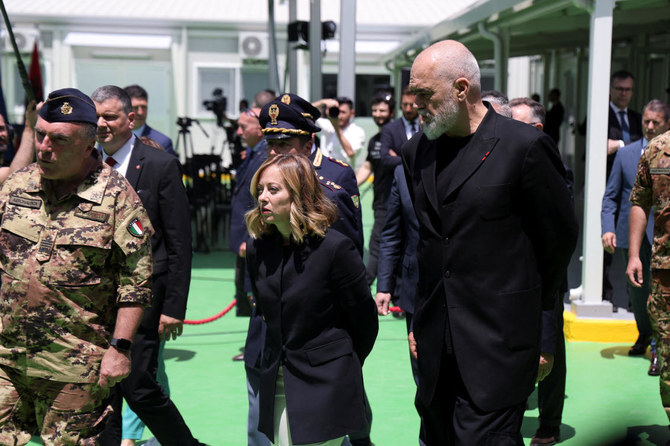
She agreed with Albanian Prime Minister Edi Rama in November 2023 to open the asylum centers.
Addressing the Senate in Rome, Meloni said her government was setting a “good example” to other countries on how to tackle irregular migration.
She added that Italy would organize an informal meeting at the EU summit ” between the member states most interested in the migration issue.”
At talks in Luxembourg on Tuesday on Albania’s negotiations to eventually join the EU, Rama said, however, that his deal with Italy may not be easily replicated by other countries.
“We have been asked by others and we have said no,” he told reporters, pointing to the long history of close Italy-Albania ties.
The five-year deal, estimated to cost Italy 160 million euros ($175 million) annually, covers certain adult male migrants intercepted on Italian boats in international waters, but within Italy’s search and rescue area.
Those sent to Albania will be from countries deemed “safe” — a debated criterion but one that allows for a more simplified repatriation process.
Critics say the numbers that can be processed in Albania at any one time — initially put at around 3,000 by Rome, but now reported to be much lower — will have little impact on overall numbers.
“In the last three days, more than 1,600 migrants have landed in Italy. An Italian ship is transporting 16 of them to Albania,” noted Matteo Villa, a researcher at the ISPI think tank.
Almost 160,000 migrants landed on Italian shores last year, up from 105,000 the year before, according to interior ministry data.
Numbers have sharply fallen in 2024, with 54,000 arrivals recorded so far, compared to almost 140,000 in the same period in 2023.
However, the government hopes that intercepting people at sea and sending them to Albania before they reach Italy will act as a deterrent.
Rome has also moved to limit the activities of charity ships that rescue migrants in the Central Mediterranean.
Under the new scheme, migrants will first arrive at a center in the northern Albanian port of Shengjin for registration and health checks. They will then go to a center in nearby Gjader to await processing of their asylum claims.
The Gjader facility — a maze of prefabricated buildings surrounded by high walls and police guards — includes a section for migrants whose asylum applications have been rejected, as well as a small jail.


![]()

Italian PM hails ‘courageous’ Albania migrant deal
Short Url
https://arab.news/23wzp
Italian PM hails ‘courageous’ Albania migrant deal
- “It is a new, courageous, unprecedented path, but one that perfectly reflects the European spirit,” Meloni said
- The scheme comes ahead of a European Union summit in Brussels this week, where migration is on the table


Latest updates


© 2026 SAUDI RESEARCH & PUBLISHING COMPANY, All Rights Reserved And subject to Terms of Use Agreement.