Israeli attack on school shelter in Gaza City kills 5 Palestinians, hospital chief says

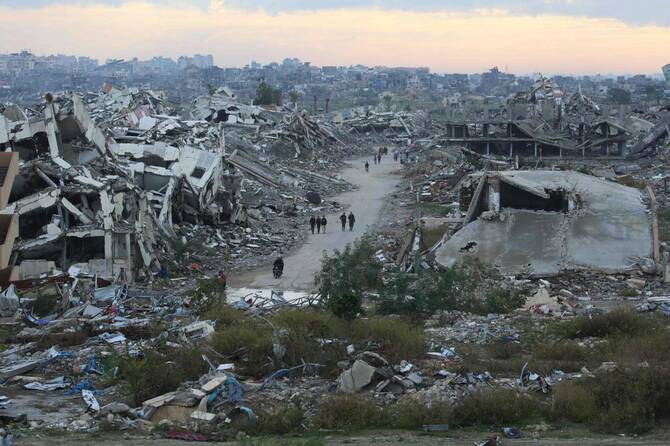
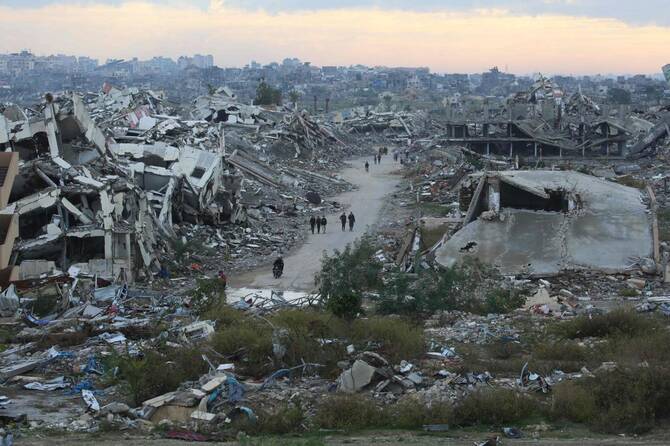
A general view of destroyed houses in Nuseirat camp in the central Gaza Strip on Dec. 19, 2025. (AFP)
Short Url
Updated 20 December 2025
Follow

Israeli attack on school shelter in Gaza City kills 5 Palestinians, hospital chief says

  • Bassal said the “five martyrs have been recovered as a result of the Israeli shelling of the shelter at the Gaza Martyrs School“
  • “Shortly after identification, the troops fired at the suspicious individuals to eliminate the threat,” the military said

GAZA CITY, Palestinian Territories: Gaza’s civil defense agency said Israeli shelling on a school-turned-shelter killed five people on Friday, while the military said it had fired at “suspicious individuals.”
Spokesman for the agency, Mahmud Bassal, told AFP that “five martyrs have been recovered as a result of the Israeli shelling of the shelter at the Gaza Martyrs School,” in the Tuffah neighborhood east of Gaza City.
When asked by AFP about the incident, the Israeli military said that “during operational activity in the area of the Yellow line in the northern Gaza Strip, a number of suspicious individuals were identified in command structures west of the Yellow line.”
Under the US-brokered ceasefire between Israel and Hamas in Gaza, Israeli forces have withdrawn to positions east of the so-called Yellow Line.
“Shortly after identification, the troops fired at the suspicious individuals to eliminate the threat,” the military said, adding that it was “aware of the claim regarding casualties in the area, and the details are under review.”
“The (Israeli military) regrets any harm to uninvolved individuals and operates to mitigate harm to the extent possible,” it said.
The ceasefire, which came into effect in October, remains fragile with both sides alleging violations, and mediators fearing that Israel and Hamas alike are stalling.
US President Donald Trump’s special envoy, Steve Witkoff, was to meet officials from Qatar, Egypt and Turkiye in Florida on Friday, hoping to salvage efforts to reach the second stage of the deal.
“Our people expect these talks to result in an agreement to put an end to ongoing Israeli lawlessness, halt all violations and compel the occupation to abide by the Sharm El-Sheikh agreement,” Hamas political bureau member Bassem Naim told AFP.
The health ministry in Gaza said on Thursday that at least 395 Palestinians have been killed by Israeli fire in the territory since the ceasefire came into effect on October 10.
Israel has also repeatedly accused Hamas of violating the ceasefire, with the military reporting three soldiers killed in the territory since the truce entered into force.


Battered by Gaza war, Israel’s tech sector in recovery mode

Updated 6 sec ago
Follow

Battered by Gaza war, Israel’s tech sector in recovery mode

  • “High-tech companies had to overcome massive staffing cuts, because 15 to 20 percent of employees, and sometimes more, were called up” to the front as reservists, IIA director Dror Bin told

JERUSALEM: Israel’s vital tech sector, dragged down by the war in Gaza, is showing early signs of recovery, buoyed by a surge in defense innovation and fresh investment momentum.
Cutting-edge technologies represent 17 percent of the country’s GDP, 11.5 percent of jobs and 57 percent of exports, according to the latest available data from the Israel Innovation Authority (IIA), published in September 2025.
But like the rest of the economy, the sector was not spared the knock-on effects of the war, which began in October 2023 and led to staffing shortages and skittishness from would-be backers.
Now, with a ceasefire largely holding in Gaza since October, Israel’s appeal is gradually returning, as illustrated in mid-December, when US chip giant Nvidia announced it would create a massive research and development center in the north that could host up to 10,000 employees.
“Investors are coming to Israel nonstop,” Prime Minister Benjamin Netanyahu said at the time.
After the war, the recovery can’t come soon enough.
“High-tech companies had to overcome massive staffing cuts, because 15 to 20 percent of employees, and sometimes more, were called up” to the front as reservists, IIA director Dror Bin told AFP.
To make matters worse, in late 2023 and 2024, “air traffic, a crucial element of this globalized sector, was suspended, and foreign investors froze everything while waiting to see what would happen,” he added.
The war also sparked a brain drain in Israel.
Between October 2023 and July 2024, about 8,300 employees in advanced technologies left the country for a year or more, according to an IIA report published in April 2025.
The figure represents around 2.1 percent of the sector’s workforce.
The report did not specify how many employees left Israel to work for foreign companies versus Israeli firms based abroad, or how many have since returned to Israel.

- Rise in defense startups -

In 2023, the tech sector far outpaced GDP growth, increasing by 13.7 percent compared to 1.8 percent for GDP.
But the sector’s output stagnated in 2024 and 2025, according to IIA figures.
Industry professionals now believe the industry is turning a corner.
Israeli high-tech companies raised $15.6 billion in private funding in 2025, up from $12.2 billion in 2024, according to preliminary figures published in December by Startup Nation Central (SNC), a non-profit organization that promotes Israeli innovation.
Deep tech — innovation based on major scientific or engineering advances such as artificial intelligence, biotech and quantum computing — returned in 2025 to its pre-2021 levels, according to the IIA.
The year 2021 is considered a historic peak for Israeli tech.
The past two years have also seen a surge in Israeli defense technologies, with the military engaged on several fronts from Lebanon and Syria to Iran, Yemen, Gaza and the occupied West Bank.
Between July 2024 and April 2025, the number of startups in the defense sector nearly doubled, from 160 to 312, according to SNC.
Of the more than 300 emerging companies collaborating with the research and development department of Israel’s defense ministry, “over 130 joined our operations during the war,” Director General Amir Baram said in December.
Until then, the ministry had primarily sourced from Israel’s large defense firms, said Menahem Landau, head of Caveret Ventures, a defense tech investment company.
But he said the war pushed the ministry “to accept products that were not necessarily fully finished and tested, coming from startups.”
“Defense-related technologies have replaced cybersecurity as the most in-demand high-tech sector,” the reserve lieutenant colonel explained.
“Not only in Israel but worldwide, due to the war between Russia and Ukraine and tensions with China.”