Pakistan seizes US-made weapons worth Rs35 million at border with Afghanistan — security sources

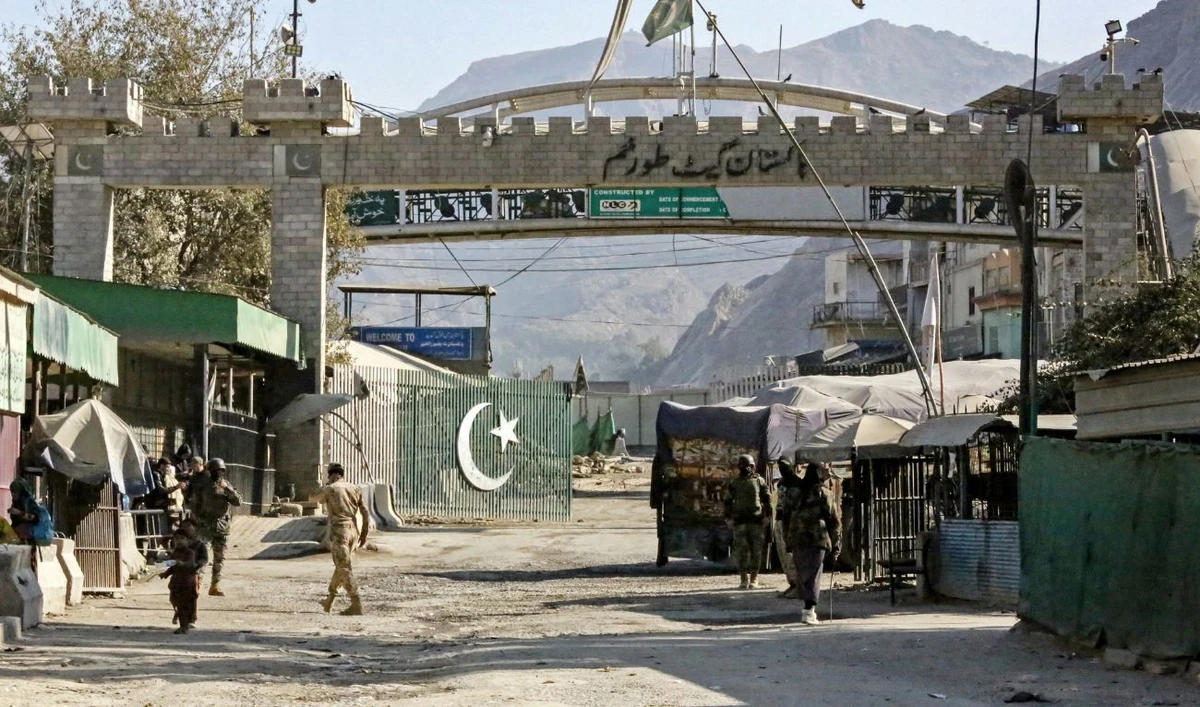
Border security personnel of Afghanistan and Pakistan stand guard at the zero point Torkham border crossing between the two countries, in Nangarhar province on January 15, 2024. (AFP/File)
Short Url
Updated 14 October 2024
Follow

Pakistan seizes US-made weapons worth Rs35 million at border with Afghanistan — security sources

  • The weapons were seized at the Torkham border crossing in Pakistan’s Khyber Pakhtunkhwa province that has witnessed a surge in militant attacks
  • Pakistan blames the surge in attacks on Pakistani Taliban and other militants operating out of neighboring Afghanistan, Kabul denies the allegation

ISLAMABAD: Pakistan’s custom authorities have seized a large cache of US-made weapons and ammunition worth approximately Rs35 million ($125,000) at a border crossing between Pakistan and Afghanistan, Pakistani security sources said on Monday.
The weapons seized at the Torkham border crossing in Pakistan’s northwestern Khyber Pakhtunkhwa (KP) province included M4 rifles and magazines, according to the security sources.
The smuggling of US leftover weapons from Afghanistan into Pakistan exposes the Afghan Taliban’s struggle with weak governance and poses a “threat to regional stability.”
“The recent seizure of US-made weapons raises concerns about potential Taliban support for TTP [Tehreek-e-Taliban Pakistan], either directly or indirectly, as a strategic move to pressure Pakistan or assert influence in the region,” the sources said.
“The rising activity of terrorist groups in Afghanistan risks destabilizing the entire region, potentially leading to increased violence, displacement, and economic hardship.”
Pakistan has seen a rise in militant attacks, mostly in KP, by the outlawed TTP and other militant groups, which have targeted security forces convoys and check posts, and carried out targeted killings and kidnappings of law enforcers and government officials in recent months.
Islamabad blames Kabul for facilitating anti-Pakistan militants and says it has consistently taken up the issue of cross-border attacks with the Taliban administration. The Taliban deny allowing the use of Afghan soil for attacks against any country.
“Afghanistan’s situation has far-reaching implications for international security,” the Pakistani security sources said. “The presence of terrorist groups and IAG’s [interim Afghan government] persistent denial of the reality could fuel global terrorism and threaten regional stability.”
Islamabad steps up vehicle checks to boost security as 166,000 cars get electronic tags

Updated 18 January 2026
Follow

Islamabad steps up vehicle checks to boost security as 166,000 cars get electronic tags

  • Authorities say over 3,000 vehicles registered in past 24 hours as enforcement intensifies
  • Extended service hours introduced to push full compliance with digital monitoring system

ISLAMABAD: Authorities in the Pakistani capital have intensified enforcement against vehicles without mandatory electronic tags with more than 166,000 cars now registered, according to data released on Sunday evening, as Islamabad moves to strengthen security and digital monitoring at key entry and exit points.

The Islamabad Capital Territory (ICT) administration introduced the electronic tagging system late last year as part of a broader effort to regulate traffic, improve record-keeping and enhance surveillance in a city that hosts the country’s main government institutions, foreign missions and diplomatic enclaves.

Under the system, vehicles are fitted with electronic tags that can be read automatically by scanners installed at checkpoints across the capital, allowing authorities to identify unregistered vehicles without manual inspections. Vehicles already equipped with a motorway tag, or m-tag, are exempt from the requirement.

“A total of 166,888 vehicles have successfully been issued M-Tags so far, including 3,130 vehicles in the last 24 hours,” the ICT administration said, according to the Excise Department.

Officials said readers installed at checkpoints across Islamabad are fully operational and are being used to stop vehicles still without tags, as enforcement teams carry out checks across the city.

To facilitate compliance, authorities have expanded installation facilities and extended operating hours. The Excise Department said m-tag installation is currently available at 17 booth locations, while select centers have begun operating beyond normal working hours.

According to Director General Excise Irfan Memon, m-tag centers at 26 Number Chungi and 18 Meel are providing services round the clock, while counters at Kachnar Park and F-9 Park remain open until midnight to accommodate motorists unable to visit during daytime hours.

Officials said the combination of enforcement and facilitation was aimed at achieving full compliance with minimal disruption, adding that operations would continue until all vehicles operating in the capital are brought into the system.

The enforcement drive builds on a wider push by the federal government to integrate traffic management, emergency response and security monitoring through technology-driven “safe city” initiatives. Last month, Interior Minister Mohsin Naqvi reviewed Islamabad’s surveillance infrastructure and said reforms in monitoring systems and the effective use of technology were the “need of the hour.”

Authorities have urged motorists to obtain electronic tags promptly to avoid delays and penalties at checkpoints as enforcement continues across the capital.