

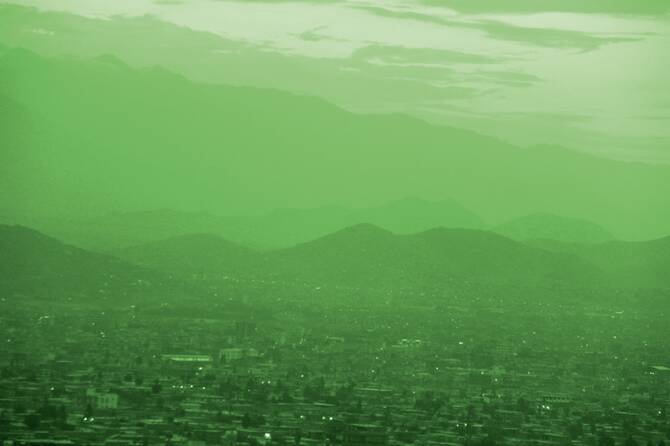

Aziz Harara

‘Shab Nama I (Night Chronicles)’
In this video installation — a new commission for the biennale — the Afghan artist “reconstructs landscapes at night using both existing and generated data extracted from the circuit boards of abandoned military night-vision goggles,” the biennale catalogue explains. The installation is Harara’s exploration of the strategy of “plausible deniability,” defined in the catalogue as “a state strategy of manufacturing ambiguity to deny involvement in events.” The green images generated by night-vision goggles and other surveillance equipment intended for use in the dark have become a movie and TV trope over recent decades, but here Hazara “subverts the imperial tool of surveillance … to point towards the intangible cumulative trauma of decades of conflict experienced by generations of people, while simultaneously being sensationalized in mainstream media.” The work also uses the “metaphor of the night” as “a dual space of communal life and violence, transforming it into a site of resistance where fiction and humor counter the official record.”
Sarker Protick

From his ‘AWNGAR’ series
The Bangladeshi artist uses photography, video, and audio in his practice to create “abstract, sensorial, and experimental works tracing the sociopolitical cartography of Bangladesh and its historical region, Bengal.” This image is from a series taken in present-day West Bengal, India, and Bangladesh in which Protick “examines the ruins of the British Empire and today’s late capitalism through a documentation of coal mines and disused railway lines … Subverting the familiar image production of colonial geological surveys, as well as ‘exotic’ and ‘picturesque’ British aesthetics, Protick captures dystopian landscapes clouded in dust, denouncing extractivism as the imperial and geopolitical origin of the climate crisis,” the show catalogue states. “Protick captures terrains marked by combustion, displacement, and exhaustion … These are landscapes altered not only by time and pressure, but by the greed of capitalist enterprise.”
Raven Chacon

‘For Zitkála-Šá’
The Navajo artist is perhaps best known as a composer, having won the 2022 Pulitzer Prize for Msuic for his composition “Voiceless Mass.” He has, the biennale catalogue notes, “long been committed to supporting indigenous composers, performers, and knowledge bearers, while exploring ways to unsettle the conventions of Western music traditions through composition and collective practice.” His work at the biennale is a series of 12 prints of single-page graphic scores that are “dedicated to contemporary Indigenous American, First Nations, and mestiza women working in music, composition, and sound art.” The work “honors the Yankton Sioux composer and musician Zitkála-Šá (1876-1938), whose creative life spanned music, literature, political organizing, and community building.” Chacon has said of graphic scores that they “resist the history of Western notation, and with that can also eliminate normalizations and assumptions of time that influence how we see the universe.”
Rajesh Chaitya Vangad

‘Untitled’
Vangad practices Warli painting, a traditional artform of the Warli people, native to the west of India along the Gujarat-Maharashtra border. “Created in ritual settings to commemorate weddings, harvests and festivals, Warli paintings often depict festivals and dances that convey the interconnectedness of humans with nature and the cosmos,” the biennale catalogue explains. In his untitled large-scale painting from 2018 — detail of which is shown here — Vangad focuses on the tarpa — the name of both a wind instrument and a dance performed to celebrate the harvest. “A spiraling movement unravels from the tarpa player at its center, whose music … guides a procession of dancing figures — human and nonhuman — moving in synchrony.”
Pacita Abad

‘Typhoon’
The late Filipina-American artist’s work, the biennale catalogue states, “was profoundly shaped by her nomadic life — over her 32-year career she lived, traveled, and worked across Asia, Africa, the Americas, and Oceania.” This 1990 work comes from her series “Asian Abstractions,” created between 1983 and 1992, and begun following her training in traditional Korean ink painting, which she adapted to her trapunto technique of using quilted paintings of stuffed and stitched canvases, embellished with textiles, mirrors, buttons, and other materials. She once said of her practice: “I always see the world through color, although my vision, perspective and paintings are constantly influenced by new ideas and changing environments.”


