

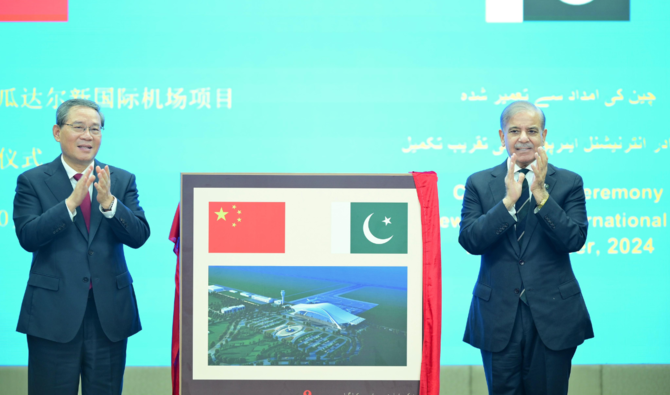

ISLAMABAD: Chinese Premier Li Qiang virtually inaugurated on Monday a Chinese-funded airport in Pakistan’s Balochistan province, saying it would bring more investment and trade opportunities to the South Asian country.
The start of operations at the $200-million Gwadar International Airport had been delayed amid deadly attacks by separatist militants in the southwestern Pakistani province in recent months.
Li inaugurated the airport alongside Pakistani Prime Minister Shehbaz Sharif during his visit to Islamabad to attend a summit of the Shanghai Cooperation Organization (SCO) on Oct 15-16.
This marks the first visit by a Chinese prime minister to Pakistan in 11 years. Li is leading a high-level delegation of ministers and officials on the visit that runs from October 14 till October 17.
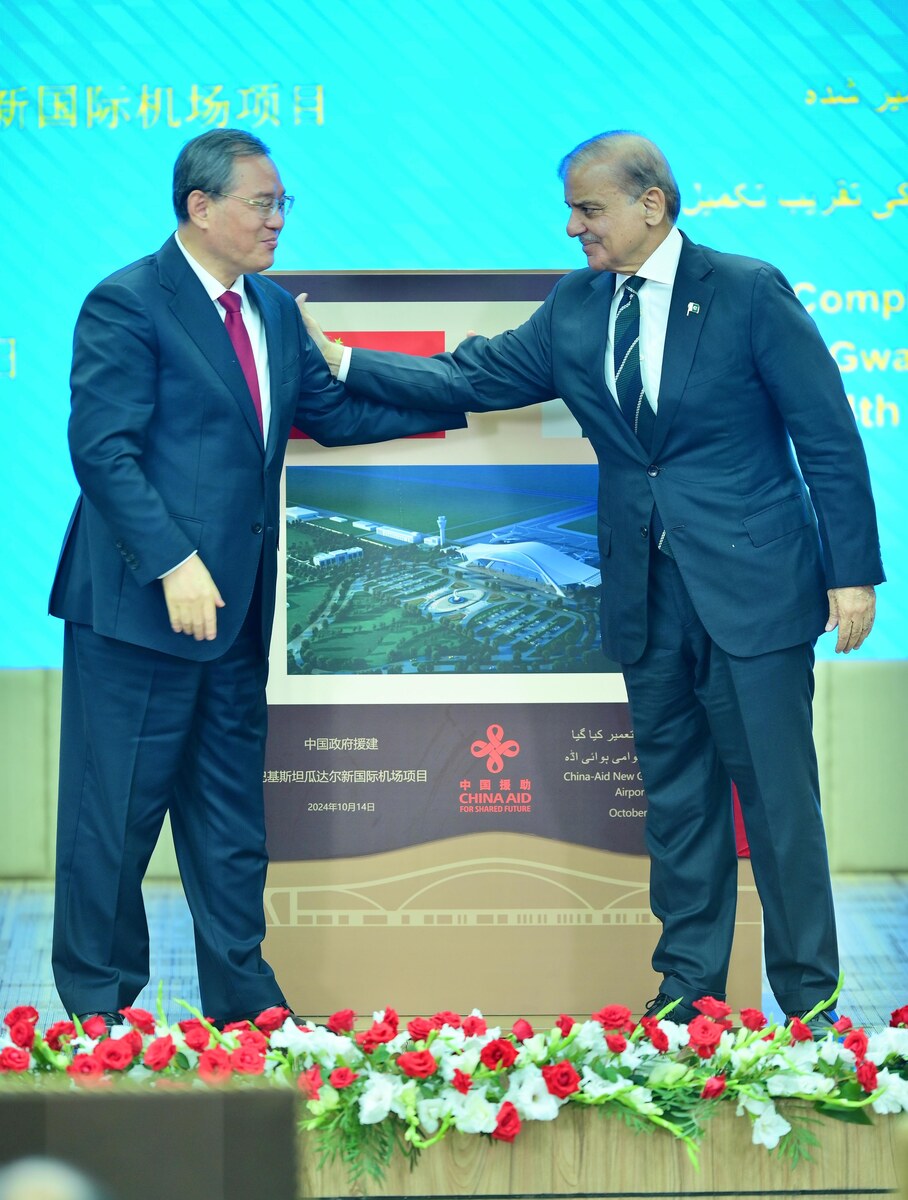
Prime Minister Shehbaz Sharif (R) and Chinese Premier Li Qiang shake hands after unveiling a plaque to mark the completion of New Gwadar International Airport in Islamabad, Pakistan on October 14, 2024. (PMO)
“I believe that the inauguration of the new airport will significantly enhance the security of the Gwadar region, capitalize integration of port shipping and bring more investment and trade opportunities to Pakistan’s western regions,” the Chinese premier said, while addressing the inauguration ceremony.
China, a key regional ally and investor, has invested billions in Pakistan through the China-Pakistan Economic Corridor (CPEC), a network of transport, energy and infrastructure projects aimed at enhancing regional trade and connectivity.
Li said through the concerted efforts of both sides, CPEC had produced significant outcomes and played a positive role in Pakistan’s economic and social development as well as regional integration.
“China will continue to work with Pakistan to uphold the principle of planning together, building together and benefiting together, engaging in open, green and clean cooperation and pursue the goal of high standard people sustainability in order to make the model project of high-quality Belt and Road cooperation,” he said.
Speaking at the ceremony, Sharif said the new international airport would not only transform the economy of Gwadar, a port city in Balochistan that lies at the heart of CPEC, but also positively impact Pakistan’s overall economy.
“I want to assure you that I will work with you very closely, not only to promote CPEC’s second phase, but also to promote peace and security for the people of China and Pakistan,” he added.
MoU signing
In a televised ceremony, the two prime ministers witnessed the signing of several memorandums of understanding (MoUs), agreements and protocols aimed at enhancing cooperation between Pakistan and China in various fields.
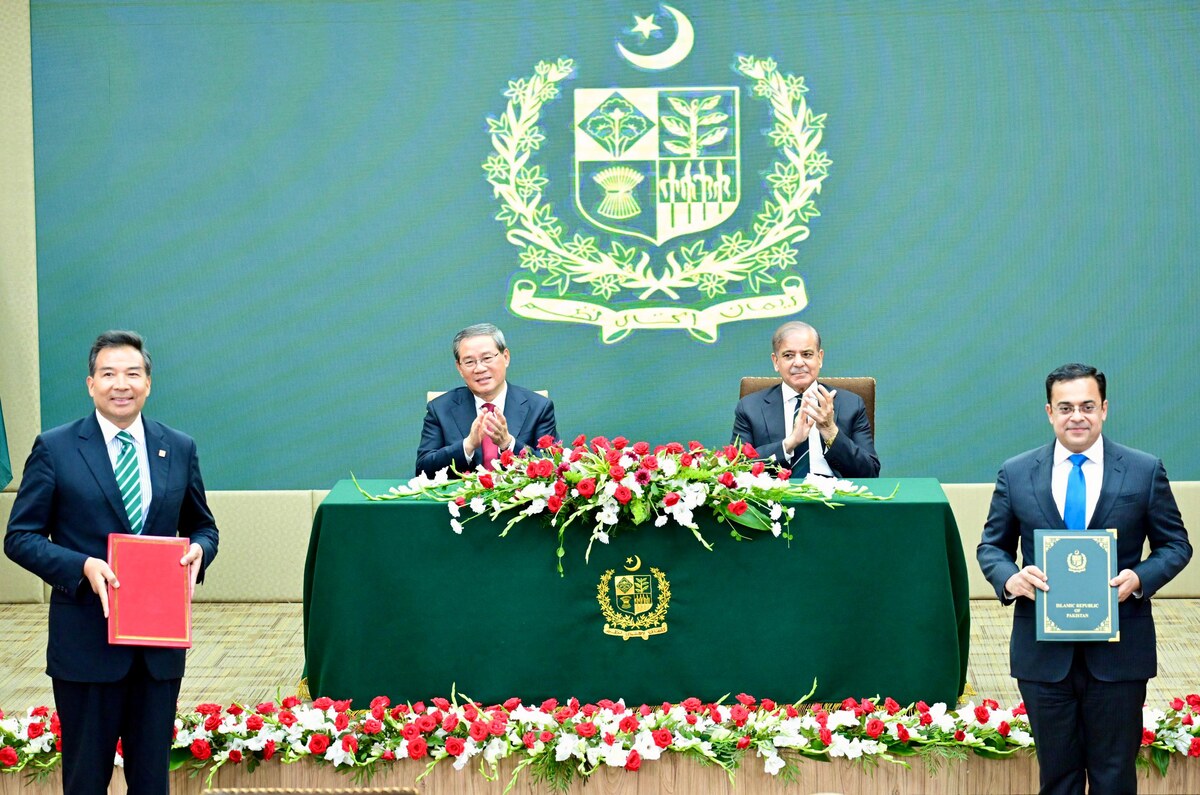
Prime Minister Shehbaz Sharif (2nd right)) and Chinese Premier Li Qiang (2nd left) witness the signing of several memorandums of understanding (MoUs), in Islamabad, Pakistan on October 14, 2024. (PMO)
The agreements were aimed at promoting cooperation within the CPEC Livelihood Working Group, strengthening collaboration in information and communication technology, advancing cooperation on water conservancy facilities, flood control and disaster reduction, enhancing security cooperation, and supporting the construction of joint laboratories.
Additionally, agreements on a currency swap between the People’s Bank of China and the State Bank of Pakistan as well as co-production of television programs were also reached between the two countries.
“Exchange of MoUs between Pakistan and China in agriculture, commerce and other fields will shape into agreements very soon through joint efforts of both the countries,” Sharif said, after the signing ceremony.
The Pakistan prime minister’s office said Sharif and his Chinese counterpart also held a delegation-level meeting and discussed all aspects of bilateral relations as well as regional and global issues of mutual interest.
“The two leaders reiterated their support for each other on all core issues and expressed their commitment for high-quality development of China-Pakistan Economic Corridor (CPEC) Phase 2,” Sharif’s office said, adding that both leaders emphasized on the need for timely completion of all ongoing projects.
Sharif also assured Premier Li of Pakistan’s commitment to ensure the safety of Chinese residents and projects in Pakistan, it added.


