


ISLAMABAD: Chinese Premier Li Qiang arrived in Islamabad on Monday to oversee the signing of bilateral trade and economic agreements with Pakistan, inaugurate a key international airport in the southwestern Balochistan province and attend the upcoming Shanghai Cooperation Organization (SCO) summit in the capital, the Prime Minister’s Office said.
Qiang’s visit to Pakistan makes it the first time in 11 years that a Chinese prime minister has arrived in Pakistan on a bilateral visit. The Chinese premier is leading a high-level delegation comprising ministers and officials from the ministries of foreign affairs and commerce, the National Development and Reform Commission and the China International Development Cooperation Agency in his visit to China from Oct. 14-17.
China is a major regional ally and investor that has funneled billions of dollars into Pakistan over the years for projects part of the China-Pakistan Economic Corridor (CPEC). CPEC is a multi-billion-dollar transport, energy and infrastructure network that links Pakistan’s deep-sea ports to Chinese cities to bolster regional trade and commercial activity.
“The Chinese prime minister will hold a meeting today with Prime Minister Sharif followed by delegation-level talks at the PM House,” the PMO said in a statement. “Both the prime ministers will participate in the signing ceremony of the Memorandum of Understanding regarding China-Pakistan cooperation, which includes CPEC-2 as well as other major projects.”

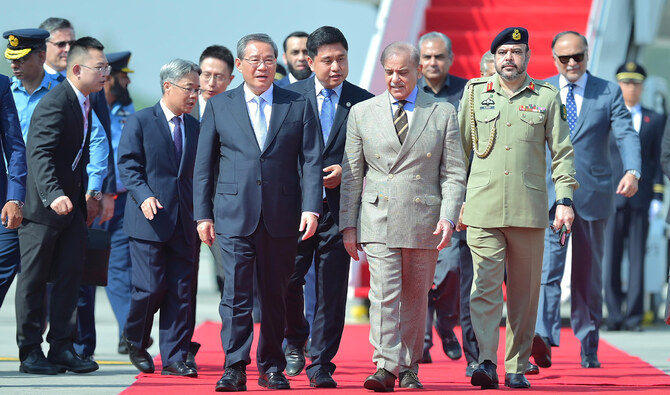
Pakistani PM Shahbaz Sharif (right) receives Chinese premier Li Qiang upon his arrival in Pakistan on October 14, 2024. (Government of Pakistan)
In a televised ceremony, Sharif and key members of his cabinet could be seen welcoming the Chinese prime minister after his aircraft landed in the capital. Deputy Prime Minister Ishaq Dar, Planning Minister Ahsan Iqbal, Interior Minister Mohsin Naqvi and Information Attaullah Tarar were some of the officials who received the Chinese delegation with Sharif.
Sharif’s office said the signing ceremony will also include the virtual inauguration of the Gwadar International Airport, located in Pakistan’s southwestern port city of Gwadar. The China-funded airport will handle domestic and international flights, Pakistan’s Civil Aviation Authority has said, and will be one of the country’s biggest airports.
Qiang will also meet Pakistan’s President Asif Ali Zardari and the country’s senior military leadership during his visit, and attend the upcoming Shanghai Cooperation Organization (SCO) Council of Heads of Government summit from Oct. 15-16 in Islamabad.
Qiang’s visit to Pakistan takes place in the backdrop of the Oct. 6 suicide attack near the Karachi airport. Two Chinese engineers were killed while 10 others were injured in the suicide attack claimed by the separatist militant group Baloch Liberation Army (BLA).
A decades-long insurgency in Balochistan by separatist militant groups has led to frequent attacks against the government, army and Chinese interests in the region to press demands for a share in mineral-rich regional resources. China has frequently urged Pakistan to ensure security for its citizens.
SCO SUMMIT
The recent surge in attacks in Pakistan’s southwestern and northwestern provinces has put Pakistan’s security under the microscope, especially a day before the SCO summit kicks off.
The SCO CHG is the second-highest forum within the inter-governmental organization, which focuses on fostering cooperation among member states in socio-economic, trade, and financial sectors.
The council meets once a year to discuss multilateral cooperation between member states and priority areas within the organization, determine fundamental and topical issues in economic and other spheres, and approve the SCO budget.
The last SCO CHG meeting was held in Bishkek on Oct. 26, 2023, during which Pakistan assumed the rotating chair of the platform.
Apart from Qiang, the summit will be attended by Russian Prime Minister Mikhail Mishustin, Prime Minister of Belarus Roman Golovchenko, Prime Minister of Kazakhstan Olzhas Bektenov, Kyrgyz Prime Minister Akylbek Japarov, Prime Minister of Tajikistan Kokhir Rasulzoda, Uzbek Prime Minister Abdulla Aripov, First Iranian Vice President Mohammadreza Aref, and Indian External Affairs Minister Subrahmanyam Jaishankar.
Other participants include Prime Minister of Mongolia Oyun-Erdene Luvsannamsrai as an observer and deputy chairman of the cabinet of ministers and foreign ministers of Turkmenistan, Rashid Meredov, as a special guest.


