Pakistan says it is targeting militant infrastructure in Afghanistan as Kabul threatens to hit Islamabad

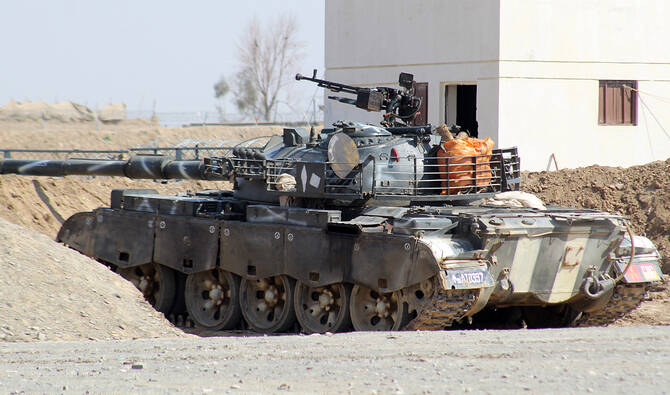
A Pakistani army tank stands at the Pakistan-Afghanistan border in Chaman, Balochistan province on March 4, 2026, amidst the ongoing clashes between the two countries. (AFP/File)
Short Url
Updated 07 March 2026
Follow

Pakistan says it is targeting militant infrastructure in Afghanistan as Kabul threatens to hit Islamabad

  • Ata Tarar says Pakistan is carrying out ‘precise intelligence-based operations’ to avoid civilian casualties
  • Afghan defense minister says the underlying dispute between the two sides is over the ‘Durand Line’ border

ISLAMABAD: Pakistan said on Saturday it was conducting intelligence-based operations against militant infrastructure inside Afghanistan while attempting to avoid civilian casualties, as a senior Afghan Taliban official warned Kabul could retaliate by targeting Islamabad if Pakistani forces struck the Afghan capital.

The escalating rhetoric comes as cross-border fighting between the two neighbors intensifies following clashes that began last month when Afghan forces launched attacks on Pakistani military installations along the frontier. Kabul said the assault was retaliation for Pakistani airstrikes targeting what Islamabad called militant camps inside Afghanistan.

Pakistan’s defense minister Khawaja Muhammad Asif said last week the situation had effectively become “open war” between the two countries.

“Pakistan is only targeting terrorist infrastructures and support system with precise intelligence based operations ensuring no collateral damage takes place,” Pakistan’s Information Minister Ataullah Tarar said in a statement.

He challenged the recent claims made by an Afghan defense ministry spokesperson earlier this week who said his country was making significant battlefield gains against Pakistan including the killing of 109 soldiers and the capture or destruction of 14 military posts in large scale attacks.

“These so called attacks by Afghan Taliban in coordination with FAK [Fitna Al Khawarij] Terrorists once again confirm the nexus of Afghan Taliban regime and multiple terrorist organizations operating from within their territory,” Tarar continued. “All such attempts are responded to, immediately and effectively with severe retributive punishment that is swift, precise and effective.”

“The imaginary numbers being floated by Afghan Taliban regime are however not worth any serious comment,” he added.

Tarar said Pakistan’s military campaign — described as Operation Ghazb Lil Haq — had inflicted heavy losses on Afghan Taliban forces.

According to figures shared by the minister, 527 Taliban fighters had been killed and more than 755 injured since the clashes began, while 237 check posts were destroyed and 38 captured and destroyed. He said 205 tanks, armored vehicles and artillery guns were destroyed and 62 locations across Afghanistan had been targeted by air strikes.

Arab News could not independently verify the claims made by either side.

CIVILIAN CASUALTIES

Earlier this week, the United Nations raised concern over the toll of the escalating conflict on civilians.

UN human rights chief Volker Turk said on Friday that 56 Afghan civilians — nearly half of them children — had been killed since hostilities between Pakistan and Afghanistan intensified.

However, Tarar questioned the UN findings, saying its assertions appeared to rely heavily on information provided by Taliban authorities and did not adequately reflect independently verified intelligence.

“Pakistan categorically reiterates that all counter-terrorism operations conducted by its security forces are carried out with the highest degree of precision, professionalism, and responsibility,” he said.

Islamabad has long accused the Taliban government of allowing militant groups, including the Tehreek-e-Taliban Pakistan (TTP), to operate from Afghan soil, a charge Kabul denies.

“Operations are meticulously planned so that civilian areas remain completely safe,” the minister said. “The locations targeted are remote terrorist hideouts and facilities far removed from populated zones, including sensitive areas such as Kabul’s Green Zone.”

AFGHAN WARNING

Meanwhile, Afghanistan’s Defense Minister Mullah Yaqoob issued a warning to Pakistan in remarks circulated by Afghan broadcaster TOLOnews.

“If Kabul lacks peace, there will be no peace in Islamabad. If Kabul is attacked, Islamabad will be attacked,” Yaqoob said in a promotional clip of an interview shared on social media.

Yaqoob rejected Pakistan’s justification that the presence of the TTP in Afghanistan warranted military action and suggested the underlying dispute was over the contested “Durand Line” border between the two countries.

So far, there has been no official response from Pakistan to Yaqoob’s remarks.


Pakistan announces four-day work week among austerity measures to offset impact of Middle East crisis

Updated 54 min 30 sec ago
Follow

Pakistan announces four-day work week among austerity measures to offset impact of Middle East crisis

  • The development comes as ongoing US-Israeli strikes on Iran disrupt oil supplies in Strait of Hormuz, push prices past $119 a barrel
  • Islamabad bans government purchases, cuts fuel allocation for vehicles as well as workforce in public and private offices by 50 percent

ISLAMABAD: Prime Minister Shehbaz Sharif on Monday announced austerity measures, including a four-day work week and cuts in government expenditures, to offset the impact of rising global oil prices due to an ongoing conflict in the Middle East.

Global fuel supply lines have been disrupted in the Strait of Hormuz, which supplies nearly a fourth of world oil consumption, after Tehran blocked it following United States-Israeli strikes on Iran and counterattacks against US interests in the Gulf region.

Oil prices surged more than 25 percent globally on Monday to $119.50 a barrel, the highest levels since mid-2022, as some major producers cut supplies and fears of prolonged shipping disruptions gripped the market due to the expanding US-Israeli war with Iran.

In his televised address on Sunday night, Sharif said global oil prices were expected to rise again in the coming days but vowed not to let the people bear their brunt, announcing austerity measures to lessen the impact of fuel price hikes.

“Fifty percent staff in public and private entities will work from home,” he announced, adding this would not be applicable to essential services. “Offices will remain open for four days a week. One-day additional off is being given to conserve oil, but it would not be applicable to banks.”

Sharif didn’t specify working days of the week and the government was likely to issue a notification in this regard.

He said a decrease of 50 percent was being made in fuel allocation for government vehicles immediately for the next two months, but they would not include ambulances and public buses.

“Cabinet members, advisers and special assistants will not draw salaries for the next two months, 25 percent salaries of parliamentarians are being deducted, two-day salaries of Grade 20 and above officers, or those who are paid Rs300,000 ($1,067) a month, are being deducted for public relief,” he said.

Similarly, there will be 20 percent reduction in public department expenses and a complete ban on the purchase of cars, furniture, air conditioners and other goods, according to the prime minister.

Foreign trips of ministers and other government officials will also be banned along with government dinners and iftar buffets, while teleconferences and online meetings will be given priority.

Sharif’s comments were aired hours after Pakistani authorities said the country had “comfortable levels” of petroleum stocks and the supply chains were functioning smoothly, despite intensifying Middle East conflict.

Petroleum Minister Ali Pervaiz Malik said three oil shipments were due to reach Pakistan this week, state media reported.

Meanwhile, Pakistan Navy (PN) launched ‘Operation Muhafiz-ul-Bahr’ to safeguard national energy shipments, the Pakistani military said on Monday, amid disruptions to critical sea lanes due to the conflict.

The navy is conducting escort operations in close coordination with the Pakistan National Shipping Corporation (PNSC), according to the Inter-Services Public Relations (ISPR), the military’s media wing. It is fully cognizant of the prevailing maritime situation and is actively monitoring and controlling the movement of merchant vessels to ensure their safe and secure transit.

“With approximately 90 percent of Pakistan’s trade conducted via sea, the operation aims to ensure that vital sea routes remain safe, secure, and uninterrupted,” the ISPR said on Monday. “Currently, PN ships are escorting 2 x Merchant Vessels, one of which is scheduled to arrive Karachi today.”