

North Kosovo ethnic tensions remain risk for violence, NATO official says

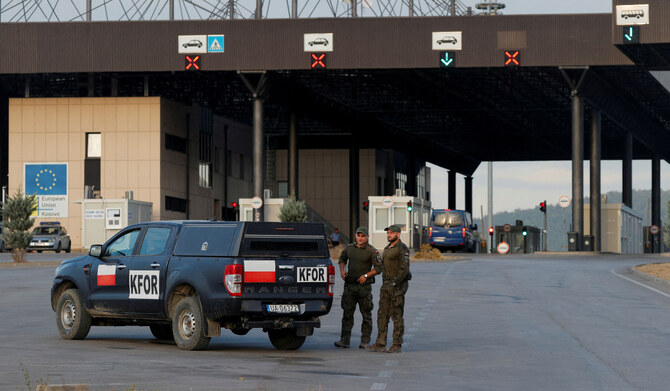
Polish soldiers part of the NATO-led peacekeeping mission stand as they monitor the main Kosovo-Serbia border crossing in Merdare, Kosovo September 6, 2024. (REUTERS)
Short Url
Updated 13 October 2024
Follow

North Kosovo ethnic tensions remain risk for violence, NATO official says

  • The US and the European Union, Kosovo’s leading global allies, have criticized the Pristina government for taking unilateral actions in the north that could spark ethnic violence and risk the lives of some 4,000 NATO troops on duty there

PRISTINA: Persistent ethnic tension in north Kosovo could trigger a repeat of violence seen in the area last year, when four people died in a gunbattle and NATO peacekeepers were hurt in clashes, a senior official from the military alliance warned on Saturday.
Kosovo is predominantly ethnic Albanian but about 50,000 Serbs in the north reject Pristina’s government and see Belgrade as their capital. A former Serbian province, Kosovo declared independence in 2008 a decade after a guerrilla uprising.
US Navy Admiral Stuart B. Munsch, commander of the Allied Joint Force Command Naples — which oversees NATO’s peacekeeping in force in Kosovo — said the alliance remained concerned about the risk of repeated violence in the volatile north.
“Heated political rhetoric could inspire some non-government forces to commit violence such as what happened last year,” Munsch told reporters in Pristina.
“I would not say that definitely conflict is coming, I think there is a persistent risk,” he said, referring to a lack of progress in EU-mediated talks between Kosovo’s government and Serbia.
A police officer and three gunmen were killed in September 2023 when a group of heavily armed attackers entered from Serbia and attacked police in the village of Banjska.
Four months earlier, more than 90 soldiers were injured when Serb protesters attacked NATO peacekeepers.
Kosovo has accused Serbia of being behind the Banjska attack but Belgrade has denied the accusations.
The US and the European Union, Kosovo’s leading global allies, have criticized the Pristina government for taking unilateral actions in the north that could spark ethnic violence and risk the lives of some 4,000 NATO troops on duty there.
Kosovo rejects such criticism, and the issue has strained Pristina’s ties with its Western supporters.
As part of the EU-mediated dialogue, Kosovo and Serbia have been holding talks for more than a decade to normalize their relations, but there has been little progress.
Like the Serbs living in north Kosovo, Belgrade also considers Kosovo to be part of Serbia and refuses to recognize it as a state.


Three Afghan migrants die of cold while trying to cross into Iran

Updated 58 min 36 sec ago
Follow

Three Afghan migrants die of cold while trying to cross into Iran

  • More than 1.8 million Afghans were forced to return to Afghanistan by the Iranian authorities between January and the end of November 2025

AFGHANISTAN: Three Afghans died from exposure in freezing temperatures in the western province of Herat while trying to illegally enter Iran, a local army official said on Saturday.
“Three people who wanted to illegally cross the Iran-Afghanistan border have died because of the cold weather,” the Afghan army official told AFP on condition of anonymity.
He added that a shepherd was also found dead in the mountainous area of Kohsan from the cold.
The migrants were part of a group that attempted to cross into Iran on Wednesday and was stopped by Afghan border forces.
“Searches took place on Wednesday night, but the bodies were only found on Thursday,” the army official said.
More than 1.8 million Afghans were forced to return to Afghanistan by the Iranian authorities between January and the end of November 2025, according to the latest figures from the United Nations refugee agency (UNHCR), which said that the majority were “forced and coerced returns.”
“These mass returns in adverse circumstances have strained Afghanistan’s already overstretched resources and services” which leads to “risks of onward and new displacement, including return movements back into Pakistan and Iran and onward,” UNHCR posted on its site dedicated to Afghanistan’s situation.
This week, Amnesty International called on countries to stop forcibly returning people to Afghanistan, citing a “real risk of serious harm for returnees.”
Hit by two major earthquakes in recent months and highly vulnerable to climate change, Afghanistan faces multiple challenges.
It is subject to international sanctions particularly due to the exclusion of women from many jobs and public places, described by the UN as “gender apartheid.”
More than 17 million people in the country are facing acute food insecurity, the UN World Food Programme said Tuesday.