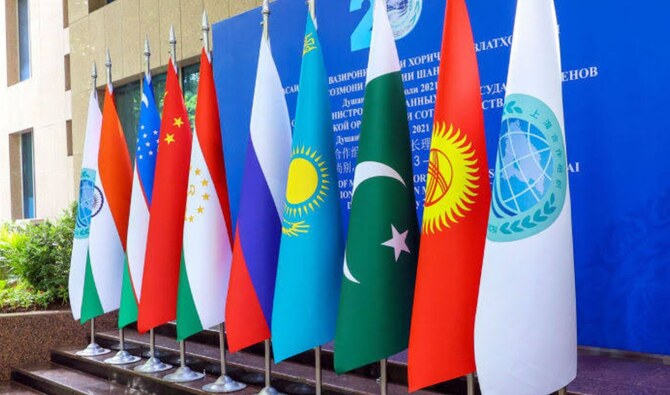
ISLAMABAD: The foreign office of Pakistan released the names of countries attending the 23rd meeting of the Council of Heads of Government (CHG) of the Shanghai Cooperation Organization (SCO), scheduled for October 15-16 in Islamabad, notably excluding Afghanistan, while key member states like China, Russia and India are set to attend.
Afghanistan is not a full SCO member but holds observer status, which has reportedly remained inactive since September 2021, following the Taliban takeover.
Pakistan’s relations with Afghanistan have severely deteriorated for more than a year over the issue of cross-border militancy, with officials in Islamabad repeatedly accusing the Taliban-led government of “facilitating” armed groups responsible for attacks on Pakistani soil, an allegation denied by Kabul.
Tensions further escalated last year when Pakistan decided to expel Afghan refugees, citing national security concerns and the alleged involvement of some refugees in militancy and crime.
“Pakistan will be hosting the Twenty-third meeting of the Council of the Heads of Government (CHG) of the Member States of the Shanghai Cooperation Organization (SCO) from 15 to 16 October 2024 in Islamabad,” the foreign office said in a brief curtain raiser.
“SCO member States will be represented by the Prime Ministers of China, Russia, Belarus, Kazakhstan, Kyrgyzstan, Tajikistan and Uzbekistan as well as the First Vice President of Iran and External Affairs Minister of India,” it added. “Prime Minister of Mongolia (Observer State) and Deputy Chairman of the Cabinet of Ministers and Foreign Ministers of Turkmenistan (Special Guest) will also participate in the meeting.”
The foreign office said Prime Minister Shehbaz Sharif will preside over the SCO meeting in his capacity of the current chair of the CHG.
He will also hold important bilateral meetings with visiting heads of delegation on the sidelines of the summit.
The government has made extensive preparations for the event while focusing on both security and beautification of Islamabad.
According to Dawn newspaper, over 10,000 security personnel have been deployed to ensure the safety of around 900 international delegates.
Special efforts are also being made to enhance the appearance of the city, particularly along VIP routes and the Jinnah Convention Center where the summit will be held.
The prime minister himself has finalized the arrangements by visiting all these places.
The SCO meeting will discuss ongoing cooperation in the fields of economy, trade, environment, socio-cultural linkages and review the performance of the Organization.
The participants will adopt important organizational decisions to further enhance cooperation among SCO member states and approve the budget of the organization.


Pakistan lists SCO summit attendees, excluding Afghanistan, ahead of high-profile event
https://arab.news/m6jxv
Pakistan lists SCO summit attendees, excluding Afghanistan, ahead of high-profile event

- Afghanistan holds the SCO observer status that has reportedly remained inactive since Taliban’s 2021 takeover
- Pakistan has made extensive preparations for the summit, focusing on Islamabad’s security and beautification

Pakistan’s OGDC ramps up unconventional gas plans
- Pakistan has long been viewed as having potential in tight and shale gas but commercial output has yet to be proved
- OGDC says has tripled tight-gas study area to 4,500 square km after new seismic, reservoir analysis indicates potential
ISLAMABAD: Pakistan’s state-run Oil & Gas Development Company is planning a major expansion of unconventional gas developments from early next year, aiming to boost production and reduce reliance on imported liquefied natural gas.
Pakistan has long been viewed as having potential in both tight and shale gas, which are trapped in rock and can only be released with specialized drilling, but commercial output has yet to be proved.
Managing Director Ahmed Lak told Reuters that OGDC had tripled its tight-gas study area to 4,500 square kilometers (1,737 square miles) after new seismic and reservoir analysis indicated larger potential. Phase two of a technical evaluation will finish by end-January, followed by full development plans.
The renewed push comes after US President Donald Trump said Pakistan held “massive” oil reserves in July, a statement analysts said lacked credible geological evidence, but which prompted Islamabad to underscore that it is pursuing its own efforts to unlock unconventional resources.
“We started with 85 wells, but the footprint has expanded massively,” Lak said, adding that OGDC’s next five-year plan would look “drastically different.”
Early results point to a “significant” resource across parts of Sindh and Balochistan, where multiple reservoirs show tight-gas characteristics, he said.
SHALE PILOT RAMPS UP
OGDC is also fast-tracking its shale program, shifting from a single test well to a five- to six-well plan in 2026–27, with expected flows of 3–4 million standard cubic feet per day (mmcfd) per well.
If successful, the development could scale to hundreds or even more than 1,000 wells, Lak said.
He said shale alone could eventually add 600 mmcfd to 1 billion standard cubic feet per day of incremental supply, though partners would be needed if the pilot proves viable.
The company is open to partners “on a reciprocal basis,” potentially exchanging acreage abroad for participation in Pakistan, he said.
A 2015 US Energy Information Administration study estimated Pakistan had 9.1 billion barrels of technically recoverable shale oil, the largest such resource outside China and the United States.
A 2022 assessment found parts of the Indus Basin geologically comparable to North American shale plays, though analysts say commercial viability still hinges on better geomechanical data, expanded fracking capacity and water availability.
OGDC plans to begin drilling a deep-water offshore well in the Indus Basin, known as the Deepal prospect, in the fourth quarter of 2026, Lak said. In October, Turkiye’s TPAO with PPL and its consortium partners, including OGDC, were awarded a block for offshore exploration.
A combination of weak gas demand, rising solar uptake and a rigid LNG import schedule has created a surplus of gas that forced OGDC to curb output and pushed Pakistan to divert cargoes from Italy’s ENI and seek revised terms with Qatar.


