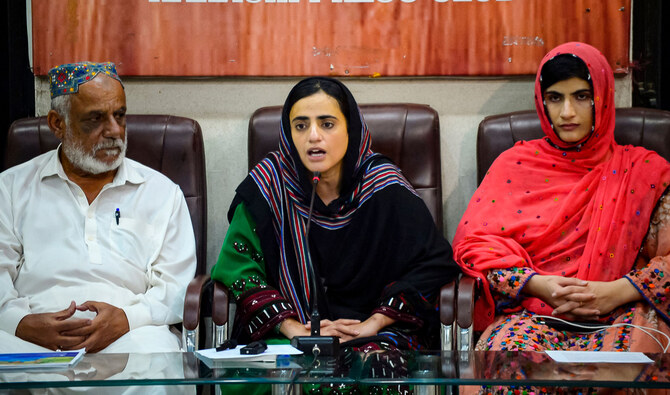
KARACHI: Police in Pakistan’s southern port city of Karachi on Friday registered a case against Dr. Mahrang Baloch, a prominent Baloch rights activist, accusing her of facilitating operations of Baloch separatist organizations in the country.
The development came days after the killing of three people, including two Chinese nationals, and injuries to 10 others in a roadside bomb attack near the Karachi airport. The outlawed Baloch Liberation Army (BLA) separatist group claimed responsibility for the attack on Oct. 6.
A fierce critic of Pakistan’s powerful military, Baloch has been vocal about alleged enforced disappearances and extrajudicial killings in Balochistan, a region struggling with a decades-long separatist insurgency. Baloch, recognized by the Time magazine as one of the world’s 100 emerging leaders for her peaceful advocacy of Baloch rights, was also barred this week from flying to the US to receive the honor.
On Friday, a citizen named Asad Ali filed the case against Baloch at the Quaidabad police station in Karachi under the Anti-Terrorism Act and the Pakistan Penal Code, accusing Baloch and her group, the Baloch Yakjehti Committee (BYC), of blocking highways, leveling “false accusations” against security agencies, inciting educated Baloch youth to violence, obstructing movement of non-Baloch individuals, and targeting laborers arriving in Balochistan.
“To continue this, Mahrang Baloch has been brought to the forefront, who brings terrorists to the cities in the form of groups during her rallies,” read the police report seen by Arab News.
“These terrorists conduct reconnaissance on sensitive locations and target foreign, Chinese nationals, orchestrating attacks to undermine peace and stability of our homeland.”
Baloch and her BYC group last December led hundreds of women in a long march to the Pakistani capital of Islamabad to demand justice for their “disappeared” husbands, sons, and brothers. Earlier this year, she organized the ‘Baloch Raaji Muchi,’ or Baloch National Gathering, in the strategic port city of Gwadar to unite the Baloch people against alleged rights abuses in Pakistan’s southwestern Balochistan province.
At a press conference in August, Pakistani military spokesperson Lt. Gen. Ahmad Sharif Chaudhry had said the purpose of the BYC and the Baloch Raaji Muchi it had convened in July in Gwadar, where China is building a deep seaport, was to make development projects and investments “controversial” and incite people against the Pakistan army and other security forces involved in operations against insurgency and crime in Balochistan.
Pakistan’s Balochistan province, which shares porous borders with Afghanistan and Iran, has been the scene of a low-level insurgency for nearly two decades. Ethnic Baloch militants often target police, security forces, foreigners and workers from other provinces over what they call as the exploitation of the mineral-rich region’s resources. The Pakistani state denies the allegations.
Late on Thursday, unidentified gunmen killed 20 miners and injured another seven in Balochistan’s Duki district in the latest attack to hit the volatile region, according to police. The laborers, who hailed from various Pashtun-dominated areas of Balochistan and the neighboring Afghanistan, came under attack while they were asleep in their accommodation outside a private coal mining site.
In August, the BLA, the most prominent of separatist groups, carried out multiple attacks in Balochistan that killed more than 50 people, while authorities responded by killing 21 insurgents in the province. Those killed included 23 passengers, mostly from the eastern Punjab province, who were fatally shot after being taken from buses, vehicles and trucks in the Musakhail district.


![]()

Pakistani police charge Baloch rights activist with facilitating separatist militants
Short Url
https://arab.news/r9mvm
Pakistani police charge Baloch rights activist with facilitating separatist militants
- Dr. Mahrang Baloch was recently recognized by the Time magazine as one of the world’s 100 emerging leaders for her peaceful advocacy of Baloch rights
- Pakistan’s Balochistan, which shares porous borders with Afghanistan and Iran, has been the scene of a low-level insurgency for nearly two decades


Latest updates


© 2026 SAUDI RESEARCH & PUBLISHING COMPANY, All Rights Reserved And subject to Terms of Use Agreement.