

US expands sanctions on Iran in response to its ballistic attack on Israel

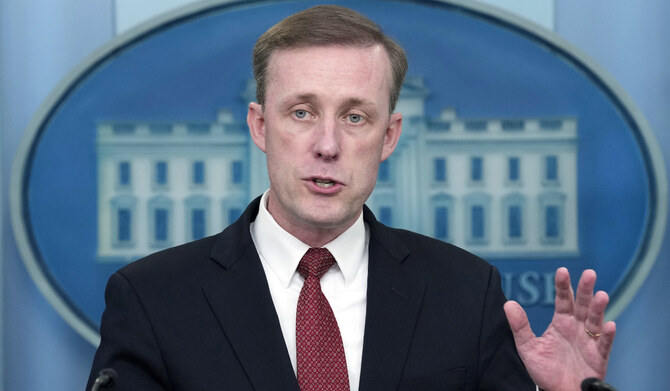
White House national security adviser Jake Sullivan speaks during the daily briefing at the White House in Washington, May 22, 2024. (AP file photo)
Short Url
Updated 12 October 2024
Follow

US expands sanctions on Iran in response to its ballistic attack on Israel

  • Increasingly, however, escalating attacks between Israel and Iran and its Arab allies threaten to push the Middle East closer to a regional war

WASHINGTON: The US on Friday announced new sanctions on Iran’s energy sector in response to its Oct. 1 attack on Israel when it fired roughly 180 missiles into the country.
Iran said the barrage was retaliation for a series of devastating blows Israel has landed in recent weeks against the Iran-backed militant group Hezbollah in Lebanon, which has been firing rockets into Israel since the war in Gaza began.
Included in Friday’s sanctions are blocks on Iran’s so-called “ghost fleet” of ships and associated firms that span the United Arab Emirates, Liberia, Hong Kong and other jurisdictions that allegedly obfuscate and transport Iranian oil for sale to buyers in Asia.
Additionally, the US State Department designated a network of companies based in Suriname, India, Malaysia and Hong Kong for allegedly arranging for the sale and transport of petroleum and petroleum products from Iran.
Current US law authorizes sanctions targeting Iran’s energy sector as well as foreign firms that buy sell and transport Iranian oil. But energy sanctions are often a delicate issue as restricting supplies could push up prices for global commodities that the US and its allies need.
Jake Sullivan, the US national security advise, said the new sanctions “will help further deny Iran financial resources used to support its missile programs and provide support for terrorist groups that threaten the United States, its allies, and partners.”
The penalties aim to block them from using the US financial system and bar American citizens from dealing with them.
Israel and Iran have fought a shadow war for years, but rarely have they come into direct conflict. Increasingly, however, escalating attacks between Israel and Iran and its Arab allies threaten to push the Middle East closer to a regional war.
Iran launched another direct attack on Israel in April, but few of its projectiles reached their targets. Many were shot down by a US-led coalition while others apparently failed at launch or crashed in flight.
Treasury Secretary Janet Yellen said Friday that the United States “will not hesitate to take further action to hold Iran accountable.”


Italian police fire tear gas as protesters clash near Winter Olympics hockey venue

Updated 08 February 2026
Follow

Italian police fire tear gas as protesters clash near Winter Olympics hockey venue

  • Police vans behind a temporary metal fence secured the road to the athletes’ village, but the protest veered away, continuing on a trajectory toward the Santagiulia venue

MILAN: Italian police fired tear gas and a water cannon at dozens of protesters who threw firecrackers and tried to access a highway near a Winter Olympics venue on Saturday.
The brief confrontation came at the end of a peaceful march by thousands against the environmental impact of the Games and the presence of US agents in Italy.
Police held off the violent demonstrators, who appeared to be trying to reach the Santagiulia Olympic ice hockey rink, after the skirmish. By then, the larger peaceful protest, including families with small children and students, had dispersed.
Earlier, a group of masked protesters had set off smoke bombs and firecrackers on a bridge overlooking a construction site about 800 meters (a half-mile) from the Olympic Village that’s housing around 1,500 athletes.
Police vans behind a temporary metal fence secured the road to the athletes’ village, but the protest veered away, continuing on a trajectory toward the Santagiulia venue. A heavy police presence guarded the entire route.
There was no indication that the protest and resulting road closure interfered with athletes’ transfers to their events, all on the outskirts of Milan.
The demonstration coincided with US Vice President JD Vance’s visit to Milan as head of the American delegation that attended the opening ceremony on Friday.
He and his family visited Leonardo da Vinci’s “The Last Supper” closer to the city center, far from the protest, which also was against the deployment of US Immigration and Customs Enforcement agents to provide security to the US delegation.
US Homeland Security Investigations, an ICE unit that focuses on cross-border crimes, frequently sends its officers to overseas events like the Olympics to assist with security. The ICE arm at the forefront of the immigration crackdown in the US is known as Enforcement and Removal Operations, and there is no indication its officers are being sent to Italy.
At the larger, peaceful demonstration, which police said numbered 10,000, people carried cardboard cutouts to represent trees felled to build the new bobsled run in Cortina. A group of dancers performed to beating drums. Music blasted from a truck leading the march, one a profanity-laced anti-ICE anthem.
“Let’s take back the cities and free the mountains,” read a banner by a group calling itself the Unsustainable Olympic Committee. Another group called the Association of Proletariat Excursionists organized the cutout trees.
“They bypassed the laws that usually are needed for major infrastructure project, citing urgency for the Games,” said protester Guido Maffioli, who expressed concern that the private entity organizing the Games would eventually pass on debt to Italian taxpayers.
Homemade signs read “Get out of the Games: Genocide States, Fascist Police and Polluting Sponsors,” the final one a reference to fossil fuel companies that are sponsors of the Games. One woman carried an artificial tree on her back decorated with the sign: “Infernal Olympics.”
The demonstration followed another last week when hundreds protested the deployment of ICE agents.
Like last week, demonstrators Saturday said they were opposed to ICE agents’ presence, despite official statements that a small number of agents from an investigative arm would be present in US diplomatic territory, and not operational on the streets.