Many Palestinian camps in Lebanon ‘empty after Israeli strikes’

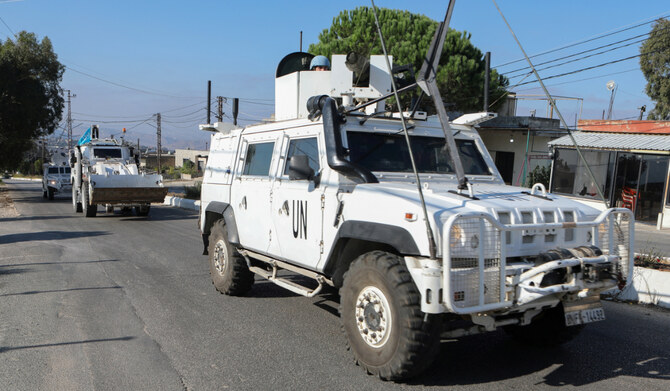
UNIFIL vehicles drive in Marjayoun, near the border with Israel. (Reuters)
Short Url
Updated 12 October 2024
Follow

Many Palestinian camps in Lebanon ‘empty after Israeli strikes’

  • Israel has ramped up strikes across southern Lebanon and on Beirut’s once-densely populated southern suburbs

BEIRUT: Most Palestinian refugees living in camps in southern Lebanon or near Beirut have fled following escalating Israeli strikes, the head of the UN agency on Palestine refugees said on Friday, drawing parallels with mass displacement in Gaza.
UNRWA chief Philippe Lazzarini said that the agency continued to provide services to the most vulnerable left behind — and that repeatedly fleeing was sadly “part of the history” of Palestinians. “Now, that’s part, unfortunately, of the plight, but if you compare it with what happened also in Gaza recently, you might have heard me describing how people are constantly being moved like pinballs. And one of the fears is that we replicate a situation similar to the one we have seen until now in Gaza,” he said.
Israel has ramped up strikes across southern Lebanon and on Beirut’s once-densely populated southern suburbs over the last three weeks, issuing evacuation warnings for more than 100 towns in southern Lebanon and neighborhoods near the capital.
They include evacuation warnings and strikes on the Burj Al-Barajneh Palestinian refugee camp in Beirut’s southern suburbs and the Rashidiyeh Palestinian refugee camp near the south coastal city of Tyre. Many of the Palestinians who arrived in Lebanon after Israel’s creation in 1948, and their descendants, were living in 12 refugee camps around the country, which hosted about 174,000 Palestinian refugees.
Israeli leaders have accused UNRWA staff of collaborating with Hamas militants in Gaza, leading many donors to suspend funding.
The UN launched an investigation into Israel’s accusations and dismissed nine staff.
In July, the Israeli parliament gave preliminary approval to a bill that would declare UNRWA a “terrorist organization.”
Asked about the move, Lazzarini said the agency “has never, ever been as much under assault and attack.”
“A year ago, it was primarily a financial existential threat, but today it’s a combination of a political and financial threat. 2025 will be, again, a difficult year,” he said. He said he would have more clarity early next year on whether the US would resume funding.


International law at ‘breaking point’ amid ‘epidemic’ of conflicts: Survey

Updated 02 February 2026
Follow

International law at ‘breaking point’ amid ‘epidemic’ of conflicts: Survey

  • Gaza war highlighted as one of the most concerning areas; atrocities in Sudan also noted
  • ‘Well over’ 100,000 civilians have been killed in past 18 months amid ‘rampant impunity’

LONDON: A new survey of 23 conflicts worldwide has said more than 100,000 civilians have been killed in the past 18 months, with adherence to international humanitarian law reaching “a critical breaking point.”

The “War Watch” survey highlighted the war in Gaza as one of the most concerning areas in an “epidemic” of violence, while also noting concerning levels of atrocities in Sudan.

Taken under the auspices of the Geneva Academy of International Humanitarian Law and Human Rights, the survey covers July 2024 to the end of 2025.

Lead author Stuart Casey-Maslen said: “Atrocity crimes are being repeated because past ones were tolerated. Our actions — or inaction — will determine whether international humanitarian law vanishes altogether.”

In Gaza, local authorities say 18,592 children and 12,400 women have been killed since Israel invaded the Palestinian enclave in October 2023. 

The report said Gaza’s overall population had declined by “about 254,000 people, a 10.6 percent decline compared with pre-conflict estimates,” making it one of the most deadly conflicts in the world. It noted that despite a ceasefire being agreed late last year, civilian casualties have continued.

In Sudan, after the fall of the city of El-Fasher to the Rapid Support Forces last October, widespread reports of survivors “being gang-raped by RSF fighters” — including in the presence of relatives — were recorded in numerous instances.

The survey said: “We do not know how many civilians have been killed in the conduct of hostilities during armed conflicts in 2024 and 2025, but we do know that the number is well over 100,000 in each of the two years.”

It added that “serious violations of international humanitarian law (IHL) were wrought … on a huge scale and with rampant impunity.” 

The report said IHL and the laws of armed conflict, established after the Second World War to protect civilians, must be upheld by every state under the Geneva Conventions “in all circumstances.”

It added: “Addressing widespread impunity for serious violations of international law should be treated as a policy priority.”

The report suggested several policy ideas to reduce the number of people suffering, including arms export bans for countries “where there is a clear risk that the arms or ammunition to be delivered will be used to commit or facilitate serious violations” of IHL.

It also proposed limiting the use of drones and artificial intelligence targeting in civilian areas, as well as unguided gravity bombs or inaccurate long-range artillery.

In addition, it called for “systematic prosecution of war crimes,” saying more political and financial support need to be given to the International Criminal Court by members of the international community.