US expands sanctions on Iran in response to its ballistic attack on Israel

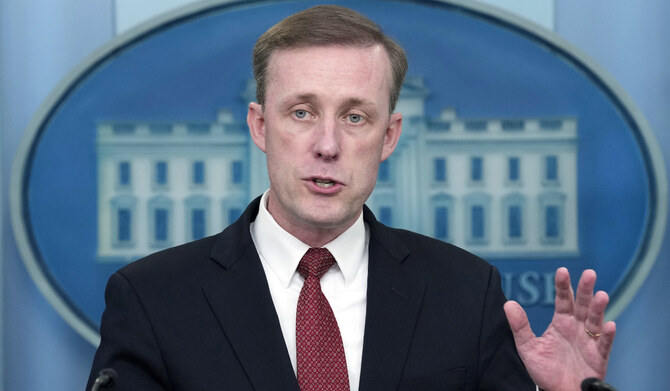
White House national security adviser Jake Sullivan speaks during the daily briefing at the White House in Washington, May 22, 2024. (AP file photo)
Short Url
Updated 12 October 2024
Follow

US expands sanctions on Iran in response to its ballistic attack on Israel

  • Increasingly, however, escalating attacks between Israel and Iran and its Arab allies threaten to push the Middle East closer to a regional war

WASHINGTON: The US on Friday announced new sanctions on Iran’s energy sector in response to its Oct. 1 attack on Israel when it fired roughly 180 missiles into the country.
Iran said the barrage was retaliation for a series of devastating blows Israel has landed in recent weeks against the Iran-backed militant group Hezbollah in Lebanon, which has been firing rockets into Israel since the war in Gaza began.
Included in Friday’s sanctions are blocks on Iran’s so-called “ghost fleet” of ships and associated firms that span the United Arab Emirates, Liberia, Hong Kong and other jurisdictions that allegedly obfuscate and transport Iranian oil for sale to buyers in Asia.
Additionally, the US State Department designated a network of companies based in Suriname, India, Malaysia and Hong Kong for allegedly arranging for the sale and transport of petroleum and petroleum products from Iran.
Current US law authorizes sanctions targeting Iran’s energy sector as well as foreign firms that buy sell and transport Iranian oil. But energy sanctions are often a delicate issue as restricting supplies could push up prices for global commodities that the US and its allies need.
Jake Sullivan, the US national security advise, said the new sanctions “will help further deny Iran financial resources used to support its missile programs and provide support for terrorist groups that threaten the United States, its allies, and partners.”
The penalties aim to block them from using the US financial system and bar American citizens from dealing with them.
Israel and Iran have fought a shadow war for years, but rarely have they come into direct conflict. Increasingly, however, escalating attacks between Israel and Iran and its Arab allies threaten to push the Middle East closer to a regional war.
Iran launched another direct attack on Israel in April, but few of its projectiles reached their targets. Many were shot down by a US-led coalition while others apparently failed at launch or crashed in flight.
Treasury Secretary Janet Yellen said Friday that the United States “will not hesitate to take further action to hold Iran accountable.”


Fourth Palestine Action activist ends hunger strike in UK prison

Protesters take part in a demonstration in support of "Defend Our Juries" and their campaign against the ban on Palestine Action
Updated 24 December 2025
Follow

Fourth Palestine Action activist ends hunger strike in UK prison

  • Amy Gardiner-Gibson began eating again after 49 days of protest
  • Govt rejects claims it ignored prison safety protocols

LONDON: A fourth Palestine Action activist imprisoned in the UK has ended her hunger strike.

Amy Gardiner-Gibson, who also uses the name Amu Gib, began eating again after 49 days of fasting, the campaign group Prisoners for Palestine said.

Qesser Zuhrah, another activist, ended her hunger strike last week after 48 days but said she might resume it next year, Sky News reported.

Four Palestine Action activists have now ended their hunger strikes while in prison, while four others are continuing to fast.

All of them are in prison on remand, awaiting trial for a series of high-profile alleged break-ins and criminal damage.

Palestine Action was proscribed as a terrorist organization and banned earlier this year.

On Tuesday, Swedish climate activist Greta Thunberg was arrested in central London at a rally in support of the hunger strikers.

The protesters are demanding that weapons factories in Britain with ties to Israel be shut down, as well as the removal of Palestine Action’s proscription.

They are also calling for immediate bail to be given to imprisoned pro-Palestine activists and an end to the alleged mistreatment of prisoners in custody.

Seven imprisoned members of Palestine Action have been transferred to hospital over the course of the hunger strike campaign. Doctors have highlighted concerns about the long-term impact of fasting on the activists.

Lawyers representing the group on Monday initiated legal action against the government over its alleged failure to follow prison safety regulations.

The government, however, has rejected this accusation, Sky News reported.

A Ministry of Justice spokesperson said: “Ministers do not intervene in individual cases. Where individuals are on remand, doing so would risk prejudicing ongoing legal proceedings and undermine the independence of the justice system.

“Concerns about welfare and process can be raised through established legal and administrative channels, including prison governors and ultimately the prison and probation ombudsman.

“Healthcare decisions are taken independently by qualified NHS professionals and appropriate care and oversight frameworks remain in place.”

The activists still on hunger strike include Heba Muraisi and Teuta Hoxha. Hoxha has been on remand for 13 months and her family told Sky News they feared she would die in prison.

Another of the activists, Kamran Ahmad, is believed to have been on hunger strike for 45 days and hospitalized three times.

Lewie Chiaramello, who has Type 1 diabetes, is on day 31 of his strike and taking part by fasting every other day.