Beijing sends team to Pakistan to join probe into Karachi bombing that killed two Chinese

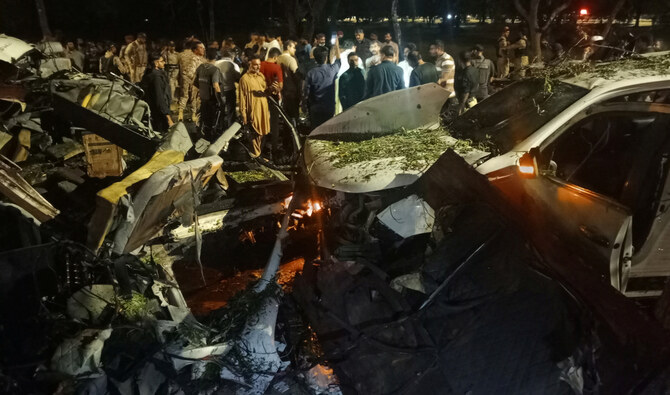
People stand near the wreckage of vehicles as they gather after an explosion near Jinnah International Airport in Karachi, Pakistan on October 6, 2024. (REUTERS)
Short Url
Updated 11 October 2024
Follow

Beijing sends team to Pakistan to join probe into Karachi bombing that killed two Chinese

  • Two Chinese nationals among three people were killed and 10 others injured in the bomb attack near the Karachi airport on Oct. 6
  • Pakistan fully dealing with the aftermath, investigating the attack and nailing down the perpetrators, Chinese foreign ministry says

ISLAMABAD: China has sent an inter-agency working group to join an investigation into last week’s bomb attack in Pakistan’s southern city of Karachi that killed two Chinese nationals, Chinese state media reported, citing a foreign ministry spokesperson.
Two Chinese nationals among three people were killed and 10 others injured in the attack near the Karachi airport on Oct. 6, according to Pakistani and Chinese authorities. The Baloch Liberation Army (BLA) separatist group claimed responsibility for the attack, saying that Chinese nationals were targeted by a vehicle-borne improvised explosive device.
A Chinese foreign ministry spokesperson said on Friday that Beijing quickly sent an inter-agency working group to Pakistan as part of its response to the attack on a Chinese convoy of the Port Qasim coal-fired power plant that killed and injured Chinese personnel, Chinese state-run CGTN news channel reported.
“After arriving in Islamabad on October 8, the working group immediately joined the Embassy in Pakistan and the company concerned in the emergency response,” the spokesperson was quoted as saying by the English-language news channel.
“The working group met intensively with heads of Pakistani Ministry of Foreign Affairs, Ministry of Interior, and military, police and intelligence departments, and asked the Pakistani side to properly handle ensuing matters, make every effort to save the injured, conduct thorough investigations, bring all the perpetrators to justice, and step up security measures to ensure the safety and security of Chinese personnel, institutions and projects in Pakistan.”
Pakistan strongly condemned the attack and is fully dealing with the aftermath, investigating the incident and nailing down the perpetrators, according to the spokesperson. Islamabad has said it will further strengthen security measures and make all-out efforts to protect Chinese interests in Pakistan.
Pakistan Prime Minister Shehbaz Sharif this week met Chinese Ambassador Jiang Zaidong and assured him of personally overseeing investigation into the militant attack and promised that those responsible would be brought to justice.
The Chinese ambassador expressed confidence in the Pakistani government’s “effective investigation, prompt identification of the responsible terrorists, and their swift punishment,” Sharif’s office said in a statement.
Sunday’s attack is the latest by the BLA, the most prominent of a number of separatist groups fighting for independence for Pakistan’s gas-and-mineral-rich Balochistan province, where a low-lying insurgency has been ongoing for the past two decades. Baloch militants blame the Pakistani state for exploiting the province’s resources, a charge denied by state authorities.
The BLA also accuses Beijing of helping Islamabad exploit the province and has attacked Chinese interests and projects in the past, in particular the strategic port of Gwadar on the Arabian Sea. It has previously killed Chinese citizens working in the region and attacked Beijing’s consulate in Karachi.
In March this year, a suicide bombing killed five Chinese engineers and a Pakistani driver in northwestern Pakistan as they headed to the Dasu Dam, the biggest hydropower project in the country. In 2022, three Chinese educators and their Pakistani driver were killed when an explosion ripped through a van at the University of Karachi.


Pakistan opposition to continue protest over ex-PM Khan’s health amid conflicting reports

Updated 16 February 2026
Follow

Pakistan opposition to continue protest over ex-PM Khan’s health amid conflicting reports

  • Pakistan’s government insists that the ex-premier’s eye condition has improved
  • Khan’s personal doctor says briefed on his condition but cannot confirm veracity

ISLAMABAD: Pakistan’s opposition alliance on Monday vowed to continue their protest sit-in at parliament and demanded “clarity” over the health of jailed former prime minister Imran Khan, following conflicting medical reports about his eye condition.

The 73-year-old former cricket star-turned-politician has been held at the high-security Adiala prison in Rawalpindi since 2023. Concerns arose about his health last week when a court-appointed lawyer, Barrister Salman Safdar, was asked to visit Khan at the jail to assess his living conditions. Safdar reported that Khan had suffered “severe vision loss” in his right eye due to central retinal vein occlusion (CRVO), leaving him with just 15 percent sight in the affected eye.

On Sunday, a team of doctors from various hospitals visited the prison to examine Khan’s eye condition, according to the Adiala jail superintendent, who later submitted his report in the court. On Monday, a Supreme Court bench led by Chief Justice Yahya Afridi observed that based on reports from the prison authorities and the amicus curiae, Khan’s “living conditions in jail do not presently exhibit any perverse aspects.” It noted that Khan had “generally expressed satisfaction with the prevailing conditions of his confinement” and had not sought facilities beyond the existing level of care.

Having carefully perused both reports in detail, the bench observed that their general contents and the overall picture emerging therefrom are largely consistent. The opposition alliance, which continued to stage its sit-in for a fourth consecutive day on Monday, held a meeting at the parliament building on Monday evening to deliberate on the emerging situation and discuss their future course of action.

“The sit-in will continue till there is clarity on the matter of [Khan's] health,”  Sher Ali Arbab, a lawmaker from Khan's Pakistan Tehreek-e-Insaf (PTI) party who has been participating in the sit-in, told Arab News, adding that PTI Chairman Gohar Ali Khan and Opposition Leader in Senate Raja Nasir Abbas had briefed them about their meeting with doctors who had visited Khan on Sunday.

Speaking to reporters outside parliament, Gohar said the doctors had informed them that Khan’s condition had improved.

“They said, 'There has been a significant and satisfactory improvement.' With that satisfactory improvement, we also felt satisfied,” he said, noting that the macular thickness in Khan’s eye had reportedly dropped from 550 to 300 microns, a sign of subsiding swelling.

Gohar said the party did not want to politicize Khan’s health.

“We are not doctors, nor is this our field,” he said, noting that Khan’s personal physician in Lahore, Dr. Aasim Yusuf, and his eye specialist Dr. Khurram Mirza had also sought input from the Islamabad-based medical team.

“Our doctors also expressed satisfaction over the report.”

CONFLICTING ACCOUNTS

Despite Gohar’s cautious optimism, Khan’s personal physician, Dr. Yusuf, issued a video message on Monday, saying he could neither “confirm nor deny the veracity” of the government’s claims.

“Because I have not seen him myself and have not been able to participate in his care... I’m unable to confirm what we have been told,” Yusuf said.

He appealed to authorities to grant him or fellow physician, Dr. Faisal Sultan, immediate access to Khan, arguing that the ex-premier should be moved to Shifa International Hospital in Islamabad for specialist care.

Speaking to Arab News, PTI’s central information secretary Sheikh Waqas Akram said Khan’s sister and their cousin, Dr. Nausherwan Burki, will speak to media on Tuesday to express their views about the situation.

The government insists that Khan’s condition has improved.

“His eye [condition] has improved and is better than before,” State Minister Talal Chaudhry told the media in a brief interaction on Monday.

“The Supreme Court of Pakistan is involved, and doctors are involved. What medicine he receives, whether he needs to be hospitalized or sent home, these decisions are made by doctors. Neither lawyers nor any political party will decide this.”