

Pakistan warns Pashtun rights group against stoking ethnic division as clashes kill 3

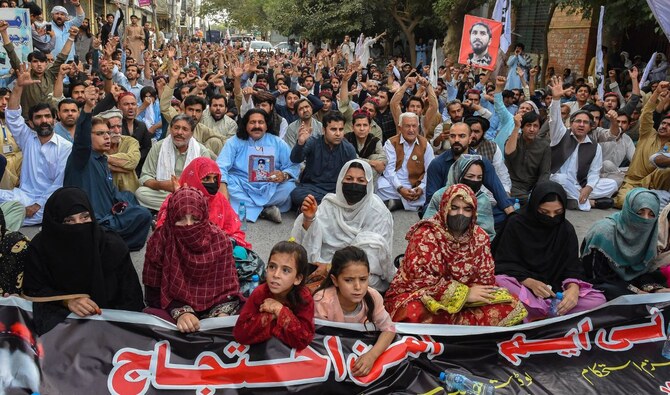
Supporters and activists of Pashtun Tahafuz Movement (PTM) take part in a protest against the military operations in Khyber Pakhtunkhwa, in Quetta on July 7, 2024. (AFP/File)
Short Url
Updated 09 October 2024
Follow

Pakistan warns Pashtun rights group against stoking ethnic division as clashes kill 3

  • Pashtun Tahafuz Movement organizes protest in northwestern Jamrud town against government’s ban on group 
  • PTM is a fierce critic of the powerful military, accusing it of abusing Pashtuns’ rights in northwestern Pakistan

ISLAMABAD: Pakistan’s Interior Minister Mohsin Naqvi warned a prominent Pashtun rights group against stoking ethnic division in the country on Wednesday, as protests in the country’s northwestern province claimed the lives of three people. 

At least three protesters were killed on Wednesday afternoon as clashes erupted between Pakistani police and supporters of the Pashtun Tahafuz Movement (PTM) in the northwestern town of Jamrud near Peshawar city.

The clashes erupted during protests by the PTM against a ban placed on the group by Pakistan’s interior ministry on Sunday. The ministry said it had banned the PTM, alleging that the group was found to be involved in activities prejudicial to the peace and security of the country. 

The PTM alleges Pashtuns have faced rights abuses during Pakistan’s war against militants, mainly in its northwestern Khyber Pakhtunkhwa province. It blames Pakistan’s powerful military for rights abuses in the northwestern province, a charge the institution has consistently denied.

“The main reason for banning them two days ago was that you, on the one hand, are abusing your state institutions and police. You are promoting ethnic discrimination and talking to the nation about division,” Naqvi said at a press conference. 

The minister pointed out that as per Pakistani law, if an organization is declared a proscribed entity its offices are sealed, bank accounts closed, arms licenses, passports, and identity cards are canceled and restrictions are placed on it regarding its media interactions and travel.

“Anyone who helps them [PTM] or facilitates them will face the same restrictions,” Naqvi warned. 

The PTM plans to hold a tribal jirga or tribal council gathering of thousands of people from Oct. 11-13 in defiance of the state’s ban in Jamrud. Naqvi warned the Pashtun rights group against holding the event, saying that the government would share important details of the PTM’s funding in the upcoming days. 

“On the one hand you are calling it a jirga and then also calling it a court,” he said. “This is the decision of Pakistan’s government that we cannot allow any parallel judicial system in the country.”

Formed by veterinary sciences student Manzoor Pashteen in 2014, the PTM was a pressure group that shot to national prominence when they spearheaded protests against the killing of Naqeebullah Mehsud, a young garment trader and aspiring model shot dead by police in Karachi in 2018.

In the 2018 election, PTM leaders Mohsin Dawar and Ali Wazir were elected to parliament from Pakistan’s restive North and South Waziristan districts, respectively.

The PTM says it has faced harassment, intimidation and censorship at the hands of Pakistan’s powerful military, which has ruled the country directly for over 30 years since it gained independence in 1947.

The military denies the PTM’s accusations and has often accused it of being funded by foreign intelligence agencies, notably Afghanistan’s National Directorate of Security (NDS) and India’s Research and Analysis Wing (RAW). The PTM denies these allegations. 


Pakistan FM discusses regional situation with Saudi counterpart, urges restraint and dialogue

Updated 5 sec ago
Follow

Pakistan FM discusses regional situation with Saudi counterpart, urges restraint and dialogue

  • This is the second time the two foreign ministers have spoken since the Arab Coalition targeted weapon shipments on Yemen’s Mukalla port
  • Saudi Arabia’s foreign ministry has invited factions in south Yemen to hold a dialogue in Riyadh to ‘discuss just solutions to southern cause’

ISLAMABAD: Pakistan’s foreign minister, Ishaq Dar, discussed the regional situation with his Saudi counterpart, Prince Faisal bin Farhan, and called for restraint and dialogue to resolve issues, the Pakistani foreign office said late Friday, amid tensions prevailing over Yemen.

This is the second time the two foreign ministers have spoken this week since the Saudi Arabia-led Coalition to Support Legitimacy in Yemen carried out a “limited” airstrike on Dec. 30, targeting two shipments of smuggled weapons and military equipment sent from the Emirati port of Fujairah to Mukalla in southern Yemen.

A coalition forces spokesperson said the weapons were meant to support the Southern Transitional Council (STC) forces, backed by the United Arab Emirates (UAE), in Yemen’s Hadramaut and Al-Mahra “with the aim of fueling the conflict.” The UAE has since announced withdrawal of its remaining troops from Yemen, rejecting any actions that could threaten the Kingdom or undermine regional stability.

In their telephonic conversation late Friday, the Pakistani and Saudi foreign ministers discussed the latest situation in the region, according to the Pakistani foreign office.

“FM [Dar] stressed that all concerned in the region must avoid any escalatory move and advised to resolve the issues through dialogue and diplomacy for the sake of regional peace and stability,” it added.

Separately, Saudi Arabia’s foreign ministry invited factions in south Yemen to hold a dialogue in Riyadh to “discuss just solutions to the southern cause.”

The ministry statement said the conference in the Saudi capital had been requested by Rashad Al-Alimi, President of the Yemeni Presidential Leadership Council, and the Kingdom urged all factions to participate “to develop a comprehensive vision” that would fulfill the aspirations of the southern people.

Disregarding previous agreements with the Arab Coalition, the STC separatist group launched a sweeping military campaign early in December, seizing the governorates of Hadramaut along the Saudi border and the eastern governorate of Al-Mahra in Yemen’s border with Oman. It also took control of the strategic PetroMasila oilfields, which account for a massive portion of Yemen’s remaining oil wealth.

The advance has raised the spectre of the return of South Yemen, a separate state from 1967 to 1990, while dealing a hammer-blow to slow-moving peace negotiations with Iran-backed Houthi rebels.

Saudi Arabia said the STC action poses a direct threat to the Kingdom’s national security, and regional stability. The Kingdom has reiterated the only way to bring the southern cause to a resolution is through dialogue.

On Thursday, Pakistan’s foreign office expressed solidarity with Saudi Arabia and reaffirmed Islamabad’s commitment to the Kingdom’s security, amid rising tensions in Yemen.

“Pakistan expresses complete solidarity with the Kingdom of Saudi Arabia and reaffirms its commitment to security of the Kingdom,” Pakistani foreign office spokesperson Tahir Andrabi told reporters at a weekly news briefing.

“Pakistan maintains its firm support for the resolution of Yemen issue through dialogue and diplomacy and hopes that Yemen’s people and regional powers work together toward inclusive and enduring settlement of the issue, safeguarding regional stability.”

Pakistan and Saudi Arabia signed a landmark defense pact in September last year, according to which aggression against one country will be treated as an attack against both. The pact signaled a push by both governments to formalize long-standing military ties into a binding security commitment.