

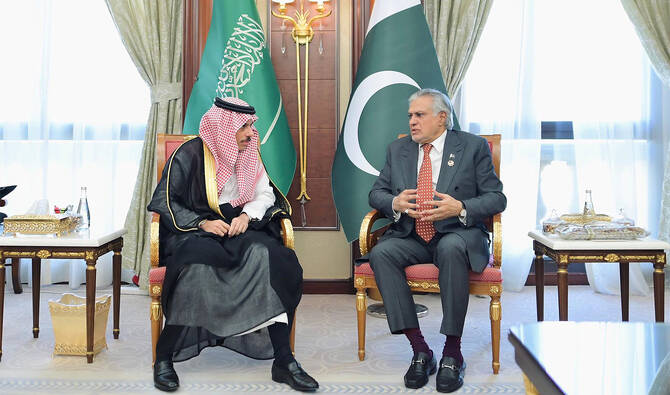
Pakistan FM discusses regional situation with Saudi counterpart, urges restraint and dialogue

Pakistan's Deputy Prime Minister and Foreign Minister, Muhammad Ishaq Dar (right) meets with the Foreign Minister of Saudi Arabia, Prince Faisal bin Farhan, in Riyadh on October 28, 2025. (PID/File)
Short Url
Updated 03 January 2026
Follow

Pakistan FM discusses regional situation with Saudi counterpart, urges restraint and dialogue

  • This is the second time the two foreign ministers have spoken since the Arab Coalition targeted weapon shipments on Yemen’s Mukalla port
  • Saudi Arabia’s foreign ministry has invited factions in south Yemen to hold a dialogue in Riyadh to ‘discuss just solutions to southern cause’

ISLAMABAD: Pakistan’s foreign minister, Ishaq Dar, discussed the regional situation with his Saudi counterpart, Prince Faisal bin Farhan, and called for restraint and dialogue to resolve issues, the Pakistani foreign office said late Friday, amid tensions prevailing over Yemen.

This is the second time the two foreign ministers have spoken this week since the Saudi Arabia-led Coalition to Support Legitimacy in Yemen carried out a “limited” airstrike on Dec. 30, targeting two shipments of smuggled weapons and military equipment sent from the Emirati port of Fujairah to Mukalla in southern Yemen.

A coalition forces spokesperson said the weapons were meant to support the Southern Transitional Council (STC) forces, backed by the United Arab Emirates (UAE), in Yemen’s Hadramaut and Al-Mahra “with the aim of fueling the conflict.” The UAE has since announced withdrawal of its remaining troops from Yemen, rejecting any actions that could threaten the Kingdom or undermine regional stability.

In their telephonic conversation late Friday, the Pakistani and Saudi foreign ministers discussed the latest situation in the region, according to the Pakistani foreign office.

“FM [Dar] stressed that all concerned in the region must avoid any escalatory move and advised to resolve the issues through dialogue and diplomacy for the sake of regional peace and stability,” it added.

Separately, Saudi Arabia’s foreign ministry invited factions in south Yemen to hold a dialogue in Riyadh to “discuss just solutions to the southern cause.”

The ministry statement said the conference in the Saudi capital had been requested by Rashad Al-Alimi, President of the Yemeni Presidential Leadership Council, and the Kingdom urged all factions to participate “to develop a comprehensive vision” that would fulfill the aspirations of the southern people.

Disregarding previous agreements with the Arab Coalition, the STC separatist group launched a sweeping military campaign early in December, seizing the governorates of Hadramaut along the Saudi border and the eastern governorate of Al-Mahra in Yemen’s border with Oman. It also took control of the strategic PetroMasila oilfields, which account for a massive portion of Yemen’s remaining oil wealth.

The advance has raised the spectre of the return of South Yemen, a separate state from 1967 to 1990, while dealing a hammer-blow to slow-moving peace negotiations with Iran-backed Houthi rebels.

Saudi Arabia said the STC action poses a direct threat to the Kingdom’s national security, and regional stability. The Kingdom has reiterated the only way to bring the southern cause to a resolution is through dialogue.

On Thursday, Pakistan’s foreign office expressed solidarity with Saudi Arabia and reaffirmed Islamabad’s commitment to the Kingdom’s security, amid rising tensions in Yemen.

“Pakistan expresses complete solidarity with the Kingdom of Saudi Arabia and reaffirms its commitment to security of the Kingdom,” Pakistani foreign office spokesperson Tahir Andrabi told reporters at a weekly news briefing.

“Pakistan maintains its firm support for the resolution of Yemen issue through dialogue and diplomacy and hopes that Yemen’s people and regional powers work together toward inclusive and enduring settlement of the issue, safeguarding regional stability.”

Pakistan and Saudi Arabia signed a landmark defense pact in September last year, according to which aggression against one country will be treated as an attack against both. The pact signaled a push by both governments to formalize long-standing military ties into a binding security commitment.


Pakistan defense minister discusses regional, global developments with counterparts in Munich

Updated 5 sec ago
Follow

Pakistan defense minister discusses regional, global developments with counterparts in Munich

  • The high-powered meeting of government leaders, diplomats comes shortly before Russia’s war on Ukraine enters its fifth gruelling year
  • Bruised by President Donald Trump’s comments, European leaders at summit have pledged to shoulder more of the burden of shared defenses

ISLAMABAD: Pakistan’s Defense Minister Khawaja Asif on Friday met his Italian and Albanian counterparts to discuss bilateral cooperation and regional and global developments on the sidelines of the Munich Security Conference, the Pakistani embassy in Germany said.

The high-powered Munich meeting of government leaders, diplomats, defense and intelligence chiefs comes shortly before Russia’s full-scale war on Ukraine is set to enter its fifth gruelling year.

Bruised by President Donald Trump’s designs on Greenland and his often hostile comments about America’s traditional bedrock allies, European leaders at the conference have pledged to shoulder more of the burden of shared defenses.

Asif met his Italian counterpart Guido Crosetto during the conference, running from Feb. 13 till Feb. 15, with both sides agreeing to enhance bilateral ties, according to the Pakistani embassy.

“Asif met the Defense Minister of Republic of Albania, Mr. Pirro Vengu, on the sidelines of the 62nd Munich Security Conference,” the Pakistani embassy said on X.

“Discussed matters related to enhancing bilateral cooperation in the wake of recent regional and international developments.”

The development came as US Secretary of State Marco Rubio was set to address European leaders on Saturday as they try to step up their autonomy in defense while salvaging transatlantic ties badly strained under President Trump.

German Chancellor Friedrich Merz acknowledged a “rift” had opened up between Europe and the United States, fueled by culture wars, but issued an appeal to Washington: “Let’s repair and revive transatlantic trust together.”

“In the era of great power rivalry, even the United States will not be powerful enough to go it alone,” said the conservative leader, who has ramped up defense spending in the top EU economy.

Macron said a new framework was needed to deal with “an aggressive Russia” once the fighting in Ukraine ends.

Ukrainian President Volodymyr Zelensky, who has been in Munich since Friday and meeting multiple allies, was expected to address the meeting on Saturday. No Russian officials have been invited.

Kremlin critic Mikhail Khodorkovsky said he feared “a new cold war” between Europe and Russia in the coming decade, making reopening dialogue with Moscow essential.

“If it makes sense to talk, we are willing to talk,” said Merz, but he also charged that “Russia is not yet willing to talk seriously.”