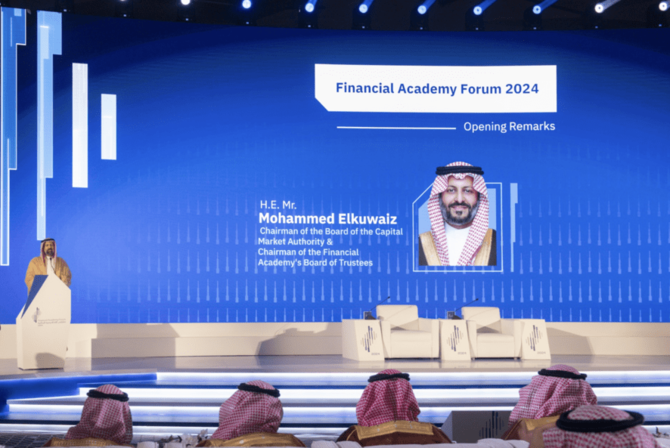

RIYADH: Saudi Arabia announced a range of initiatives aimed at enhancing its financial sector through talent development, leadership training, and global partnerships during a dedicated event in Riyadh.
These measures, announced at the Financial Academy Forum 2024, reflect the Kingdom’s commitment to strengthening its economic landscape in alignment with Vision 2030 goals.
Key highlights included a partnership with the Chartered Financial Analyst Institute to boost the number of CFA certification holders in Saudi Arabia and an accreditation from the Chartered Insurance Institute marking the Financial Academy as the first professional development center of its kind in the Kingdom.
These collaborations aim to raise the standards of financial expertise and position the Kingdom as a hub for global talent in the industry.
“The financial sector is undergoing rapid transformation, with new products, instruments, and channels. To keep pace, we must invest in the development of human capital,” said Mohammed El-Kuwaiz, chairman of the Capital Market Authority, during his inaugural address.
He emphasized that these initiatives are critical for fostering a skilled workforce and maintaining the Kingdom’s competitive edge in the financial industry.
The forum also unveiled a partnership with the Sutardja Center for Entrepreneurship and Technology at the University of California, Berkeley.
This initiative will provide Saudi professionals with access to entrepreneurship programs and training, helping them develop skills in financial innovation.
This collaboration is part of the Kingdom’s ongoing efforts to promote a culture of entrepreneurship and technological growth in the financial sector.
Enhancing leadership
One of the cornerstone initiatives announced at the forum was the launch of a leadership program in collaboration with the Swiss Re Institute. This program, the first of its kind in the region, aims to qualify 150 insurance leaders through the Emerging Insurance Leaders Program.
The initiative will focus on executive training and leadership development, providing specialized programs that address the unique challenges of the insurance sector.
El-Kuwaiz highlighted the importance of leadership in the financial industry, saying: “The path ahead remains long, whether it be in developing our sector or our economy. This is why events like this are essential in upskilling and training for future growth.”
He emphasized that strong leadership is essential to navigating the complexities of a rapidly evolving global financial market.
The forum also saw the launch of the “Executive Financial Managers of the 21st Century” initiative, a program that aims to train 60 such professionals in its first year.
Launched in collaboration with New York University, Paris School of Business, and the CFA Institute, it is designed to elevate the capabilities of financial executives in Saudi Arabia, ensuring they are equipped to handle the growing complexities of the financial landscape.
Financial Academy’s impact
Since its establishment in 2020, the Financial Academy has played a critical role in the development of Saudi Arabia’s professionals in the sector.
To date, the academy has trained over 50,000 individuals across the industry, offering 49 qualifying programs and exams, El-Kuwaiz revealed during the forum.
These efforts have resulted in the certification of nearly 90,000 professionals, positioning the institute as a central pillar in the Kingdom’s financial infrastructure.
In addition to its local impact, the Financial Academy has developed partnerships with over 40 leading educational institutions worldwide.
These collaborations ensure that the academy’s curriculum and training programs meet international standards, providing Saudi financial professionals with globally recognized qualifications.
El-Kuwaiz pointed to the academy’s ongoing evolution in response to the changing needs of the financial sector.
“We are seeing a large degree of change within our financial institutions, whether it be new products, instruments, or channels, and their interconnectedness with other sectors,” he said, underscoring the need for continued innovation and upskilling within the industry.
Role of technology
A major theme of the forum was the integration of advanced technologies within the financial sector.
Vice Minister of Finance Abdulmuhsen Al-Khalaf highlighted the pivotal role that technology, particularly artificial intelligence, plays in driving innovation and improving efficiency across the financial industry.
“Technology is strongly useful in predicting both positive economic forecasts and potential shocks. By integrating advanced tech, we have significantly improved the accuracy of our predictions,” Al-Khalaf said.
He noted that the Ministry of Finance has already begun incorporating AI and data management systems across its departments. These tools have proven essential in enhancing the accuracy of financial forecasting and streamlining decision-making processes.
“Within the ministry, we have created AI units across different teams, particularly in expenditure prediction, which has allowed us to move beyond traditional economic modeling tools,” Al-Khalaf added.
In addition to AI, the forum also emphasized the growing importance of cybersecurity within the financial sector. As institutions increasingly rely on digital infrastructure, the need for robust cybersecurity measures has become more critical than ever.
Al-Khalaf highlighted the ministry’s ongoing efforts to strengthen its online defensive capabilities, ensuring that the Kingdom’s financial data remains secure in the face of evolving digital threats.
Knowledge-based economy
By investing in the development of its human capital and embracing cutting-edge technologies, Saudi Arabia is positioning itself as a leader in the global financial industry.
As part of these efforts, the Kingdom is focused on building a knowledge-based economy that emphasizes innovation, entrepreneurship, and technological advancement.
The partnerships announced at the forum, such as the collaboration with the University of California, Berkeley, are designed to support this vision by providing Saudi professionals with access to world-class expertise and training in entrepreneurship and finance.
These initiatives are not only aimed at enhancing the skills of current financial professionals but also at preparing the next generation of leaders to drive the Kingdom’s financial sector forward.
As the financial landscape continues to evolve, the need for skilled, forward-thinking professionals will be more critical than ever.