PESHAWAR: At least three people were killed in clashes Wednesday between Pakistani police and supporters of a rights group advocating for the Pashtun ethnic minority, angered by a government ban imposed on the organization this week, local officials said.
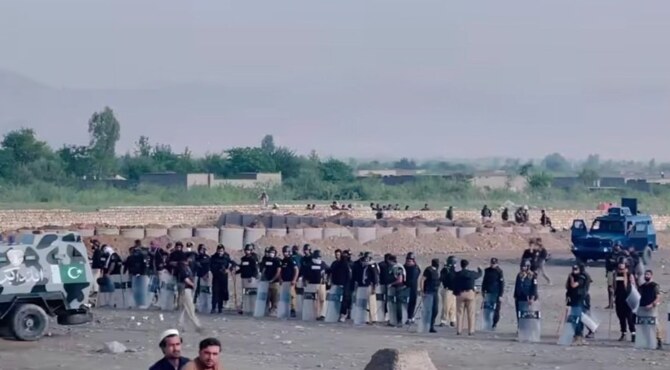
Officers fired tear gas and swung batons to disperse hundreds of protesters who had gathered in the town of Jamrud, near the city of Peshawar to denounce the ban. Roohul Ameen, a doctor at a main local hospital said they received three bodies brought in following the clashes and about a dozen injured protesters.
Footage on social media showed police firing in the air, unleashing tear gas and wielding batons among the crowd, which responded by throwing stones at the officers.
The violence came after the government on Monday banned the Pashtun Protection Movement, saying it supports the Pakistani Taliban, an outlawed militant group.
It also banned rallies by the group in the restive northwest, allegedly because the demonstrations are against the interests of Pakistan. The Pashtun Protection Movement denies backing the Pakistani Taliban.
The group was founded in 2014, after its leaders accused the Pakistani military and local police of abuses against the Pashtuns in their war against militants.
The group also says Pakistani security forces have been illegally detaining its members. The military and the government have denied all the allegations, saying their operations only target insurgents.
The group has since been waging a campaign to force the military to leave the former tribal regions in the northwest that border Afghanistan. Ethnic Pashtuns live mainly in eastern and southern Afghanistan but also all across Pakistan, in particular in parts along the Afghanistan-Pakistan border.
The Pakistani Taliban are a militant group that is separate but also a close ally of the Afghan Taliban, who seized power in Afghanistan in August 2021. They have stepped up attacks in recent years mainly targeting Pakistani security forces but hundreds of civilians have also been killed in the crossfire.
Manzoor Pashteen, who heads the Pashtun Protection Movement, said the group does not accept the government ban and was determined to hold a peaceful meeting of elders on Friday in the town of Regi, a former militant stronghold in the Khyber Pakhtunkhwa province.
Amnesty International on Wednesday also asked Pakistan’s government to revoke the ban on the Pashtun group.
The “latest arbitrary ban under over-broad powers of the terror law is only the tip of the iceberg,” said Babu Ram Pant, Amnesty’s deputy regional director for South Asia, accusing the authorities of “resorting to unlawful use of force, enforced disappearances, and media bans on the coverage of protests or rallies.”


![]()

3 protesters are killed in clashes with police after Pakistan banned an ethnic rights group
Short Url
https://arab.news/mtfbd
3 protesters are killed in clashes with police after Pakistan banned an ethnic rights group
- Officers fired tear gas and swung batons to disperse hundreds of protesters who had gathered in the town of Jamrud
- Footage on social media showed police firing in the air, unleashing tear gas and wielding batons among the crowd


Latest updates




© 2026 SAUDI RESEARCH & PUBLISHING COMPANY, All Rights Reserved And subject to Terms of Use Agreement.