India’s prime minister says it has reached a free trade deal with the EU

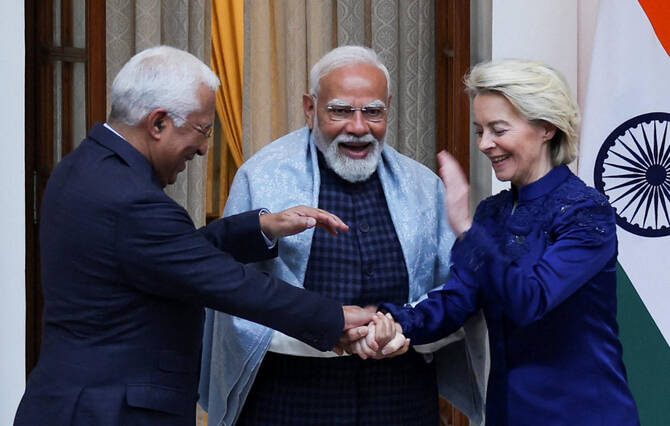
It touches a whopping 2 billion people and is one of the biggest bilateral engagements on commerce. (REUTERS)
Short Url
Updated 27 January 2026
Follow

India’s prime minister says it has reached a free trade deal with the EU

  • It touches a whopping 2 billion people and is one of the biggest bilateral engagements on commerce
  • The timing comes as Washington targets both India and the EU with steep import tariffs

NEW DELHI: Prime Minister Narendra Modi said Tuesday that India and the European Union have reached a free trade agreement to deepen their economic and strategic ties.
The accord, which touches a whopping 2 billion people, was concluded after nearly two decades of negotiations. It was dubbed the “mother of all deals” by both sides.
It is one of the biggest bilateral engagements on commerce. The timing comes as Washington targets both India and the EU with steep import tariffs.
“This agreement will bring major opportunities for the people of India and Europe. It represents 25 percent of the global GDP and one-third of global trade,” Modi said while virtually addressing an energy conference.
The deal comes at a time when Washington is targeting both India and the EU with steep tariffs, disrupting established trade flows and pushing major economies to seek alternate partnerships.
Modi was scheduled to meet with European Commission President Ursula von der Leyen later Tuesday to jointly announce the agreement.
India has stepped up efforts to diversify its export destinations as part of a broader strategy to offset the impact of higher US tariffs.
The tariffs include an extra 25 percent levy on Indian goods for its unabated purchases of discounted Russian oil, bringing the combined tariffs imposed by the United States on its ally to 50 percent.
The deal gives the EU expanded access to one of the world’s fastest-growing major economies, helping European exporters and investors to reduce their reliance on more volatile markets.
Bilateral trade between India and EU stood at $136.5 billion in 2024-25. The two sides hope to increase that to about $200 billion by 2030, India’s Trade Ministry officials said.
“Ultimately, the agreement is about creating a stable commercial corridor between two major markets at a time the global trading system is fragmenting,” said Indian trade analyst Ajay Srivastava.
The EU is still reeling from the aggressive approach of its once-stalwart ally across the Atlantic. There’s a widespread sense of betrayal across the 27-nation bloc from US President Donald Trump’s onslaught of higher tariffs, embrace of far-right parties, and belligerence over Greenland.
Brussels has accelerated its outreach to markets around the world: Over the past year, von der Leyen has signed deals with Japan, Indonesia, Mexico, and South America under the catchphrase “strategic autonomy,” which in practice is akin to decoupling from a US seen by most European leaders as erratic.
“We are showing a fractured world that another way is possible,” she posted on X after arriving in India on Sunday.


Somalia welcomes its first bowling alley as the middle class and diaspora returnees grow

Updated 4 sec ago
Follow

Somalia welcomes its first bowling alley as the middle class and diaspora returnees grow

MOGADISHU: In a city long defined by conflict, Somalia ‘s capital of Mogadishu now echoes with the crash of pins at the country’s first modern bowling alley.
It’s the latest sign of revival in the once-thriving Indian Ocean port shaped by 35 years of civil war and militant bombings. Millions of people were forced to flee what became one of the world’s most dangerous cities. Those who remained avoided public spaces as the Al-Qaeda-linked group Al-Shabab waged an insurgency against the Somali state.
In recent years, improved security measures against Al-Shabab, an expanded government presence and growing private investment have allowed daily life to re-emerge. Cafes line newly reopened streets, beaches draw evening crowds and traffic congestion, once unimaginable, now clogs key intersections.
The Feynuus Bowling Center opened last year and draws many locals and Somalis returning from the diaspora, who bring investment and business ideas after years of sending billions of dollars in remittances from abroad.
On a recent evening, young Somalis gathered in groups, laughing and filming each other on their phones while music played. Many from the diaspora are visiting Mogadishu for the first time in years, or the first time ever.
“I couldn’t believe Mogadishu has this place,” said Hudoon Abdi, a Somali-Canadian on holiday, as she prepared to take her turn to bowl.
“I’m enjoying it. Mogadishu is actually safe,” she said, urging others to visit.
Mogadishu remains vulnerable to militant attacks, however, with security measures like checkpoints and heavily guarded zones part of daily life. Non-Somalis remain largely confined to a compound at the international airport.
But residents say the ability to gather for recreation signals an important psychological shift. Such venues provide a welcoming environment for a younger generation eager for safe spaces to socialize.
Abukar Hajji returned from the United Kingdom on holiday after many years away and found the difference between what he imagined and what he experienced eye-opening.
“When I was flying from the UK, I believed it was a scary place, like a war-torn country,” he said. “Everyone told me, ‘Good luck,’ but when I came and saw it with my own eyes, I didn’t want to leave.”
Sadaq Abdurahman, the manager of the bowling center, said the idea for the business emerged from a growing demand among young people for recreational facilities.
“It has created employment opportunities for at least 40 youths,” he said.
According to the Somali National Bureau of Statistics, Somalia’s unemployment rate stands at 21.4 percent.
The bowling alley has private security guards, bag checks and surveillance cameras, reflecting the precautions common at public venues in Mogadishu.
Urban planners and economists say businesses like the bowling alley signal a broader shift in Mogadishu’s recovery, as private sector growth increasingly complements international aid and government-led rebuilding efforts.
Ahmed Khadar Abdi Jama, a lecturer in economics at the University of Somalia, said innovative businesses are responding to the needs of diaspora returnees and the growing middle class, “which in turn adds to the expected increase in Somalia’s GDP.”
Outside the bowling alley, traffic hummed and neon signs flickered, other reminders of Mogadishu’s fragile transformation.