Qatar launches ‘air bridge’ for aid to war-struck Lebanon

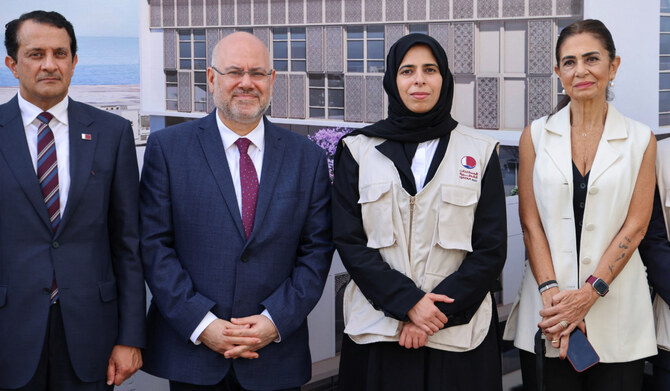
Qatari Minister of State for International Cooperation at the Ministry Of Foreign Affairs, Lolwah Bint Rashid Al Khater and Lebanese Minister of Public Health Firass Abiad pose for a picture, amid ongoing hostilities between Hezbollah and Israeli forces, outside of Beirut Governmental Hospital in Beirut's Karantina district, Lebanon, October 8, 2024. (REUTERS)
Short Url
Updated 08 October 2024
Follow

Qatar launches ‘air bridge’ for aid to war-struck Lebanon

  • Lebanese Health Minister Firass Abiad said the Qatari aid “will help cover shortages of medical, relief and support supplies” and will be “a vital push” for the hundreds of thousands of displaced and injured people

BEIRUT, Lebanon: Doha launched an “air bridge” to transport medical supplies and food aid to Lebanon, a Qatari minister said in Beirut on Tuesday, more than two weeks into intense Israeli strikes on the country.
“Today we launched the air bridge with consecutive planes carrying food, shelter materials and medical supplies,” said Qatar’s Minister of State for International Cooperation Lolwah Al-Khater from a public hospital in Beirut.
She said Doha was working “on medium and long-term plans to contain this humanitarian crisis.”
Since September 23, Israel has launched an intense air campaign mainly targeting Hezbollah strongholds in Lebanon, killing more than 1,150 people and displacing upwards of a million people.
Lebanese Health Minister Firass Abiad said the Qatari aid “will help cover shortages of medical, relief and support supplies” and will be “a vital push” for the hundreds of thousands of displaced and injured people.
Prime Minister Najib Mikati also met the Qatari minister.
A French plane carrying medical aid also landed in Beirut Tuesday, one of several planeloads of aid that arrived at Lebanon’s only international airport since the escalation began.
The United Arab Emirates, Turkiye, Iraq, Egypt, Jordan and Romania are also among the countries that have sent aid to Lebanon.


Sudan defense minister welcomes UN sanctions on RSF leaders as ‘long overdue’

Updated 7 sec ago
Follow

Sudan defense minister welcomes UN sanctions on RSF leaders as ‘long overdue’

  • Yassin Ibrahim said charges against commanders who perpetuated “atrocities of a kind rarely seen across broad stretches of history” were a “step in the right direction”
  • Among those targeted were RSF deputy commander Abdul Rahim Hamdan Dagalo, Brig. Gen. Al-Fateh Abdullah Idris, known as “the butcher of El-Fasher,” deputy commander Gedo Hamdan Ahmed and field commander Tijani Ibrahim

LONDON: Sudan’s Defense Minister Yassin Ibrahim on Wednesday called UN sanctions on Rapid Support Forces leaders “long overdue,” but a “step in the right direction.”

“Imposing sanctions on individuals or leaders of the Rapid Support Forces is long overdue. Nevertheless, it remains a step in the right direction,” he said.

“These crimes constitute war crimes, genocide and atrocities of a kind rarely seen across broad stretches of history. There should be far more charges brought forward, with arrest warrants issued not only against senior leadership but also against mid-level commanders operating on the ground — in addition to members of the ‘government of establishment,’ which serves as the political wing of the Rapid Support Forces.

“A new commander has recently joined their ranks within the ‘government of establishment,’ now operating in coordination with the Rapid Support Forces; the forces of Abdelaziz Al-Hilu and Joseph Tuka in Blue Nile.”

The UN Security Council imposed sanctions on four RSF leaders over atrocities in the western Sudanese city of El-Fasher. Among those targeted were RSF deputy commander Abdul Rahim Hamdan Dagalo and Brig. Gen. Al-Fateh Abdullah Idris, known as “the butcher of El-Fasher.” RSF deputy commander Gedo Hamdan Ahmed and field commander Tijani Ibrahim were also targeted.

The move, which followed recommendations by the US, UK and France, was submitted on Feb. 17 and aimed to include the leaders within the sanctions system established under Resolution 1591. The measures include travel bans and asset freezes to help curb the violence in Sudan.

The RSF’s capture of El-Fasher in October was one of the most brutal episodes of Sudan’s nearly three-year civil war. Last week, a UN fact-finding mission concluded that the takeover bore the hallmarks of genocide.

In a related move, the US Treasury’s Office of Foreign Assets Control last week sanctioned three RSF commanders for actions in El-Fasher, accusing them of “perpetrating a horrific campaign of ethnic killings, torture, starvation and sexual violence.” Those targeted were Idris, Gedo and Tijani Ibrahim.

The sanctions followed a UN Security Council statement on Tuesday that “strongly condemned” the RSF’s assault and destabilization in the Kordofan region and “all forms of violations and abuses committed against the civilian population.”

The UN council called on the warring parties to “immediately halt the fighting,” warning that deliberate attacks on humanitarian personnel “may constitute war crimes.”

Members also expressed “grave concern” over conflict-induced famine and extreme food insecurity in parts of Sudan, warning the crisis risks spreading.

The RSF has acknowledged “violations” in El-Fasher and said that it is investigating, but insists the scale of atrocities has been exaggerated by its enemies.