Egypt, Jordan voice support for Lebanon in face of Israeli ‘aggression’

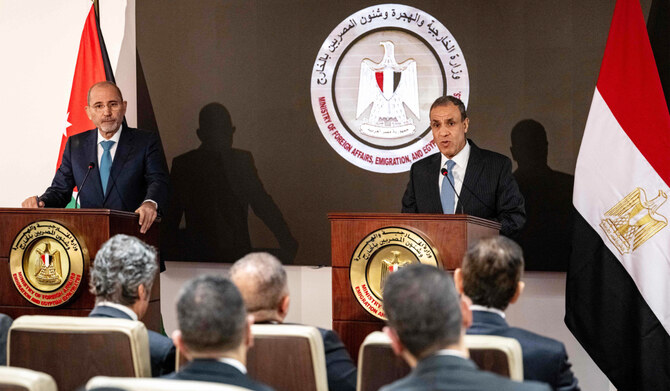
Egypt's Foreign Minister Badr Abdelatty (R) and Jordan's Foreign Minister Ayman Safadi give a joint press conference at the foreign ministry headquarters in the New Administrative Capital, about 45 kilometres east of Cairo, on October 8, 2024. (AFP)
Short Url
Updated 08 October 2024
Follow

Egypt, Jordan voice support for Lebanon in face of Israeli ‘aggression’

  • Both Amman and Cairo have repeatedly warned that the region is on the brink of all-out war and have accused Israel of being given impunity by its Western allies to systematically violate international law

CAIRO: The foreign ministers of Egypt and Jordan, the only two Arab countries to have made peace with Israel, expressed solidarity with Lebanon Tuesday in the face of Israel’s widening offensive.
Addressing a joint news conference in Cairo with his Egyptian counterpart Badr Abdelatty, Jordanian Foreign Minister Ayman Safadi called for an end to “Israeli aggression on three fronts” — in Gaza, in the occupied West Bank and now in Lebanon.
“We condemn the Israeli aggression on Lebanon, we condemn Israel’s shelling of the Lebanese capital, we condemn Israel’s killing of Lebanese citizens,” Safadi said.
Both Amman and Cairo have repeatedly warned that the region is on the brink of all-out war and have accused Israel of being given impunity by its Western allies to systematically violate international law.
“You have a country that finds itself above the law and unaccountable,” Abdelatty said.
Israel launched a wave of strikes against Hezbollah strongholds in Lebanon on September 23, leaving at least 1,150 people dead since then and forcing more than a million people to flee.
While battling Hamas in Gaza, Israel has vowed to secure its northern border with Lebanon to allow the return home of tens of thousands of Israelis displaced by Hezbollah’s cross-border fire in support of its Palestinian ally.


Iran launches new attacks at Gulf Arab countries as it keeps up pressure on the region

Updated 9 sec ago
Follow

Iran launches new attacks at Gulf Arab countries as it keeps up pressure on the region

  • In addition to firing missiles and drones at Israel and American bases in the region, Iran has also been targeting energy infrastructure

DUBAI, United Arab Emirates: Iran launched new attacks Tuesday at Gulf Arab countries as it keeps up pressure on the region, while five pro-Iranian militants were killed in an airstrike northern Iraq.
Incoming missile sirens sounded early in the morning in Dubai in the United Arab Emirates and Bahrain, while Saudi Arabia said it had destroyed two drones over its oil-rich eastern region and Kuwait’s National Guard said it had show down six drones.
In addition to firing missiles and drones at Israel and American bases in the region, Iran has also been targeting energy infrastructure which, combined with its stranglehold on the Strait of Hormuz, has sent oil prices soaring.
Brent crude, the international standard, spiked to nearly $120 on Monday before falling back but was still at around $90 a barrel on Tuesday, nearly 24 percent higher than when the war started on Feb. 28.
US President Donald Trump, who has previously said that the war could last for a month or longer, on Tuesday sought to downplay growing fears that it could be a long-term regional conflict, saying it was “going to be a short-term excursion.”
Trump sends contradictory messages as Tehran says it’s prepared for a long war
The war has choked off major supplies of oil and gas to world markets and sent fuel prices rising across the US The fighting has also led foreigners to flee from business hubs and prompted millions to seek shelter as bombs hit military bases, government buildings, oil and water installations, hotels and at least one school.
Iran has effectively stopped tankers from using the Strait of Hormuz, the shipping lane between the Arabian Gulf and the Gulf of Oman — the gateway to the Indian Ocean — through which 20 percent of the world’s oil is carried. Attacks on merchant ships near the strait have killed at least seven sailors, according to the International Maritime Organization.
In a post on social media on Tuesday, Trump seemed not to acknowledge that, saying that “If Iran does anything that stops the flow of Oil within the Strait of Hormuz, they will be hit by the United States of America TWENTY TIMES HARDER than they have been hit thus far.”
In an apparent response to Trump’s remarks published in Iranian state media, a spokesperson for the paramilitary Revolutionary Guard, Ali Mohammad Naini, said “Iran will determine when the war ends.”
Kamal Kharazi, foreign policy adviser to the office of the supreme leader, told CNN on Monday that Iran is prepared for a long war. He said he sees no “room for diplomacy anymore” unless economic pressure prompts other countries to intervene and stop the “aggression of Americans and Israelis against Iran.”
Airstrike on Iran-linked militia in Iraq kills five
As the conflict has spread against the region, Israel has launched multiple attacks on Hezbollah in Lebanon and the Iranian-linked militia has responded by firing missiles into Israel.
Pro-Iran militias in Iraq have also launched attacks at US bases in the country since the beginning of the conflict.
Early Tuesday, one of those militias, the 40th Brigade of the Popular Mobilization Forces in the city of Kirkuk, was hit with an airstrike that killed at least five militants and wounded four others, according to officials, who spoke on condition of anonymity because they weren’t authorized to brief reporters.
It was not immediately clear who was behind the strikes.
Since the war began, at least 1,230 people have been killed in Iran, at least 397 in Lebanon and 11 in Israel, according to officials.
A total of seven US service members have been killed.
Financial markets, which swung wildly in recent days, opened the day Tuesday in Asia with early gains, building on late optimism in the US