Beirut, Lebanon: Human Rights Watch on Monday said Israeli strikes near the main Lebanon-Syria border crossing were putting civilians at "grave risk" as they prevented them from fleeing and hampered humanitarian operations.
The Israeli military said Friday its fighter jets struck Hezbollah positions near the Masnaa border crossing in Lebanon's eastern Bekaa Valley.
Syrian transport ministry official Sleiman Khalil told AFP on Monday that the road was still "completely cut off to vehicle traffic", but people could still cross on foot.
Human Rights Watch said the strikes were "impeding civilians trying to flee and disrupting humanitarian operations", adding "the situation places civilians at grave risk."
"An Israeli attack on a legitimate military target may still be unlawful if it can be expected to cause immediate civilian harm disproportionate to the anticipated military gain," it said in a statement.
If Hezbollah used the crossing to transfer weapons, the Iran-backed group too "may be failing to take all feasible precautions to protect civilians under their control", HRW added.
The Israeli military said it "struck an underground tunnel" crossing the border that "enables the transfer and storage of large quantities of weapons underground".
"The tunnel's operations were led by the 4400 Unit, the unit responsible for the transportation of weapons from Iran and its proxies to Hezbollah in Lebanon," the military added.
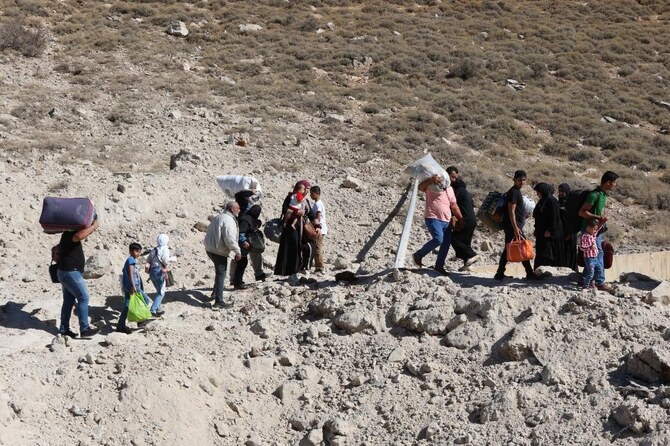
On Friday, an AFP photographer saw people carrying bags and children as they walked around a crater where a strike had hit.
The head of the United Nations refugee agency Filippo Grandi warned Sunday that the bombing of the road "has de facto blocked many people from seeking safety in Syria".
Lebanese authorities said Friday that more than 370,000 people had crossed from Lebanon into Syria since September 23, most of them Syrian nationals.
More than 774,000 Syrian refugees were registered with the UN in Lebanon before the latest escalation, though the tiny country said that it hosted some two million of them -- the world's highest ratio of refugees per capita.
HRW's Lama Fakih said that "by making a border crossing inaccessible at a time when hundreds of thousands of people are fleeing fighting and many others are in need of aid, the Israeli military threatens considerable civilian harm."
Even if the crossing were used for military purposes, "Israel would need to take into account the expected civilian harm compared to the anticipated military gain", she added in the statement.


HRW: Israeli strikes endanger civilians on Lebanon-Syria border
https://arab.news/vsc4f
HRW: Israeli strikes endanger civilians on Lebanon-Syria border

- Human Rights Watch said the strikes were "impeding civilians trying to flee and disrupting humanitarian operations"


Israel army ‘temporarily suspends’ strike on south Lebanon
- The Israeli military issued a warning earlier on Saturday announcing an imminent strike and warning people in the Yanuh area of south Lebanon to evacuate immediately
JERUSALEM: The Israeli military said it would “temporarily” suspend a strike planned for Saturday that was intended to target what it described as Hezbollah military infrastructure in southern Lebanon.
A November 2024 ceasefire sought to end over a year of fighting between Israel and the Hezbollah militant group, which broke out after the start of the Gaza war in October 2023.
But Israel has repeatedly bombed Lebanon despite the truce, usually saying it is targeting Hezbollah members and infrastructure to stop the group from rearming.
The Israeli military issued a warning earlier on Saturday announcing an imminent strike and warning people in the Yanuh area of south Lebanon to evacuate immediately.
But later Arabic-language spokesman Avichay Adraee said “the strike was temporarily suspended,” adding that the military “continues to monitor the target.”
The suspension came after the Lebanese army “requested access again to the specified site... and to address the breach of the agreement,” he said on X.
Adraee added that the military would “not allow” Hezbollah to “redeploy or rearm.”
The year-old ceasefire monitoring mechanism includes the United Nations, the United States and France.
A Lebanese security source said the army had previously tried to search the building that the Israeli military wanted to target but could not because of objections from residents.
But the source told AFP that the Lebanese army was able to enter and search the building after returning a second time, because residents “felt threatened,” adding that they were evacuated over fears of a strike.


