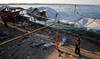
DEIR AL-BALAH, Gaza Strip: A new round of airstrikes hit Beirut suburbs late Sunday as Israel intensified its bombardment of northern Gaza and southern Lebanon in a widening war with Iran-allied militant groups across the region. Palestinian officials said a strike on a mosque killed at least 19 people.
A year after Hamas’ Oct. 7 attack, Israel has opened a new front in Lebanon against Hezbollah, which has traded fire with Israel since the war in Gaza began.
Israel’s military confirmed a Hezbollah attack on the northern city of Haifa, though it was not immediately clear whether shrapnel from “fallen projectiles” was from rockets or interceptors. Hezbollah said it tried to hit a nearby naval base. The Magen David Adom ambulance service said it treated 10 people, most of them hurt by shrapnel.
Israel also has vowed to strike Iran after a ballistic missile attack on Israel last week. The widening conflict risks further drawing in the United States, which has provided crucial military and diplomatic support to Israel. Iran-allied militant groups in Syria, Iraq and Yemen have joined in with long-distance strikes on Israel.
Israel is on high alert ahead of memorial events for the Oct. 7 attack, while rallies continue around the world marking the anniversary.
Israel bombards southern Beirut
Beirut’s skyline lit up again late Sunday with new airstrikes, a day after Israel’s heaviest bombardment of the southern suburbs known as the Dahiyeh since it escalated its air campaign on Sept. 23. It was not immediately clear if there were casualties.
Israel confirmed the strikes and says it targets Hezbollah. The militant group, the strongest armed force in Lebanon, has called its months of firing rockets into Israel a show of support for the Palestinians.
A separate Israeli strike earlier Sunday in the town of Qamatiyeh southeast of Beirut killed six people, including three children, Lebanon’s Health Ministry said.
Lebanon’s state-run National News Agency reported more than 30 strikes overnight into Sunday, while Israel’s military said about 130 projectiles had crossed from Lebanon into Israeli territory.
“It was very difficult. All of us in Beirut could hear everything,” resident Haytham Al-Darazi said. Another resident, Maxime Jawad, called it “a night of terror.”
One strike killed three sisters and their aunt in the coastal village of Jiyyeh. “This is a civilian home, and the biggest evidence is those martyred are four women,” said a neighbor, Ali Al Hajj.
Last week, Israel launched what it called a limited ground operation into southern Lebanon after a series of attacks killed longtime Hezbollah leader Hassan Nasrallah and most of his top commanders. The fighting is the worst since Israel and Hezbollah fought a month-long war in 2006.
At least 1,400 Lebanese, including civilians, medics and Hezbollah fighters, have been killed and 1.2 million driven from their homes. Israel says it aims to drive the militant group from its border so tens of thousands of Israeli citizens can return home.
The Israeli military is now setting up a forward operating base close to a UN peacekeeping mission on the border in southern Lebanon, a UN official told The Associated Press. The base puts peacekeepers at risk, said the official, who spoke on condition of anonymity due to the sensitivity of the situation.
UNIFIL, created to oversee the withdrawal of Israeli troops from southern Lebanon after Israel’s 1978 invasion, refused the Israeli military’s request to vacate some of its positions ahead of the ground incursion.
New evacuation orders in northern Gaza
An Israeli strike hit a mosque where displaced people sheltered near the main hospital in the central Gaza town of Deir Al-Balah. Another four were killed in a strike on a school-turned-shelter near the town. The military said both strikes targeted militants. An Associated Press journalist counted the bodies at the Al-Aqsa Martyrs Hospital morgue.
Israel’s military announced a new air and ground offensive in Jabaliya in northern Gaza, home to a refugee camp dating to the 1948 war surrounding Israel’s creation. Israel has carried out several operations there only to see militants regroup. The military said three soldiers were severely wounded in Sunday’s fighting in northern Gaza.
Israel reiterated its call for the complete evacuation of heavily destroyed northern Gaza, where up to 300,000 people are estimated to have remained.
“We are in a new phase of the war,” the military said in leaflets dropped over the area. “These areas are considered dangerous combat zones.” A later statement said three projectiles were identified crossing from northern Gaza into Israeli territory, with no injuries reported.
Frantic residents fled again. “Since Oct. 7 to the present day, this is the 12th time that I and my children, eight individuals, have been homeless and thrown into the streets and do not know where to go,” said one, Samia Khader.
The Civil Defense — first responders operating under the Hamas-run government — said it recovered three bodies, including a woman and a child, after a strike hit a home in the Shati refugee camp.
Residents mourned. Imad Alarabid said on Facebook an airstrike on his Jabaliya home killed a dozen family members, including his parents. Hassan Hamd, a freelance TV journalist whose footage had aired on Al Jazeera, was killed in shelling on his home in Jabaliya. Al Jazeera reporter Anas Al-Sharif confirmed his death.
Nearly 42,000 Palestinians have been killed in Gaza since the war began, according to the Gaza Health Ministry. It does not say how many were fighters, but says a little over half were women and children.
Hamas-led militants killed some 1,200 people in the Oct. 7 attack and took another 250 hostage. They still hold around 100 captives, a third of whom are believed to be dead.
UK advises against travel while France seeks partial arms embargo on Israel
The United Kingdom on Sunday advised its citizens against non-essential travel to Israel due to the violent clashes in the Mideast. The Foreign, Commonwealth and Development Office also advised against all travel in parts of northern and southern Israel, most of the West Bank, and the Gaza Strip.
Last week the UK advised its citizens against all travel to Lebanon.
French President Emmanuel Macron on Sunday reiterated his call for a partial arms embargo on Israel, which had prompted an angry response from Israeli Prime Minister Benjamin Netanyahu.
Netanyahu had described such calls by Macron as a “disgrace.” Macron’s office insisted that “France is Israel’s unfailing friend” and called Netanyahu’s remarks “excessive.”
Later on Sunday, Netanyahu’s office said the two leaders had spoken and agreed to promote “a dialogue” on the matter. Macron’s office called the discussion “frank” and said both leaders “accepted their divergence of views.”