

Two Chinese nationals among three killed in attack near airport in Pakistan’s Karachi

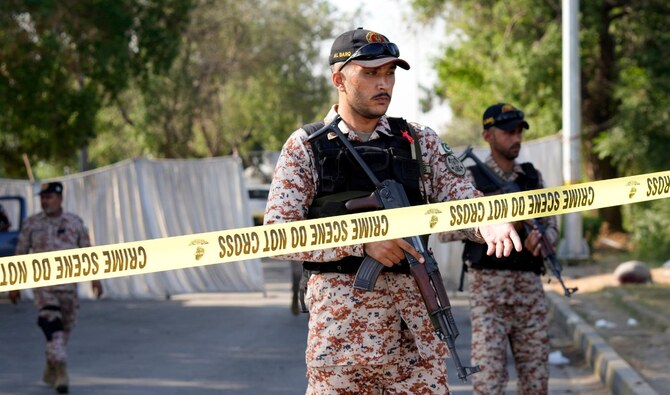
Security officials stand guard at the site of an explosion that caused injures and destroyed vehicles outside the Karachi airport, Pakistan, Monday, Oct. 7, 2024. (AP)
Short Url
Updated 07 October 2024
Follow

Two Chinese nationals among three killed in attack near airport in Pakistan’s Karachi

  • Convoy carrying Chinese staff of Port Qasim Electric Power Company targeted, Beijing confirms
  • Separatist BLA says used vehicle-borne improvised explosive device to target Chinese nationals

KARACHI: Two Chinese nationals were among three people killed and 10 injured late on Sunday night in a “terrorist attack” near the airport in Pakistan’s southern port city of Karachi, the Chinese embassy and local officials said on Monday.

The separatist militant group, the Baloch Liberation Army (BLA), claimed the attack in a statement sent to media, saying a vehicle-borne improvised explosive device had targeted the Chinese nationals.

China is a major ally and investor in Pakistan, having pledged over $65 billion in road, infrastructure and development projects under the China-Pakistan Economic Corridor (CPEC) project. 

“We have received the dead body of two Chinese nationals and the mutilated remains of an unidentified body,” chief surgeon for Karachi police, Dr. Sumaiyya Syed, told Arab News. “We have performed the autopsy of all three.”

Syed said 10 people were being treated for injuries at the Jinnah Hospital in Karachi, which included one child.


A Pakistani security official, who was injured in an explosion receives treatment inside an ambulance outside the Karachi airport, Pakistan, early Monday, Oct. 7, 2024. (AP)

The Chinese Embassy in Pakistan said in a statement a convoy of the Port Qasim Electric Power Company was targeted in an attack near the Karachi airport around 11:00pm on Sunday night. Two Chinese nationals were killed and one was injured, the statement said, adding that the Chinese side was working with Pakistani authorities in the aftermath.

“The Chinese Embassy and Consulates General in Pakistan remind Chinese citizens, enterprises and projects in Pakistan to be vigilant, pay close attention to the security situation, strengthen security measures, and make every effort to take safety precautions,” the statement concluded.

The Pakistani foreign office condemned the attack and said the country’s security and law enforcement agencies would make every effort to arrest the perpetrators and their facilitators. 

“This barbaric act will not go unpunished,” the foreign office warned. 

Sunday night’s attack is the latest by the BLA, the most prominent of a number of separatist groups fighting for independence for Pakistan’s gas-and-mineral-rich Balochistan province, where a low-lying insurgency has been ongoing for the past two decades. Baloch militants blame Pakistan’s state for exploiting the province’s resources, a charge the Pakistani state denies.
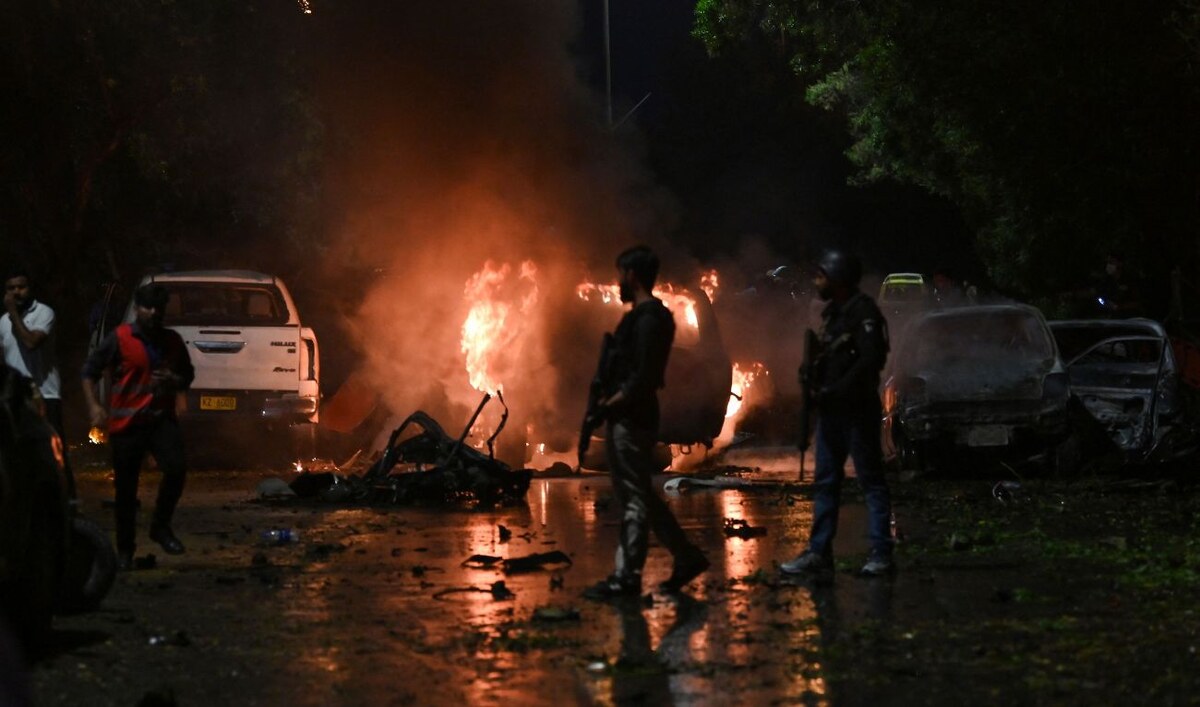


Security officials stand at the site of an explosion occured near Karachi airport in Karachi, on late October 6, 2024. (AFP)

The BLA also accuses Beijing of helping Islamabad exploit the province and has attacked Chinese interests and projects in the past, in particular the strategic port of Gwadar on the Arabian Sea. It has previously killed Chinese citizens working in the region and attacked Beijing’s consulate in Karachi. 

In March this year, a suicide bombing killed five Chinese engineers and a Pakistani driver in northwestern Pakistan as they headed to the Dasu Dam, the biggest hydropower project in the country. In 2022, three Chinese educators and their Pakistani driver were killed when an explosion ripped through a van at the University of Karachi.

Sunday’s airport attack followed a deadly day of coordinated attacks in August, most claimed by the BLA, that killed more than 50 people in Balochistan and which Prime Minister Shehbaz Sharif and other leaders had said sought to harm Chinese-funded investment and development projects.


Climate disasters to shave 0.5% points off growth this year, Pakistan tells Riyadh forum

Updated 4 sec ago
Follow

Climate disasters to shave 0.5% points off growth this year, Pakistan tells Riyadh forum

  • Finance minister says Pakistan lacks resources to fund large-scale climate adaptation without external support
  • Calls global climate funds “slow and bureaucratic” as vulnerable states struggle to access financing

ISLAMABAD: Pakistan’s finance minister said on Thursday increasingly severe floods are now routinely reducing the country’s economic growth, warning that this year’s climate disasters alone are expected to shave around half a percentage point off GDP as Islamabad presses global lenders to accelerate climate financing.

Speaking at the Global Development Finance Conference – Momentum 2025 in Riyadh, Finance Minister Muhammad Aurangzeb said Pakistan is facing a new economic normal in which climate shocks impose annual losses, strain fiscal resources and undermine its recovery from past balance-of-payments crises.

Pakistan is among the countries most exposed to climate-driven extremes, with the 2022 super-floods causing an estimated $30 billion in losses and renewed flooding this year again overwhelming provincial and federal budgets. Islamabad has created early-warning systems and emergency buffers, but Aurangzeb said adaptation costs far exceed domestic capacity and require faster external support.

“Our recent experience shows that climate change is an increasingly tangible and costly reality for Pakistan,” he told the Riyadh forum. “Pakistan expects to lose roughly half a percentage point of GDP growth this year, placing additional strain on an already challenged emerging economy.”

He said Pakistan’s commitment to macroeconomic stability, including building fiscal and external buffers, had allowed it to manage immediate rescue and relief operations from domestic resources. But long-term rehabilitation, he added, can only advance if global climate financing flows more quickly.

Aurangzeb criticized mechanisms such as the Green Climate Fund and Loss and Damage Fund for slow and bureaucratic disbursement processes that make it difficult for vulnerable countries to access urgently needed support. Pakistan, he said, has made more progress through multilaterals, including receiving the first $200 million tranche from the IMF’s Climate Resilience Fund.

The minister highlighted Pakistan’s new 10-year Country Partnership Framework with the World Bank announced this year, which allocates about $20 billion, with one-third earmarked for climate resilience and decarbonization. 

Unlocking those funds, he stressed, now depends on Pakistan rapidly preparing “high-quality, bankable projects.”

REKO DIQ

The Riyadh panel, which included ministers from Jordan and Tajikistan and the head of the West African Development Bank, underscored that emerging economies face converging pressures from climate risk, tight fiscal positions and sluggish global growth. Speakers said unlocking blended finance, streamlining multilateral processes and mobilizing private capital will be essential for adaptation in the coming decade.

Aurangzeb also linked climate adaptation to broader economic strategy, describing the near-finalization of financing for Pakistan’s flagship $7 billion Reko Diq copper and gold mining project, where the International Finance Corporation is leading a syndicate and the US Export-Import Bank has joined as a major participant.

He said the mine is expected to generate export revenues equivalent to 10 percent of Pakistan’s current export base in its first year of commercial production in 2028, helping diversify a stagnant economy.

Responding to questions on geopolitical balancing, Aurangzeb said Pakistan would continue an “and-and” approach, maintaining ties with both the United States and China. He noted that China remains Pakistan’s largest development partner through the China-Pakistan Economic Corridor (CPEC), a flagship Belt and Road Initiative program that has financed power plants, highways and ports since 2013. He said CPEC Phase 2.0, launched this year, seeks to move beyond government-to-government infrastructure by attracting private investment and export-oriented industrial projects.

At the same time, he said Pakistan’s relationship with the United States had “significantly strengthened,” particularly in sectors such as critical minerals, advanced technologies and digital infrastructure. 

His remarks came a day after Washington said the US Export-Import Bank had approved $1.25 billion in financing to support mining at the Reko Diq copper-and-gold project, with the package expected to enable up to $2 billion in US equipment and service exports. 

Aurangzeb said Pakistan expected strong interest from US, Chinese, Gulf and other global investors as the project scales.