RIYADH: More than 140 of the UN’s 193 member states have now recognized the state of Palestine.
Sept. 10 marked a significant moment as Palestine secured a seat at a UN General Assembly for the first time in history.
This was achieved despite opposition from Israel in Palestine’s quest for statehood.
Saudi Arabia’s Foreign Minister Prince Faisal bin Farhan said during his address at the General Assembly: “We affirm our appreciation for the countries that have recently recognized Palestine.
“We urge all nations to show the courage to make the same decision and join the international consensus represented by the 149 countries that recognize Palestine,” he said.
A groundbreaking development occurred recently when Prince Faisal bin Farhan announced the launch of the “Global Alliance for the Implementation of the Two-State Solution” on Sept. 26.
This alliance, endorsed by Arab and Islamic countries along with European partners, aims to advance the two-state solution as a means to resolve the Israeli-Palestinian conflict.
The inauguration of the alliance marks a significant milestone in international efforts toward lasting peace in the region.
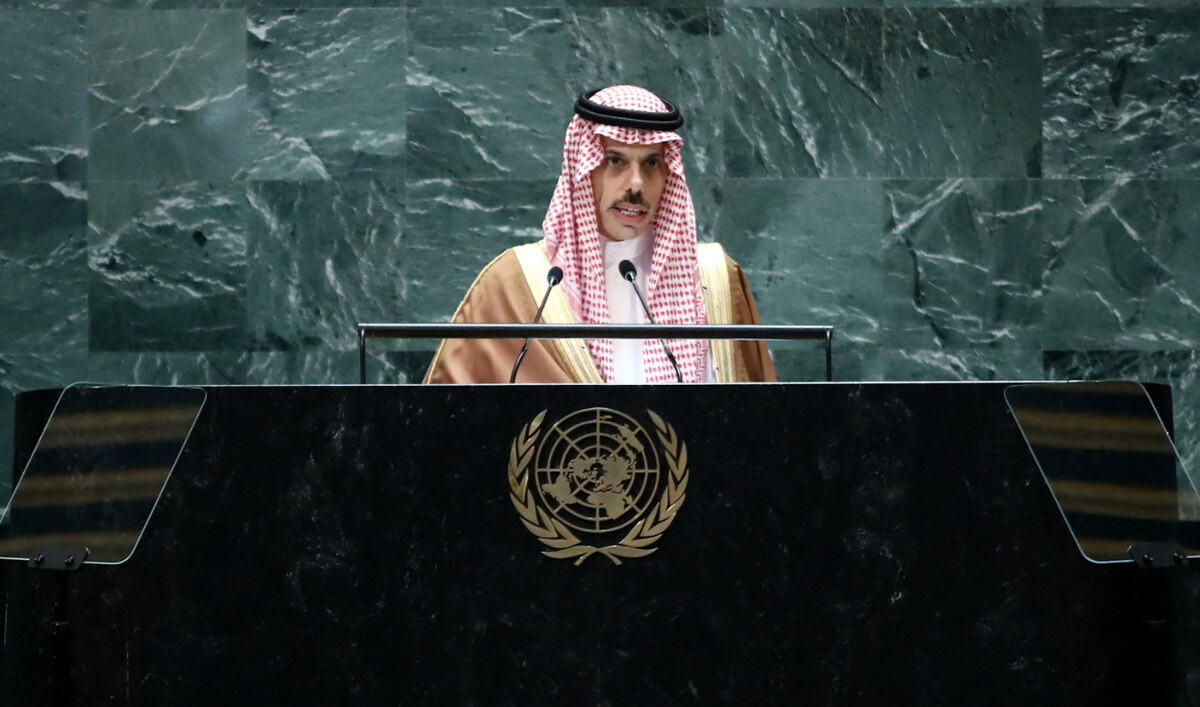
Saudi Arabia’s Minister for Foreign Affairs Prince Faisal bin Farhan speaks during the 79th Session of the United Nations General Assembly at the United Nations headquarters in New York City on September 28, 2024. (AFP)
A resolution was passed on May 10 of this year to acknowledge the review of Palestine’s UN membership in the UN Security Council, as well as the extension of additional privileges to Palestine, which currently has observer status.
Saudi Arabia expressed its support for the UN General Assembly resolution, confirming that the state of Palestine meets the requirements for becoming a UN member state.
The recognition of Palestine as a state has been a gradual process, with different countries recognizing it at different times. Most recognitions occurred after the Palestinian declaration of independence in 1988, while others joined in subsequent years.
Most African countries recognized Palestine soon after 1988, especially those in the non-aligned movement, such as Egypt, Algeria, Botswana, Burkina Faso, Central African Republic, Nigeria, Morocco and Sudan.
Some European countries recognized Palestine over the years, with the most recent trend of recognition from EU countries.
In 2024, Slovenia, Spain, Ireland, Norway and Armenia recognized the state of Palestine.
Iceland joined in 2011, Sweden in 2014 and the Vatican City in 2015.
Albania, Bulgaria, Cyprus, Poland, Romania and Yugoslavia (later split into Bosnia and Herzegovina, Croatia, North Macedonia, Montenegro, Serbia and Slovenia), recognized Palestine in 1988.
Other countries such as Russia, Bosnia and Herzegovina, and Croatia, joined in the 1990s.
Asian recognition also largely began in 1988, with widespread support among Muslim-majority countries and the socialist bloc.
These countries include Saudi Arabia, China, North Korea, Qatar, Bahrain, India, Sri Lanka, Malaysia, Afghanistan and Yemen.
The state of Palestine will be granted additional rights and privileges in participation following the 79th session of the General Assembly, without affecting its current rights and privileges.
One of these rights includes the right to actively participate in conferences and meetings organized by the UN and other international bodies, as well as the right to propose and present amendments both orally and on behalf of a group.
The two-state solution has long been regarded as a potential path to peace in the Israeli-Palestinian conflict. With recent developments and initiatives, there is renewed hope for progress toward this goal.
UN Secretary-General Antonio Guterres captured the urgency of the situation, warning that the repercussions of the devastation in Gaza could escalate into a broader conflict with catastrophic outcomes for the entire region.
Palestinian Authority President Mahmoud Abbas commended the General Assembly for adopting a resolution that called on Israel to withdraw from the Palestinian territories within 12 months, during the 79th session of the UN General Assembly on Sept. 26.
Saudi Arabia reaffirmed its commitment that it will not form diplomatic ties with Israel until significant advances are made regarding Palestine.
Saudi Crown Prince Mohammed bin Salman said on Sept. 18 that the Kingdom would not recognize Israel without a Palestinian state.
“The Kingdom will not stop its tireless work toward the establishment of an independent Palestinian state with East Jerusalem as its capital, and we affirm that the Kingdom will not establish diplomatic relations with Israel without that,” the crown prince said.
This position underscores Saudi Arabia’s unwavering support for the Palestinian cause and the realization of a viable two-state solution.
It is a continuation of historical Saudi efforts to help achieve Palestinian statehood, including the Arab Peace Initiative – A comprehensive plan to end Arab-Israeli conflict first proposed in 2002.