

Russia frees French researcher Vinatier in prisoner exchange

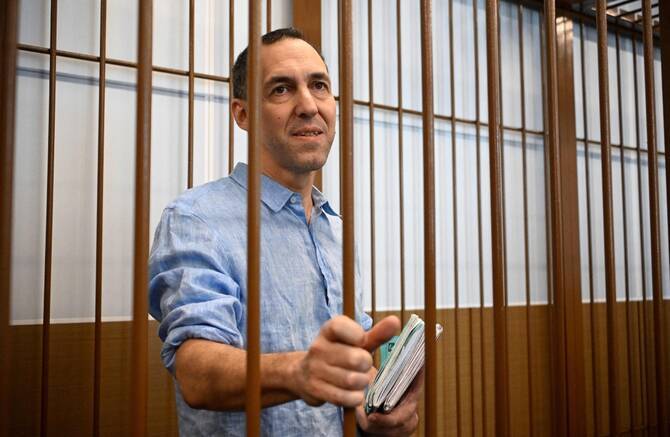
Laurent Vinatier, a French researcher serving a three-year prison sentence in Russia for violating Moscow’s foreign agent laws, has been freed as part of a prisoner exchange, French and Russian officials said on Thursday. (AFP/File)
Short Url
Updated 08 January 2026
Follow

Russia frees French researcher Vinatier in prisoner exchange

  • Macron posted on X: “Our compatriot Laurent Vinatier is free and back in France”
  • Russia’s FSB security service said Vinatier, 49, had been swapped for Daniil Kasatkin

MOSCOW/PARIS: Laurent Vinatier, a French researcher serving a three-year prison sentence in Russia for violating Moscow’s foreign agent laws, has been freed as part of a prisoner exchange, French and Russian officials said on Thursday.
President Emmanuel Macron posted on X: “Our compatriot Laurent Vinatier is free and back in France. I share the relief felt by his family and loved ones.” He added he was grateful for work done by French diplomatic officials.
Russia’s FSB security service said Vinatier, 49, had been swapped for Daniil Kasatkin, a Russian basketball player who was arrested at a Paris ⁠airport last June and who was wanted in the United States for alleged involvement in ransomware attacks.
The FSB said Vinatier had been pardoned by President Vladimir Putin, who promised last month to look into the case after a French journalist raised it during the Kremlin leader’s annual news conference.
Vinatier was arrested by the FSB at a Moscow restaurant in June 2024, and convicted in October that year of breaking laws requiring individuals deemed to be “foreign agents” to register with the ⁠Russian authorities.
While behind bars, he was placed under additional investigation for espionage, and he had been facing a likely further trial in coming months.
The FSB statement alleged that Vinatier, acting on instructions from Swiss intelligence, had collected sensitive political and military information — including on combat and training plans — that could have been used to harm Russia’s security. However, it said the case had been dismissed because of his “active repentance.”
At the time of his arrest, Vinatier was working for the Center for Humanitarian Dialogue (HD), a Swiss-based conflict mediation organization. Fellow academics said he was a respected scholar involved in legitimate research.
At his trial, Vinatier said he loved Russia, apologized for breaking the law, and even recited a verse by Russian poet Alexander Pushkin.

TENSE RUSSIA-FRANCE RELATIONS
His ⁠release comes amid a period of tense relations between Paris and Moscow over the war in Ukraine. Macron has been an outspoken ally of Kyiv — and has often drawn Russia’s ire — but he has also expressed a willingness to engage with Moscow directly to bring about an end to the war.
France had maintained Vinatier was arbitrarily detained and had called for his release. Macron denied that Vinatier worked for the French state and described his arrest as part of a misinformation campaign by Moscow.
Kasatkin, the Russian released in France, had denied the US hacking accusations. His lawyer, Frederic Belot, said he had no computer knowledge but was using a second-hand device that was controlled by cybercriminals.
Belot, who represents both Vinatier and Kasatkin, said Kasatkin had left France by plane and arrived back in Moscow on Thursday.


UK pays Guantanamo detainee ‘substantial’ compensation over US torture questions

Updated 5 sec ago
Follow

UK pays Guantanamo detainee ‘substantial’ compensation over US torture questions

  • Abu Zubaydah has been held at Guantanamo Bay without charge for 20 years
  • British security services knew he was subjected to ‘enhanced interrogation’ but failed to raise concerns for 4 years

LONDON: A Saudi-born Palestinian being held without trial by the US has received a “substantial” compensation payment from the UK government, the BBC reported.

Abu Zubaydah has been imprisoned at Guantanamo Bay in Cuba for almost 20 years following his capture in Pakistan in 2002, and was subjected to “enhanced interrogation” techniques by the CIA.

He was accused of being a senior member of Al-Qaeda in the aftermath of the Sept. 11 terror attacks on the US. The allegations were later dropped but he remains in detention.

The compensation follows revelations that UK security services submitted questions to the US to be put to Abu Zubaydah by their US counterparts despite knowledge of his mistreatment.

He alleged that MI5 and MI6 had been “complicit” in torture, leading to a legal case and the subsequent compensation.

Dominic Grieve, the UK’s former attorney general, chaired a panel reviewing Abu Zubaydah’s case.

He described the compensation as “very unusual” but said the treatment of Abu Zubaydah had been “plainly” wrong, the BBC reported.

Grieve added that the security services had evidence that the “Americans were behaving in a way that should have given us cause for real concern,” and that “we (UK authorities) should have raised it with the US and, if necessary, closed down co-operation, but we failed to do that for a considerable period of time.”

Abu Zubaydah’s international legal counsel, Prof. Helen Duffy, said: “The compensation is important, it’s significant, but it’s insufficient.”

She added that more needs to be done to secure his release, stating: “These violations of his rights are not historic, they are ongoing.”

Duffy said Abu Zubaydah would continue to fight for his freedom, adding: “I am hopeful that the payment of the substantial sums will enable him to do that and to support himself when he’s in the outside world.”

He is one of 15 people still being held at Guantanamo, many without charge. Following his initial detention, he arrived at the prison camp having been the first person to be taken to a so-called CIA “black site.”

He spent time at six such locations, including in Lithuania and Poland, outside of US legal jurisdiction. 

Internal MI6 messages revealed that the “enhanced interrogation” techniques he was subjected to would have “broken” the resolve of an estimated 98 percent of US special forces members had they been subjected to them.

CIA officers later decided he would be permanently cut off from the outside world, with then-President George W. Bush publicly saying Abu Zubaydah had been “plotting and planning murder.”

However, the US has since withdrawn the allegations and no longer says he was a member of Al-Qaeda.

A report by the US Senate Select Committee on Intelligence said Abu Zubaydah had been waterboarded at least 83 times, was locked in a coffin-like box for extended periods, and had been regularly assaulted. Much of his treatment would be considered torture under UK law.

Despite knowledge of his treatment, it was four years before British security services raised concerns with their American counterparts, and their submission of questions within that period had “created a market” for the torture of detainees, Duffy said.

A 2018 report by the UK Parliament’s Intelligence and Security Committee was deeply critical of the behavior of MI5 and MI6 in relation to Abu Zubaydah. 

It also criticized conduct relating to Guantanamo detainee Khalid Sheikh Mohammed, widely regarded as a key architect of the Sept. 11 attacks, warning that the precedent set by Abu Zubaydah’s legal action could be used by Mohammed to bring a separate case against the UK.

MI5 and MI6 failed to comment on Abu Zubaydah’s case. Neither the UK government nor Mohammed’s legal team would comment on a possible case over his treatment.