

Israel army says more troops deployed near Gaza ahead of Oct. 7 anniversary

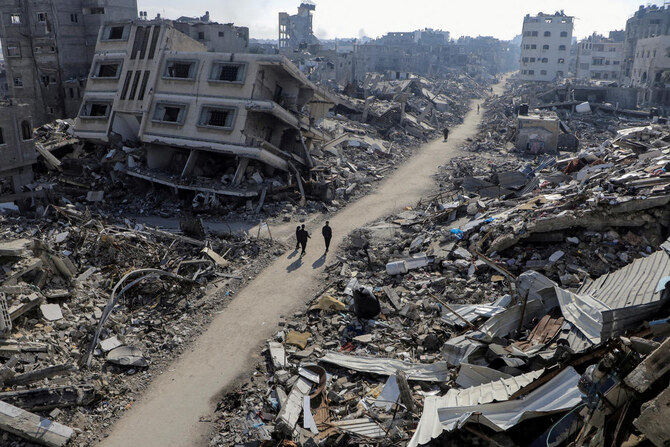
Palestinians walk past destroyed houses, amid the ongoing conflict between Israel and Hamas, in Jabalia refugee camp, in the northern Gaza Strip. (File/Reuters)
Short Url
Updated 07 October 2024
Follow

Israel army says more troops deployed near Gaza ahead of Oct. 7 anniversary

  • Israel army encircles Gaza’s Jabaliya as Hamas rebuilds

GAZA: The Israeli military said Sunday it deployed more troops to defend southern communities and areas bordering Gaza, ahead of the anniversary of the October 7 attack by Hamas.
“The IDF’s (army) Gaza Division has been reinforced with several platoons, with forces stationed to defend both the communities and the border area,” the military said.
“The soldiers are fully equipped to defend the region in coordination with local security forces,” it said in a statement.
Inside Gaza, the military said three divisions were working to “dismantle terrorist infrastructure and degrade Hamas’s capabilities.”
“The Southern Command remains at a heightened state of vigilance and readiness for the coming days,” commanding officer Major General Yaron Finkelman was quoted as saying.
Earlier, the military said its forces had surrounded the area of Jabaliya in central Gaza where Hamas was trying to rebuild its operational capabilities.

“The troops of the 401st Brigade and the 460th Brigade have successfully encircled the area and are currently continuing to operate in the area,” the military said in a statement on Sunday.
It cited intelligence suggesting the “presence of terrorists and terror infrastructure in the area of Jabaliya... as well as efforts by Hamas to rebuild its operational capabilities in the area.”
“Prior to and during the operation, the IAF (air force) struck dozens of military targets in the area to assist IDF (army) ground troops,” the military said, adding that targets hit were weapons storage facilities, underground infrastructure sites and other militant sites.

Hamas-run Gaza’s civil defense spokesman Mahmud Bassal said multiple strikes rocked Jabaliya overnight, with many casualties.
Residents said the Israeli military had targeted the area with heavy bombardments.
“The shelling is random and violent in multiple directions and we do not know where the shelling is coming from and we do not know where to go,” Gaza resident Jameel Al Habibi told AFP.
Israeli forces have regularly targeted Jabaliya since the Gaza war began, displacing most residents.
The military said it was also expanding the humanitarian area in Al-Mawasi along the coastline in southern Gaza.
“For this purpose, two humanitarian evacuation routes from northern Gaza have been reopened: one along the Salaheddine road and the other along the Al-Rashid coastal road,” the military said.
Gaza’s civil defense agency meanwhile said an Israeli air strike on a mosque-turned-shelter on Sunday in central Deir Al-Balah killed 26 people. Israel’s military said it had targeted Hamas militants.
“The number of martyrs brought to hospitals as a result of the occupation’s targeting of displaced people in the Ibn Rushd school and Al Aqsa Martyrs mosque reached 26, with several more wounded,” a health ministry statement said.
Israel’s military said it had “conducted a precise strike on Hamas terrorists who were operating within a command and control center” at the mosque.
The war in Gaza broke out after Hamas militants attacked Israel on October 7, which resulted in the deaths of 1,205 people, most of them civilians, according to an AFP tally based on official Israeli figures.
The militants also seized 251 hostages, 97 of whom are still held captive in Gaza, including 33 the Israeli military says are dead.
Israel launched a blistering military campaign in Gaza, vowing to destroy Hamas and bring back the hostages.
At least 41,825 people have been killed in Gaza, the majority of them civilians, the territory’s health ministry said Sunday.
The UN has acknowledged the figures to be reliable.


Washington presses Syria to shift from Chinese telecom systems

Updated 26 February 2026
Follow

Washington presses Syria to shift from Chinese telecom systems

  • Syria is exploring the possibility of procuring Chinese technology
  • It was unclear whether the United States ⁠pledged financial or logistical support to Syria to do so

DAMASCUS: The United States has warned Syria against relying on Chinese technology in its telecommunications sector, arguing it conflicts with US interests and threatens US national security, according to three sources familiar with the matter.
The message was conveyed during an unreported meeting between a US State Department team and Syrian Communications Minister Abdulsalam Haykal in San Francisco on Tuesday. Washington has been coordinating closely with Damascus since 2024, when Syria’s now President Ahmed Al-Sharaa ousted longtime leader Bashar Assad, who had a strategic partnership with China.
Syria is exploring the possibility of procuring Chinese technology to support its telecommunications towers and the infrastructure of local Internet service providers, according to a Syrian businessman involved in the procurement talks.
“The US side asked for clarity on the ministry’s plans regarding Chinese telecom equipment,” said ⁠another source briefed on ⁠the talks.
But Syrian officials said infrastructure development projects were time-critical and that Damascus was seeking greater vendor diversity, the source added.
SYRIAN OFFICIALS CITE US EXPORT CONTROLS AS TELECOMS BARRIER
Syria is open to partnering with US firms but the matter was urgent and export controls and “over-compliance” remained an issue, according to person familiar with the meeting in San Francisco.
A US diplomat familiar with the discussions told Reuters that the US State Department “clearly urged Syrians to use American technology or technology from allied countries in the telecoms sector.”
It was unclear whether the United States ⁠pledged financial or logistical support to Syria to do so.
Responding to Reuters questions, a US State Department spokesperson said: “We urge countries to prioritize national security and privacy over lower-priced equipment and services in all critical infrastructure procurement. If it seems too good to be true, it probably is.”
The spokesperson added that Chinese intelligence and security services “can legally compel Chinese citizens and companies to share sensitive data or grant unauthorized access to their customers’ systems” and promises by Chinese companies to protect customers’ privacy were “entirely inconsistent with China’s own laws and well-established practices.”
China has repeatedly rejected allegations of it using technology for spying purposes.
The Syrian Ministry of telecommunications told Reuters any decisions related to equipment and infrastructure are made “in accordance with national technical and security standards, ensuring data protection and service continuity.”
The ministry said it is also prioritizing the diversification of partnerships and technology sources to ⁠serve the national interest.
Syria’s telecom ⁠infrastructure has relied heavily on Chinese technology due to US sanctions imposed on successive Assad governments over the civil war that grew from a crackdown on anti-government protests in 2011.
Huawei technology accounts for more than 50 percent of the infrastructure of Syriatel and MTN, the country’s only telecom operators, according to a senior source at one of the companies and documents reviewed by Reuters. Huawei did not immediately respond to a request for comment.
Syria is seeking to develop its private telecommunications sector, devastated by 14 years of war, by attracting foreign investment.
In early February, Saudi Arabia’s largest telecom operator, STC, announced it would invest $800 million to “strengthen telecommunications infrastructure and connect Syria regionally and internationally through a fiber-optic network extending over 4,500 kilometers.”
The ministry of telecommunications says that US restrictions “hinder the availability of many American technologies and services in the Syrian market,” emphasizing that it welcomes expanding cooperation with US companies when these restrictions are lifted.
Syria has inadequate telecommunications infrastructure, with network coverage weak outside city centers and connection speeds in many areas barely exceeding a few kilobits per second.