

Pakistan confers highest civilian award on Malaysian PM

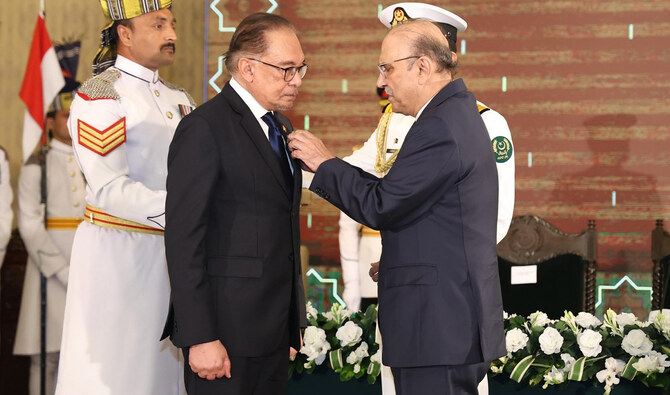
President Asif Ali Zardari (right) confers Pakistan’s highest civilian award on Malaysian Prime Minister Dato’ Seri Anwar Ibrahim in Islamabad, Pakistan on October 3, 2024. (PID)
Short Url
Updated 04 October 2024
Follow

Pakistan confers highest civilian award on Malaysian PM

  • Malaysian PM Dato’ Seri Anwar Ibrahim arrived in Islamabad on Wednesday on a three-day visit along with a delegation of ministers and senior officials
  • PM Shehbaz Sharif and his Malaysian counterpart agreed to set up a trade office in Karachi, increase halal meat and basmati rice exports to Malaysia

ISLAMABAD: President Asif Ali Zardari on Thursday conferred Pakistan’s highest civilian award on Malaysian Prime Minister Dato’ Seri Anwar Ibrahim in recognition of his support for Islamic causes and for being a great friend of Pakistan, Pakistani state media reported.

Ibrahim arrived in Islamabad on Wednesday on a three-day visit along with a delegation of ministers and senior officials to hold wide-ranging talks on trade, connectivity, energy, agriculture, the halal food industry, tourism, and cultural and educational exchanges.

The Malaysian prime minister has been a prominent advocate of humanitarian causes and Islamic values, and his leadership is marked by a profound commitment to promoting social justice and addressing global issues affecting the Islamic world, according to a report by the Radio Pakistan broadcaster.

He has also been a voice for self-determination movements and has particularly stood against oppression across the world. The award, which honors those who render “services of highest distinction” to the national interest of Pakistan, was conferred upon him at a special investiture ceremony in Islamabad.

“The Malaysian Prime Minister continues to work tirelessly to counter Islamophobia, striving to create interfaith harmony by fostering understanding and respect between different cultures and religions,” the report read.

The investiture ceremony was attended by Prime Minister Shehbaz Sharif, federal ministers, services chiefs, diplomats, and senior government officials, followed by a state dinner in honor of PM Ibrahim and his delegation.

Separately, the Malaysian prime minister met Pakistan Army Chief General Asim Munir and discussed with him bilateral strategic interests, regional security and defense cooperation.

“He emphasized on the need for increasing bilateral ties, particularly military relations, among the two brotherly countries and extended an invitation to the COAS (chief of army staff) to visit Malaysia in the same context,” the Pakistani military’s media wing, the Inter-Services Public Relations (ISPR), said in a statement.

Ibrahim’s visit comes as Islamabad pushes for foreign investment from allies and beyond in a bid to shore up its $350 billion economy, while navigating tough reforms mandated by the International Monetary Fund (IMF) as part of a $7 billion bailout.

Earlier on Thursday, PM Sharif and his Malaysian counterpart agreed to set up a trade office in Karachi, while Islamabad will increase its halal meat and basmati rice exports to the Southeast Asian country, Sharif’s office said.

“As part of the efforts to boost bilateral trade, both leaders agreed that Pakistan would export Halal meat worth $200 million per annum and 100,000 metric tons of Basmati Rice to Malaysia,” Pakistani state news agency APP reported after Sharif and Ibrahim addressed a joint press stakeout.

Trade between Malaysia and Pakistan currently stands at $1.4 billion, including in palm oil, apparel, textiles, chemical and chemical-based products, and electrics and electronic products. Among South Asian countries, Pakistan is Malaysia’s third-largest trading partner.


Pakistan issues over $7 billion sukuk in 2025, nears 20 percent Shariah-compliant debt target

Updated 29 December 2025
Follow

Pakistan issues over $7 billion sukuk in 2025, nears 20 percent Shariah-compliant debt target

  • Finance Adviser Khurram Schehzad says this was the highest-ever Sukuk issuance in a single calendar year since 2008
  • Pakistan’s Federal Shariat Court ordered in 2022 the entire banking system to transition to Islamic principles by 2027

ISLAMABAD: Pakistan’s Finance Adviser Khurram Schehzad on Monday said the country achieved a landmark breakthrough in Islamic finance by issuing over Rs2 trillion ($7 billion) sukuk this year, bringing it closer to its 20 percent Shariah-compliant debt target by Fiscal Year 2027-28.

A sukuk is an Islamic financial certificate, similar to a bond, but it complies with Shariah law, which forbids interest. Pakistan’s Federal Shariat Court (FSC) had directed the government in April 2022 to eliminate interest and align the country’s entire banking system with Islamic principles by 2027.

Following the ruling, the government and the State Bank of Pakistan (SBP) have undertaken a series of measures, including legal reforms and the issuance of sukuk to replace interest-based treasury bills and investment bonds.

“In 2025, the Ministry of Finance (MoF) through its Debt Management Office, together with its Joint Financial Advisers (JFAs), successfully issued over PKR 2 trillion in Sukuk,” Schehzad said on X, describing it as “the highest-ever Sukuk issuance in a single calendar year since 2008 by Pakistan.”

Pakistan made a total of 61 issuances across one-, three-, five- and 10-year tenors, according to the finance adviser. The country also successfully launched its first Green Sukuk, a Shariah-compliant bond designed to fund environment-friendly projects.

He said the Green Sukuk was 5.4 times oversubscribed, indicating investor demand was more than five times higher than the amount the government planned to raise, which showed strong market confidence.

“The rising share of Islamic instruments in the government’s domestic securities portfolio (domestic debt) underscores strong momentum, growing from 12.6 percent in June 2025 to around 14.5 percent by December 2025, clearly positioning the MoF to achieve its 20 percent Shariah-compliant debt target by FY28,” Schehzad said.

“This milestone also reflects the structural deepening of Pakistan’s Islamic capital market, sustained investor confidence, and the strengthening of sovereign debt management.”

He said Pakistan was strengthening its government securities market by making it more resilient, diversified, and future-ready, supported by a stabilizing macroeconomic environment, a disciplined debt strategy, and a clear roadmap for Islamic finance.