


Thousands rally in Armenia, demanding PM’s resignation over his handling of standoff with Azerbaijan

1 / 2
Armenians demonstrate in Yerevan's central Republic Square on Oct. 2, 2024 to demand Prime Minister Pashinyan's resignation. (AFP)
2 / 2
Armenians demonstrate in Yerevan's central Republic Square on Oct. 2, 2024 to demand Prime Minister Pashinyan's resignation. (AFP)
Short Url
Updated 03 October 2024
Follow

Thousands rally in Armenia, demanding PM’s resignation over his handling of standoff with Azerbaijan

  • Protesters accused PM Pashinyan of making unnecessary territorial concessions to Baku
  • Armenia and Azerbaijan fought two wars — in 2020 and the 1990s — over the disputed Nagorno-Karabakh region

YEREVAN: Thousands rallied on Wednesday in Armenia’s capital, demanding Prime Minister Nikol Pashinyan’s resignation over his handling of the decades-long standoff with Azerbaijan.
Despite a weeks-long wave of protests led in the spring by the charismatic Archbishop Bagrat Galstanyan, Pashinyan’s position held firm.
Chanting “Nikol (Pashinyan) traitor!” several thousand anti-government protesters rallied Wednesday in Yerevan’s central Republic Square, outside government headquarters, watched by a heavy police presence, according to an AFP reporter at the scene.
The rally was held days after Galstanyan vowed to renew street protests, which he promised would “guarantee” Pashinyan’s departure.
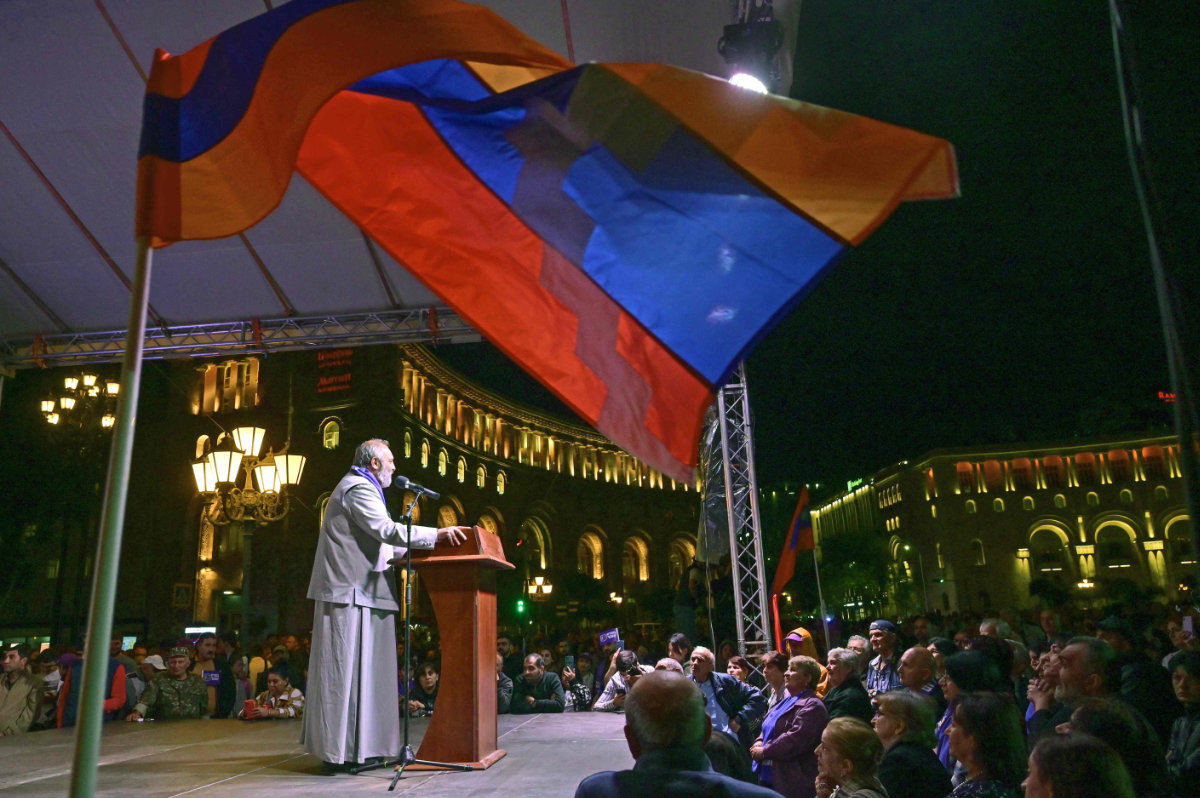


Protest leader Archbishop Bagrat Galstanyan addresses demonstrators in Yerevan's Republic Square on Oct. 2, 2024 to demand Prime Minister Pashinyan's resignation. (AFP)

The cleric has accused Pashinyan of making unnecessary territorial concessions to Baku.
“Our struggle will continue as long as evil remains in power in Armenia,” he told the crowd.
“I call on all political forces to join us, as new disasters, new losses lie ahead.”
Protesters then marched toward the offices of Armenia’s public broadcaster, to demand live air time.
Armenia’s interior ministry said in a statement it would use force against protesters should they attempt to break into the broadcaster’s offices.
“It’s not easy getting rid of Pashinyan’s government, but we can’t give up hope,” said one demonstrator, 64-year-old Sveta Sargsyan. “We need a government that will defend every centimeter of Armenian soil.”
Another protester, Karen Hovhannisyan, 55, said: “We can’t put up with Pashinyan’s rule any longer, he is flat-out pushing anti-Armenian policies.”

Armenia and Azerbaijan fought two wars — in 2020 and the 1990s — over the disputed Nagorno-Karabakh region, which Baku recaptured last year from Armenian separatists who had controlled it for three decades.
Nearly all its ethnic Armenians — more than 100,000 people — fled Karabakh in the aftermath and in May Pashinyan returned to Azerbaijan control over four border villages that it had seized decades earlier.
Galstanyan has previously sought to launch an impeachment process against Pashinyan, and even temporarily stepped down from his religious post to run for prime minister.
But he is not eligible to hold the office under Armenian law because he has dual citizenship — Armenian and Canadian — and opposition parties do not have enough seats in parliament to launch impeachment procedures.
Both Armenia and Azerbaijan have said a comprehensive peace deal to end their long-standing animosity is within reach, but the talks have so far failed to achieve a breakthrough.


Trump taking steps toward installing a Columbus statue near the White House

Updated 6 sec ago
Follow

Trump taking steps toward installing a Columbus statue near the White House

  • Trump endorses a traditional view of Columbus as leader of the 1492 mission that marked the unofficial beginning of European colonization in the Americas

ANNAPOLIS, Maryland: President Donald Trump is taking steps toward installing near the White House a replica of a statue of famed explorer Christopher Columbus that had been tossed into Baltimore’s harbor during his first term amid protests against institutional racism.
John Pica, a Maryland lobbyist and president of the Italian American Organizations United, said his group owns the statue and agreed to loan it to the federal government for placement at or near the White House.
Pica told The Associated Press in an interview that he was contacted about the statue around Columbus Day last year by an intermediary who said the White House was looking for a statue of the explorer. Pica says his organization took a straw vote and unanimously decided to send the statue to the White House. They signed the loan agreement Wednesday.
Asked if he was optimistic the statue would make it to the White House, Pica said, “Cautiously optimistic, yes.” The exact timing for any planned installation was unclear, he said, though he added, “possibly within two weeks.”
Maryland state Delaware Nino Mangione, a Republican who has worked with the Italian American group to find the statue a new home after it was pulled from the harbor, also confirmed the plans for the statue, which were first reported earlier Wednesday by The Washington Post.
The White House declined to comment to the AP on plans for the statue but reaffirmed Trump’s affinity for Columbus, whose legacy has shifted as historians and educators amplify how white European figures and their descendants treated Native Americans and enslaved Africans to develop the New World.
“In this White House, Christopher Columbus is a hero,” said Trump spokesman David Ingle. “And he will continue to be honored as such by President Trump.”
Trump wants to put his own stamp on American history ahead of big anniversary celebration
For Pica and his group, the statue’s Washington placement would celebrate a famous Italian who holds iconic status among Italian Americans. For Trump, it would be another move to reshape the telling of US history as the nation marks the 250th anniversary of the signing of the Declaration of Independence.
Trump endorses a traditional view of Columbus as leader of the 1492 mission that marked the unofficial beginning of European colonization in the Americas and the development of the modern economic and political order. But in recent years, Columbus also been recognized as a primary example of Western Europe’s conquest of the New World, its resources and its native people.
The statue now headed to Washington is a replica of one toppled by protesters on July 4, 2020, and thrown into Baltimore’s Inner Harbor after anger boiled over following the death of George Floyd at the hands of police. It was one of many statues of Columbus that were vandalized around the same time, with protesters saying the Italian explorer was responsible for the genocide and exploitation of native peoples in the Americas.
“I was there when we got it out of the harbor,” Mangione said, adding that artist Will Hemsley used parts of the old statue, first unveiled during Ronald Reagan’s presidency, “to build and restore a beautiful, brand new statue.”
In recent years, some individuals, institutions and government entities have displaced Columbus Day with recognition of Indigenous Peoples Day. President Joe Biden in 2021 became the first US president to mark Indigenous Peoples Day with a proclamation.
The statue may not be permanent
Pica emphasized that his group is lending the statue and would reclaim it if a future administration wanted it taken down.
Trump dismisses the shift on Columbus as “left-wing arsonists” bending history and twisting Americans’ collective memory. “I’m bringing Columbus Day back from the ashes.,” he declared last April. Echoing his 2024 campaign rhetoric, he complained that “Democrats did everything possible to destroy Christopher Columbus, his reputation, and all of the Italians that love him so much.”
Trump issued a Columbus Day proclamation last October and ignored Indigenous Peoples Day. He praised Columbus as “the original American hero, a giant of Western civilization, and one of the most gallant and visionary men to ever walk the face of the earth.”
That tribute reflected Trump’s broader take on history. Last spring, he signed an executive order titled “Restoring Truth and Sanity to American History,” which bemoaned “a concerted and widespread effort to rewrite our Nation’s history” in a way that misrepresents the US “as inherently racist, sexist, oppressive, or otherwise irredeemably flawed.”
Since the order, the administration has demanded a comprehensive review of exhibits across all Smithsonian museums and pushed Executive Branch agencies and state and local entities — especially colleges, universities and schools — that receive federal funding to roll back their diversity initiatives.