



UNITED NATIONS: Armenia’s prime minister said Thursday that peace with Azerbaijan was “within reach,” appealing to his neighbor to sign a treaty to turn the page on decades of conflict.
Exactly a year after Azerbaijan triumphed in a lightning military offensive, Armenia promised to meet a key demand of its historic rival: to ensure travel links.
“Today I want to say that peace between Armenia and Azerbaijan not only is possible, but is within reach,” Armenian Prime Minister Nikol Pashinyan said in an address to the United Nations General Assembly.
“All we need to do is reach out and take it,” he said.
“The pain is very deep and intense, but we must now focus on peace, because peace is the only truth understandable to the people of Armenia and Azerbaijan,” he said.
The two former Soviet republics had seen decades of war and tension over Nagorno-Karabakh, a breakaway ethnic Armenian region in Azerbaijan.
After a series of slow-moving negotiations, Azerbaijan rushed in troops last year and swiftly seized back Nagorno-Karabakh, whose entire population of nearly 120,000 people fled to Armenia.
Facing a weaker hand and the lack of intervention by Armenia’s historic ally Russia, Pashinyan has insisted on the need for peace but faced protests from nationalists opposed to compromise.
In his UN address, Pashinyan said he was ready to meet the Baku government’s key demand of allowing transportation access across Armenian soil to the exclave of Nakhchivan, letting Azerbaijan connect its main territory with its traditional ally Turkiye.
“The Republic of Armenia is ready to fully ensure the safety of the passage of cargo vehicles and people on its territory. It is our wish, our commitment, and we can do it,” Pashinyan said, saying it could become a “crossroads of peace.”
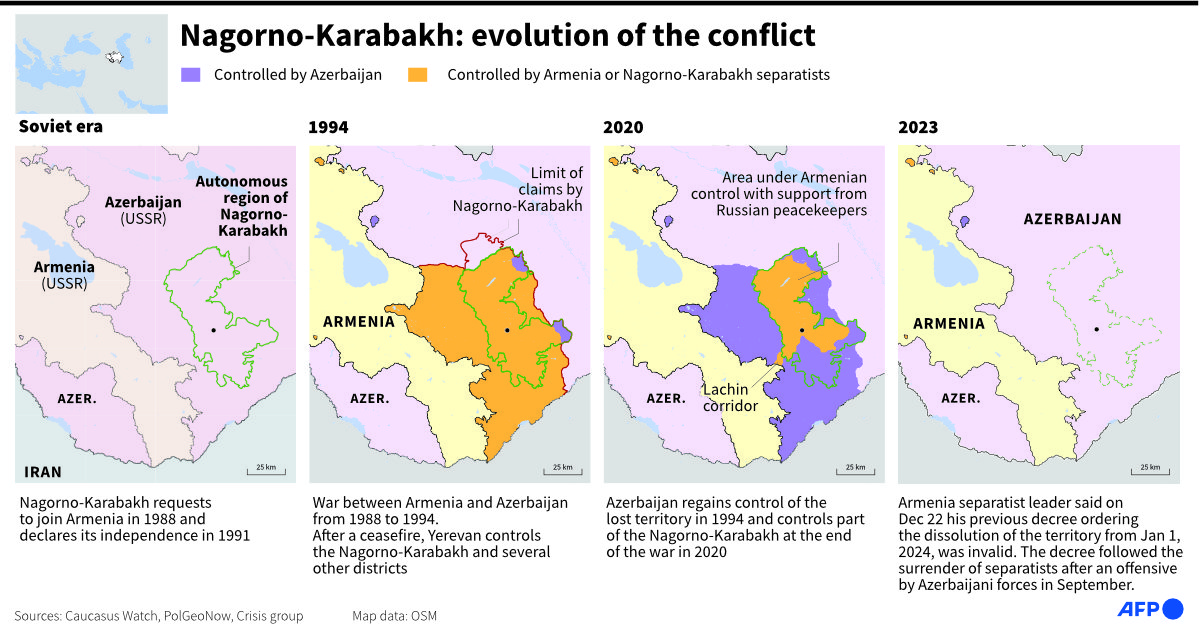
Map of Armenia and Azerbaijan showing the areas controlled by each country during the Soviet era, after the 1994 conflict and after the war in 2020.
Another key sticking point is Azerbaijan’s objections to a section of the Armenian constitution that speaks of uniting with Nagorno-Karabakh.
Pashinyan said that Armenia had its own issues with Azerbaijan’s constitution but that it did not see any obstacle as a peace agreement “solves the problem.”
Azerbaijan and Armenia both say that 80 percent of a treaty is ready, including border delineation, but Azerbaijan first wants a resolution of all issues.
Some diplomats view Azerbaijani strongman Ilham Aliyev’s stance as cynical, considering the difficulty that Pashinyan would have in changing the constitution.
The diplomats say Azerbaijan believes it can afford to wait as it has the clear upper hand, with its wealth from gas, a modernized military bolstered by Turkish weapons, and a rising international profile, with Baku in November the host of the COP29 climate summit.
Pashinyan insisted that Azerbaijan and Armenia should sign the draft treaty immediately, explaining, “There is no precedent of a peace agreement or any agreement that would regulate and solve everything.”
A treaty and diplomatic relations would improve “the overall atmosphere” between the two countries, which will “significantly facilitate the solution of the remaining issues,” Pashinyan said.
US Secretary of State Antony Blinken met the two countries’ foreign ministers on Thursday in New York.
Blinken “encouraged continued progress by both countries to finalize an agreement as soon as possible,” State Department spokesman Matthew Miller said.


