BEIRUT: Israel’s offensive against Hezbollah in Lebanon has prompted a renewed bid by some leading Lebanese politicians to fill a two-year-long presidential vacuum, an effort to revive the paralyzed state as it grapples with an escalating conflict.
Lebanon has not had a president or a fully empowered cabinet since October 2022 due to a power struggle in which Hezbollah has played a big part. Along with its allies, the heavily armed Shiite Muslim group has insisted the post, reserved for a Maronite Christian, go to their Christian ally Suleiman Frangieh.
With Hezbollah reeling from the killing of its leader Sayyed Hassan Nasrallah, the presidency came into renewed focus this week when Shiite Parliament Speaker Nabih Berri, a key Hezbollah ally, indicated flexibility on the matter, telling Prime Minister Najib Mikati he supported the election of a president who doesn’t represent “a challenge” to anyone.
A Hezbollah official told Reuters the group had delegated Berri to negotiate on its behalf over the presidency.
The presidency is decided by a vote in Lebanon’s 128-seat parliament. No single political alliance has enough seats to impose its choice, meaning an understanding among rival blocs is needed to secure the election of a candidate.
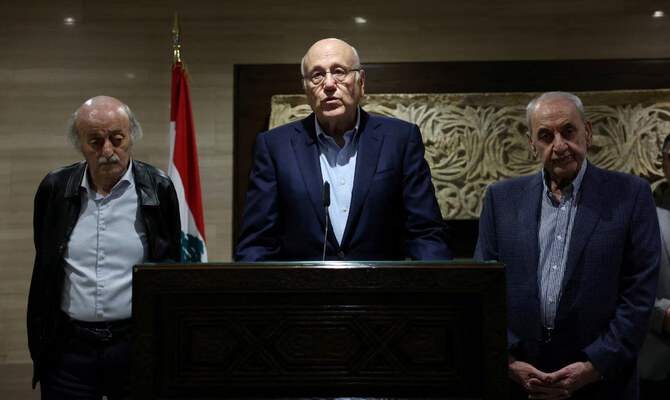
Following a meeting on Wednesday with Berri and Druze leader Walid Jumblatt, Mikati — a Sunni Muslim — read a joint statement calling for the election of a “consensus president who will reassure everyone and dispel their concerns.”
The statement did not name any candidates.
Israel is waging a major offensive against Hezbollah which has killed more than 1,000 people in Lebanon since Sept. 16 and uprooted one million.
Wael Abu Faour, a senior lawmaker from Jumblatt’s faction, told Reuters the election of a consensus president would send “a message to the outside world that there is a strong government in the country ready to negotiate” over a ceasefire.
He said the meeting of the three leaders did not represent the formation of a new alliance and that factions including Christian parties were being engaged in discussions on the presidency.
The Lebanese Forces party, a major Christian faction and fierce Hezbollah opponent, on Monday called for the election of a president, saying this was the only way for “the state to assume its responsibilities on its own” — implicit criticism of Hezbollah over its possession of a massive arsenal of weapons.
Lebanon’s last president, Michel Aoun, was a former army commander and a political ally of Hezbollah.
A senior Western diplomat who did not wish to be named said Western and Arab nations had been urging Lebanon’s politicians to elect a president, adding that it was also in the interest of Hezbollah for the political conundrum to be resolved so the state could take more of the “weight” of the Israel crisis.
Abu Faour said the three leaders also discussed avoiding internal tensions in Lebanon as a result of the displacement of hundreds of thousands of people from Hezbollah-controlled areas into other parts of the country.


![]()

Lebanese factions revive bid to fill presidency as Israel attacks
Short Url
https://arab.news/9ab4h
Lebanese factions revive bid to fill presidency as Israel attacks
- Israel is waging a major offensive against Hezbollah which has killed more than 1,000 people in Lebanon since Sept. 16 and uprooted one million


Latest updates


© 2026 SAUDI RESEARCH & PUBLISHING COMPANY, All Rights Reserved And subject to Terms of Use Agreement.