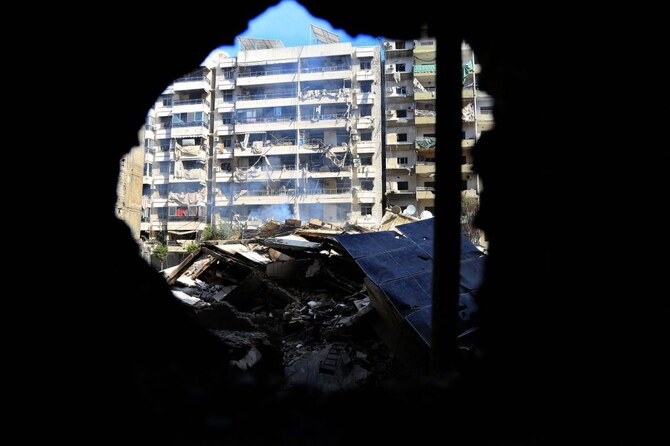
BEIRUT: Beirut’s southern suburbs, a stronghold of the Hezbollah militant group, are usually teeming with life but on Wednesday the rubble-strewn streets and burning buildings were almost empty after days of Israeli bombardment and evacuation orders.
AFP photographers saw thick smoke rising from buildings hit by overnight strikes while young men on mopeds sped along largely empty roads and residents grabbed what they could from their homes, some driving off with mattresses tied to car roofs.
Mohammed Sheaito, 31, one of the few not leaving, said that “during the night, the ground shook below us... and the sky lit up” from the force of the strikes.
“The area has become a ghost town,” said the taxi driver, who has sent his parents, his sister and her children — already displaced by Israeli bombing in south Lebanon — to safety elsewhere.
An area of tightly packed blocks of flats, shops and businesses, Beirut’s southern suburbs are also home to Hezbollah’s main institutions.
Israel says it is targeting sites belonging to the Iran-backed militant group, which was founded during the Lebanese civil war after Israel besieged the city in 1982.
A series of Israeli raids last week hit the southern suburbs — known as Dahiyeh — before a massive strike on Friday killed Hezbollah chief Hassan Nasrallah, with raids on the area increasing after that.
Thousands have fled the bombings or because of Israeli army evacuation orders on social media posted ahead of some strikes.
Some are staying with relatives, others in schools turned shelters in Beirut or in rented flats, while those with nowhere to go have been sleeping on the streets.
“The area was full of people. We used to sit at the cafe or along the street, older people would play backgammon,” Sheaito said.
Now, everything is “closed — corner stores, restaurants... even the pharmacy,” he said, adding: “I leave Dahiyeh to buy food supplies.”
Mohammed Afif, the head of Hezbollah’s information office, told journalists on a media tour that was broadcast that all the buildings hit in Dahiyeh were “civilian buildings and are not home to military activity.”
In one neighborhood, emergency workers combed the rubble of a flattened four-building residential complex in a grim search for survivors.
In another, a woman carried a cat as a building burned.
Rubble blocked some streets, with burnt-out cars scattered around various strike sites.
“I came quickly to get our identify papers and some other things,” said one resident who declined to be identified, expressing shock at finding an eight-building residential complex behind his home had been destroyed.
He said the neighborhood was uninhabitable, with no water, shops, petrol stations or even electricity because generators had shut down in a country where the state network struggles to supply a few hours of power a day.
“Our apartment is full of dust and there is a strange smell — I left quickly before I choked,” he said.
“I only saw one or two people on the street. There is no life here anymore.”

Israel strikes turn bustling south Beirut into ghost town
https://arab.news/n7zvt
Israel strikes turn bustling south Beirut into ghost town
- Mohammed Sheaito, 31, one of the few not leaving, said that “during the night, the ground shook below us... and the sky lit up” from the force of the strikes
- An area of tightly packed blocks of flats, shops and businesses, Beirut’s southern suburbs are also home to Hezbollah’s main institutions
Why the George V gold sovereign is still prized in the Middle East
- As gold prices break new records, a century-old British coin is drawing fresh attention across the Middle East
- Forged in empire, war and commerce, the gold sovereign’s legacy remains powerful — and increasingly valuable
LONDON: When the price of gold surpassed $5,000 an ounce for the first time on Jan. 26, collectors of old coins were likely weighing up the value of their collections — nowhere more so, perhaps, than in the Middle East and India, where one coin in particular has attained almost mythical status.
Between 1911 and 1932, tens of millions of the George V gold sovereign were minted, predominantly at the Royal Mint in London, which struck about 123 million of the coins, but also at “colonial branch mints” in Bombay, Ottawa, Pretoria, Melbourne, Perth and Sydney.
A genuine sovereign will weigh 0.2354 ounces, which by bullion weight alone made each one worth about £1,250 ($1,717) on Jan. 26. But experts say many other factors come into play when valuing a gold sovereign, including history, rarity, and whether or not it’s a fake.
For years, the George V gold sovereign has been prized throughout the Middle East, either as a collectible in its own right or adapted as a piece of jewellery, often mounted in a pendant frame and hung from a chain.
There are several reasons why the George V sovereign is so popular in the region, Chris Barker, research manager at the Royal Mint, the UK’s official maker of coins since about 1279, told Arab News.
“The British were flinging sovereigns around quite a lot in the region during the days of empire,” he said. “The sovereign was a circulating gold coin for a very long time and throughout the 19th century, it went all over the globe.
“Like the dollar is today, the pound was the predominant currency, and the gold sovereign was the grease in the wheels of international and colonial commerce in the 19th and early 20th centuries.”
With the start of the First World War, the sovereign ceased to be a circulating gold coin, but it continued to be produced, in London until 1917 and in most of the other branch mints until 1931.
“You’ve got a currency in the form of the sovereign that was in use for well over a century, to which people would flock in times of crisis. It’s stable, it’s trusted, it’s relied upon, and it’s got this international cache,” said Barker.
The popularity of the coin owes a great deal to the fact that during the reign of George V — from 1910 to 1936 — Britain was heavily involved in the region both politically and militarily.
“What you tended to see in the Middle East, the Levant and the Balkans was major inflation in local currencies during wartime, and people turned to gold sovereigns,” said Barker.
Battling the Ottoman Empire in Arabia, the Levant and Mesopotamia during the First World War, British troops, spies and diplomats frequently carried gold sovereigns that could be used as bribes or to buy support.
In 1916, when a large British Indian army was trapped at Kut Al-Amara, on the banks of the Tigris 160 km south of Baghdad, T.E. Lawrence (“of Arabia” fame), was dispatched from Cairo with several wooden chests packed with gold sovereigns.
The gold was intended as a ransom, to be paid in exchange for the relief of the siege and the liberation of the trapped troops.
The bribe, worth hundreds of millions of pounds in today’s terms, was rejected by the Ottoman commanders. By now starving and diseased, the heavily outnumbered garrison surrendered, and thousands died, either on the forced march to Aleppo or in captivity.
Gold sovereigns were also used to equip and pay the Arab tribes, which, at the request of the British, rose up against the Ottoman occupation of the Hejaz in 1916. Lawrence referred to the coins as “our horsemen of St. George.”
The coin continued to serve the British crown during the Second World War.
“Throughout the war, the British pumped large amounts of sovereigns into all of these theaters to help with the war effort,” said Barker.
“To take just one example, in 1943 alone, the British gave out 130,000 sovereigns to help pilgrims (from India) get to the holy city of Makkah for Hajj.”
India was seen as vital to the British war effort, and “it was about keeping things ticking over, keeping countries sweet.”
There’s a line on a document from the Foreign Office that describes the sovereign as being “an invaluable and at the same time economical means of transferring substantial sums in the Balkans and constituting the most efficient approach for post-occupation work throughout the Arab world and Persia.”
Other sovereigns will have found their way into Arabia thanks to a British policy of arming some of its troops and agents with the coins in the hope that they could bribe their way out of trouble.
Special forces soldiers and pilots operating in and above Iraq in 1991 and after the invasion of 2003 regularly carried gold coins as part of their “escape and evasion” kit.
During the 1991 Gulf War, the British Ministry of Defence bought 60,000 sovereigns at £60 each from the Bank of England for this purpose.
Legend has it that only 16,000 of the coins were returned to the MoD. To make up its losses, the ministry sold the returned coins in a special collectors’ presentation pack labeled “Behind enemy lines: Gulf War collection.”
Where the 44,000 missing coins went is anyone’s guess, although one way or another, many must have ended up in the hands of Iraqis.
In one documented case, Iraqi troops helped themselves to the gold sovereigns being carried by a British pilot and his navigator whose Tornado bomber was shot down on Jan. 17, 1991, during an air raid on Ar Rumaylah airfield in southeast Iraq.
Another incident emerged in 2000 with the publication of a memoir by Peter Ratcliffe, a former SAS soldier whose unit infiltrated Iraqi territory in 1991 in the hunt for Saddam Hussein’s Scud missiles.
Beating a hasty retreat after one action, he described how he had leapt on board one of the unit’s Land Rovers and, with bullets hitting the vehicle as it accelerated away into the desert night, dropped his M16 assault rifle with his “twenty gold sovereigns still hidden in the butt.”
He added: “I often wonder whether whoever found the weapon also discovered the secret hoard of gold.”
The 22-carat George V sovereign is iconic. The front — or “obverse” — side features the bare head of King George V. The reverse features an engraving of Britain’s patron saint, St. George, battling a dragon, by Italian artist Benedetto Pistrucci.
Born in Rome in 1783, Pistrucci came to Britain in 1815, shortly after the British defeated French Emperor Napoleon I at the Battle of Waterloo.
A gem engraver by trade, Pistrucci was chosen by the Royal Mint to engrave the image of St. George and the dragon to be used on the reverse side of a batch of new George III sovereigns in 1817.
His design would be used on the gold sovereigns struck to mark the reigns of all subsequent British monarchs, and his initials “BP” appear on all of them.
Tiny letters at the bottom of the depiction of St. George and the dragon reveal where each coin was made — “I” for India, “C” for Canada, “SA” for South Africa, and “S,” “M” and “P” for the three mints in Australia.
The absence of a letter means the coin was made at the Royal Mint in London.
Some of the coins are rarer than others. For some collectors, or “numismatists,” the ultimate goal is to collect a single coin from each of the seven mints. Others with deeper pockets aim to possess one coin from each mint for each year they were produced — a total of 52 sovereigns.
This could prove expensive. According to one specialist house, Allgold Coins, which specializes in coins from 1817 to the present day, the coin produced in London in 1917 — the last year the mint produced one, other than a one-off in 1927 — is one of the rarest and most sought after.
Exactly 1,014,740 of these sovereigns were minted, Allgold advises potential buyers, “which should not suggest it to be particularly rare, but it is certain that very few survive today.”
The reason is that after the First World War, “Britain was in considerable debt, mainly to the US, and it appears that these were paid in London-struck sovereigns which were then melted down.”
A genuine example of a 1917 coin could cost at least £15,000 and, as a result, “the 1917 is the most forged sovereign of any date or mint and even experienced collectors need to be very wary when purchasing.”
And, speaking of forgeries, there is another reason why George V gold sovereigns are so popular in the Middle East — and a reason to look a little more closely at that family heirloom.
After the Second World War, no more sovereigns were being produced, “but there was still demand and so people filled the vacuum,” said Barker.
“That led to many counterfeits being produced in the 1950s and 1960s in the Middle East and the Balkan areas.”
Forgeries can be incredibly hard to spot, not least because many were produced using exactly the same amount and weight of gold as the originals.
“Because there was such a premium on these coins, up to 60 percent above the gold price in the 1950s and 1960s, it became economically viable for counterfeiters to actually create 22-carat gold coins with the correct alloy.”
In 2004, Robert Matthew, a former Queen’s Assay Master at the Royal Mint, published an article in the magazine Numismatist revealing why in 1957 the British treasury decided to start minting sovereigns again — this time bearing the head of Queen Elizabeth II.
In November 1954, he wrote, a British assistant treasury solicitor “visited the Damascus moneychangers’ market. He found, openly quoted for sale, British-made, Swiss-made, Italian-made and Syrian-made gold sovereigns. Each had a different quoted price. The genuine British-made sovereigns being the most expensive and the Syrian-made fakes the least.”
There were, the British discovered, “two main centers used for making counterfeit sovereigns, Milan and Syria. The coins from Milan were mainly imported into Switzerland and then sent all around the world. Most were sent to Beirut for the Middle East market.”
Counterfeiting also took place in Beirut in the 1970s.
“The devastation of Beirut in the 1980s seems to have stopped production of these coins,” wrote Matthew.
“The large-scale manufacture of these counterfeits does not appear to have resumed after this time, however there are still a number of the older fakes in circulation contaminating the sovereign stock. This is especially true in the Middle East.”


